


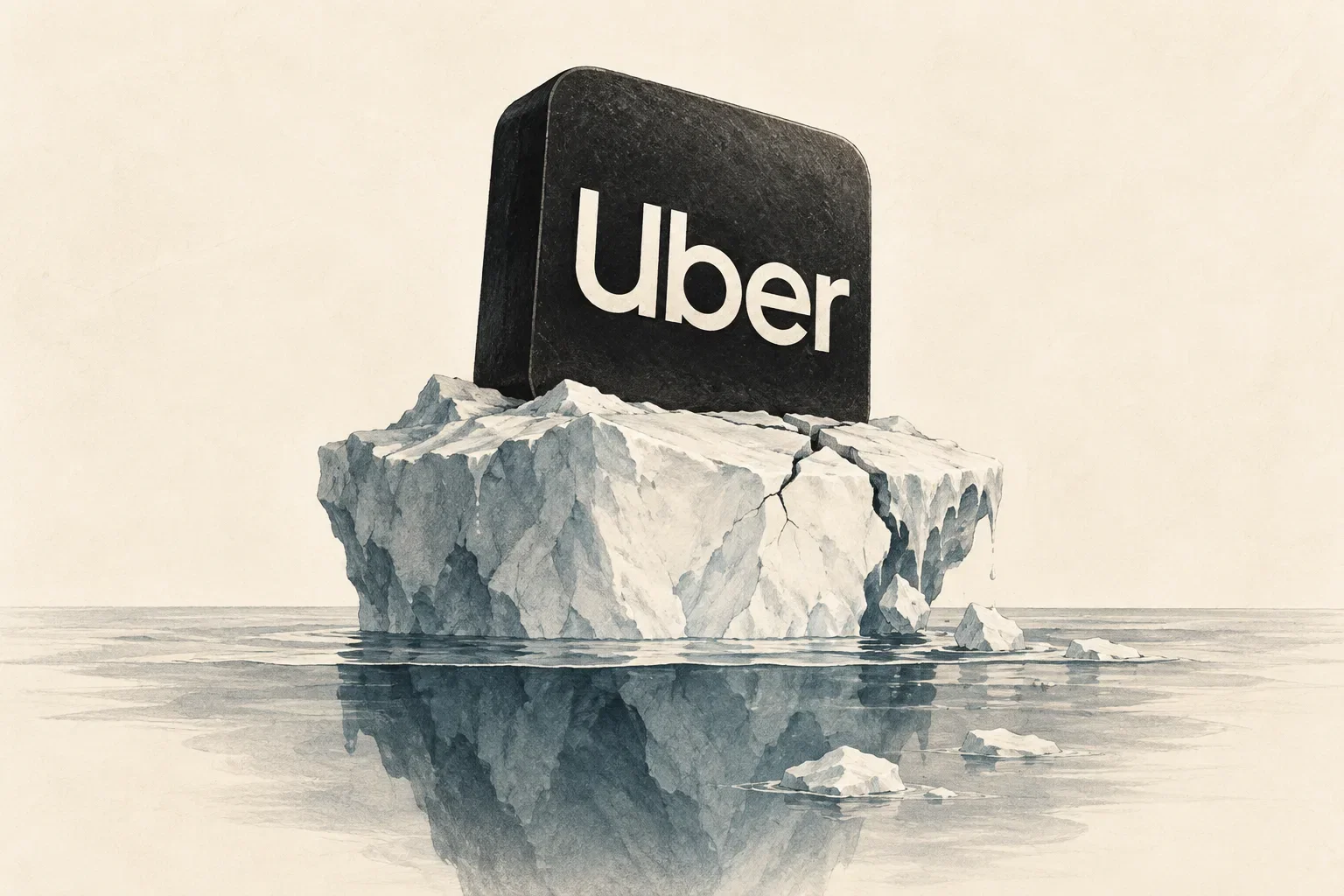
Is Uber a cheap stock or a melting iceberg?

Record cash, a P/E like a mature company, and a price near its 52-week low. Meanwhile, Uber is spending billions and its CEO is buying his own stock. Yet the market fears one thing - and that very thing will decide whether this is an opportunity or a trap.
Key points
A single September day erased roughly $6 billion of Uber's market value because of a fleet of 45 cars in Austin.
The stock trades at a P/E around 16, even though bookings have grown more than 20% for the fourth consecutive quarter.
The CEO bought about $10 million of his own stock in September, the first time since 2022.
Instead of the promised share buybacks, Uber sent billions into German food delivery and American corporate catering.
The entire dispute is decided not by valuation or cash flow, but by a single percentage that Uber repeats at every conference.
Six billion dollars for 45 cars
On September 8, $UBER lost roughly 4% in a single day. At a market cap of about $145 billion, that meant about $6 billion vanished on fears of Tesla's $TSLA Cybercabs. A few days earlier they had started carrying paying customers in Austin. How many were there? According to Texas registrations, 45. A fleet that fits in one parking lot cost Uber shareholders six billion.
Today the stock trades around $69, a few dollars above its 52-week low of $65.41 from late July and about 30% below its high of $101.30 last October. The price-to-earnings ratio is around 16. That is how mature companies with fading growth are valued: insurers, food conglomerates, telecoms.
But Uber doesn't look like that. Gross bookings have grown more than 20% for the fourth straight quarter, and free cash flow over the last twelve months exceeded $10 billion for the first time. Either the market sees something not yet reflected in the numbers, or it is giving away growth at the price of stagnation. The answer is not in the statements, but in one quiet question about the future that investors are asking.