


5 companies that can raise prices without losing customers

Any company can raise prices, but only some can keep customers after doing so. A waste hauler, a rating agency, a pest control company, a workwear supplier, and an auction house for wrecked cars have a reputation for pricing power. Results from 2026 show that for two of them this reputation is backed by numbers, for another two only partially, and for one it rests mainly on the past.
Key points
The pricing power of these five companies rests on the essential nature of the service, the cost of switching suppliers, or on data and network effects.
It is strongest where it is protected by regulation or hard-to-replicate infrastructure. It is weakest at companies with few large customers.
Only one company measures direct price increases. For the others, revenue growth alone does not prove pricing power.
The most expensive stock belongs to the company with the least evidence of pricing power, and the cheapest to the company with the weakest position vis-à-vis customers.
Two stocks lost over 40% in a year, but a lower valuation alone does not compensate for weaker pricing power.
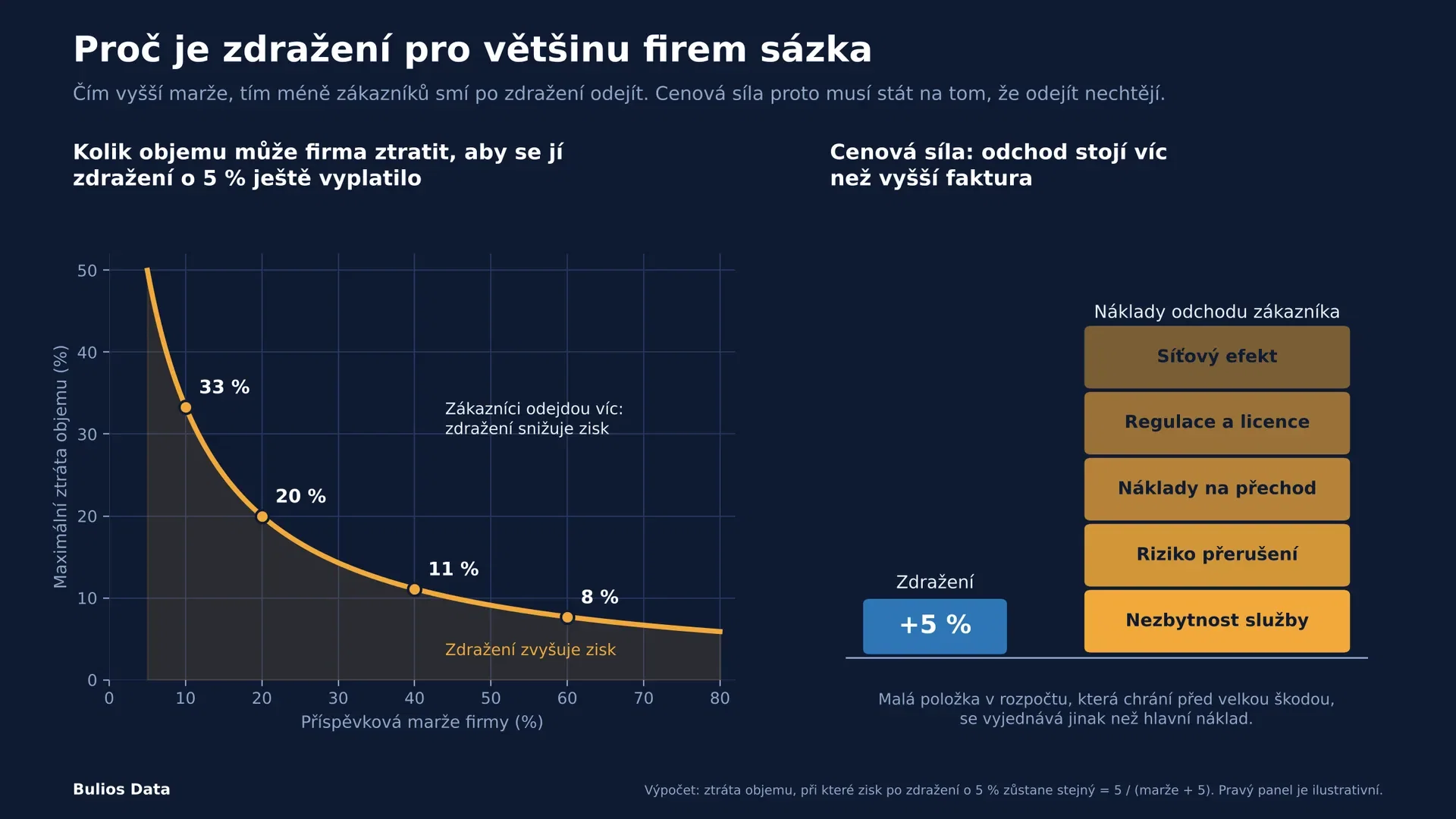
When a company raises its price by 5%, it is deciding about much more than 5% of revenue. A customer who leaves because of the increase takes with them the entire revenue from the contract, and a new customer usually costs more to acquire than it did to keep the old one. Economics describes this sensitivity of demand to price as price elasticity. For most businesses it is so high that raising prices becomes an either/or choice between market share and margin. The exception is companies whose customers perceive a change of supplier as a greater risk than a higher invoice.
Pricing power arises where leaving is more costly for the customer than the price increase itself. The reason may be the essential nature of the service, the risk of interrupting it, contractual and operational costs of switching suppliers, regulation limiting the number of competitors, or a network effect where the platform's value grows with the number of participants. The share of the service in the customer's budget also plays a big role. An item that forms a fraction of costs and at the same time protects against large damage is negotiated differently than a major cost item.
A high margin or a dominant market share do not automatically prove pricing power. A margin may be high because of low costs, and a market share may be held precisely because the company is cheap. Convincing evidence is only when a company repeatedly raises prices faster than costs, volumes do not decline significantly, and customers do not defect to competitors. The evidence situation differs greatly among the five companies in this analysis. Some publish a direct price indicator, others only overall organic growth from which price cannot be separated.
For an investor, pricing power has a dual significance. It protects profitability during inflation because higher wages and fuel can be passed through to prices. At the same time, it is a quality for which the market usually pays a high earnings multiple. If it proves weaker than the market assumed, the stock can lose even while earnings grow. That is exactly what happened to two of the five tracked names in the last twelve months.
Waste Management
Infrastructure that cannot be built quickly
Waste collection is a service that cannot be postponed. A household, restaurant, or factory cannot store waste for a month, so demand for collection fluctuates with the economy only to a limited extent. But necessity alone does not explain pricing power: even collection can be handled by a smaller local company with a few trucks. The key asset of Waste Management $WM is its network of landfills and transfer stations, which forms the bottleneck of the entire industry.
A new landfill requires years of permitting, approval from local authorities, and usually faces public opposition. A competitor can therefore offer cheaper collection, but the waste still has to go somewhere, and in many regions that means to a WM or Republic Services landfill. Whoever owns the end infrastructure sets the price even for those who compete with them in collection. Route density then adds a cost advantage: a truck that serves ten customers on one street instead of three has significantly lower costs per container.
Core price rises faster than costs
WM publishes a direct price indicator, which is exceptional among the five companies. In Q2 2026, core price was 5.7% and yield on price in the collection and disposal segment was 3.6%. Volume in that segment fell by 1.8%, or by 0.4% after adjusting for last year's post-fire cleanup work. Wage costs rose by roughly 4%, but collection operating costs rose by less than 1.7%, and adjusted operating EBITDA margin widened by 40 basis points to 30.9%.
The difference between core price and yield on price is important for investors. Core price measures increases for existing customers, while yield on price captures the actually realized average price including discounts, defections, and changes in contract mix. Core price is also an internal management metric calculated using historical assumptions, not an accounting figure. A more reliable proof is therefore the combination of yield on price above the pace of inflation and a small volume decline.
Where pricing power ends
Part of the volume decline is intentional. WM deliberately abandons less profitable residential contracts, whose losses, according to management, narrowed by 210 basis points year-over-year in Q2. This step also shows the limit of pricing power. Municipal residential collection contracts are bid in public tenders for several years, municipalities choose on price, and WM cannot raise prices arbitrarily there. The company therefore prefers to let a contract go rather than renew it at a disadvantageous price.
The strong pricing position thus mainly concerns commercial customers and landfill fees, and is weaker with municipalities. The reduction of the revenue outlook to $26.28–26.48 billion due to lower volumes also reminds that price cannot fully offset weaker industrial activity. WM's pricing power is therefore long-term but uneven geographically and by segment: strongest in regions where the company owns a landfill, weakest where it competes only in collection.