


5 companies profiting from the fact that American factories need modernization

Construction of new factories in the US is falling by more than 20% year over year, yet production remains in expansion and orders for industrial equipment suppliers are growing by double digits. It therefore matters who profits from operating and maintaining existing lines and who needs new projects, and how much the market is currently willing to pay for that.
Key points
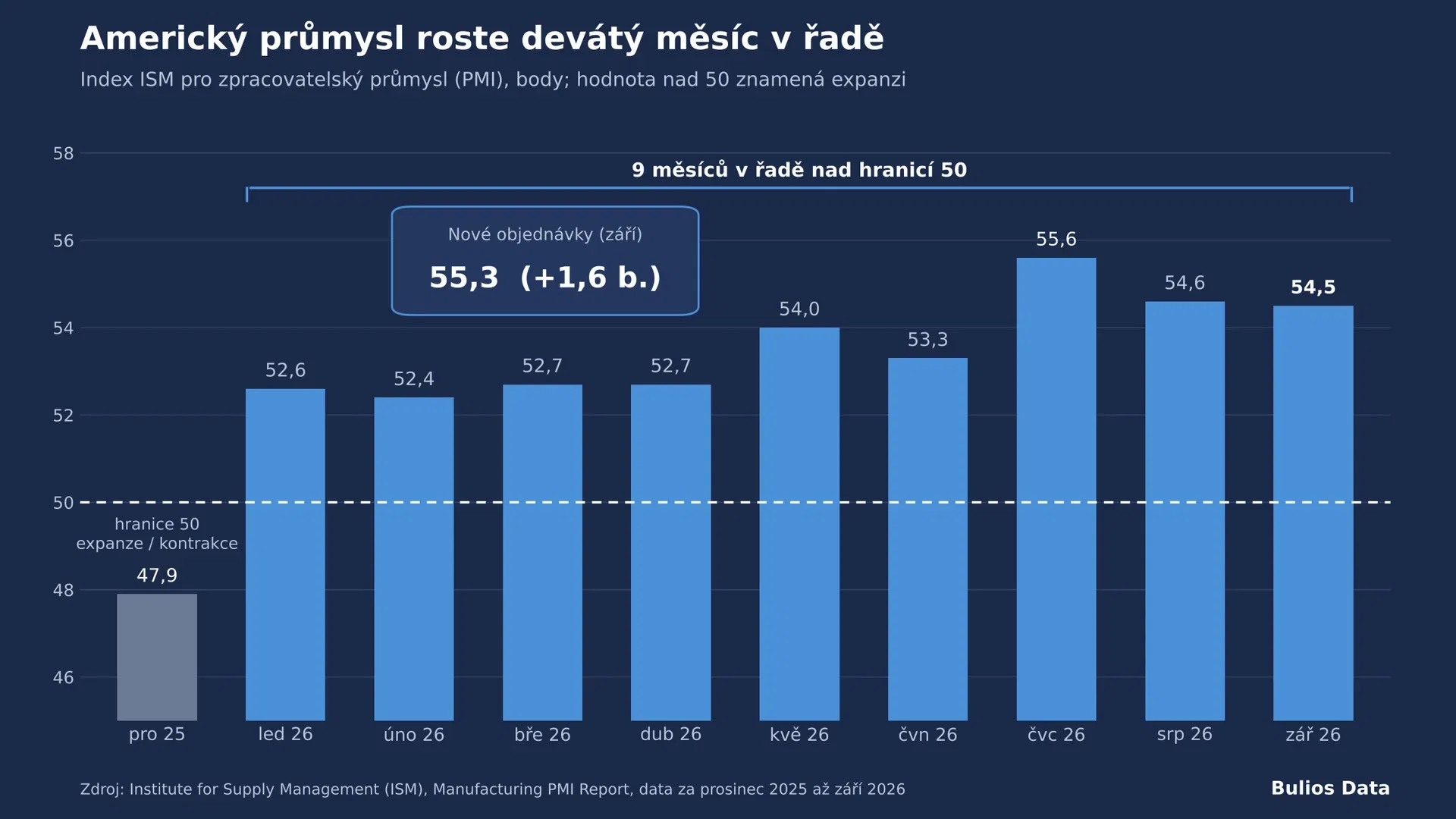
Factory construction spending fell 22% in the 12 months through June 2026, while the ISM index has held expansion for nine straight months (54.5 points in September). The modernization is happening inside existing facilities, not in new buildings.
Rockwell Automation is the purest play on automation, growing organically by 10%, but with a forward P/E of 29.9 it is the most expensive stock of the five.
Parker-Hannifin has the strongest combination of margins and aftermarket revenue, but it is buying Filtration Group for $9.25 billion and its debt will increase.
Dover offers the lowest valuation (forward P/E 16.9) with orders growing 16%, but pays for it with lower portfolio quality and lower return on capital.
If multiples compressed to 20x, only Dover and ITW would achieve a positive result in two years. For ROK, PH and IEX, the price already assumes permanently high growth.
American industry in 2026 is in a peculiar situation. Manufacturing and new orders indicators point to a recovery, but construction of new production capacity is falling sharply. The practical takeaway for investors: companies that supply equipment and components to factories cannot rely on the wave of new plants from 2022 to 2024. Their growth must be based on modernization, maintenance, and higher utilization of existing facilities.
Five US industrial stocks profit from the same trend in completely different ways. The first company sells the factory's brain, i.e. control systems and software that determine the operation of the entire line. The second supplies muscles and veins in the form of hydraulics, pneumatics, and filtration, whose parts wear out with every operating hour. The remaining three are portfolios of specialized technologies in which factories are only part of the end market. What matters, therefore, is not only whether the modernization is actually happening, but also how much of it the market has already priced in.
Is factory modernization real, or just a story?
Construction falls, production rises
Data do not provide a simple answer. According to a Census Bureau analysis cited by the AGC association, spending on manufacturing construction fell 22% in the 12 months through June 2026. Consulting firm FMI expects a full-year 2026 decline of 17.4% to $178 billion. The reason is the completion of semiconductor and battery megaprojects supported by the CHIPS Act and IRA, with no new projects of comparable scale following.
Production itself is moving in the opposite direction. The ISM manufacturing index reached 54.5 points in September, the ninth consecutive month above 50, and the new orders subindex rose to 55.3 points. Federal Reserve data show that manufacturing output grew at an annualized rate of 5.5% in the second quarter.
Capacity utilization as a key argument
Decisive, however, is the capacity utilization indicator. In manufacturing it was only 75.7% in August 2026, well below the long-term average of around 78%. This has two implications for the thesis:
Negative: American companies do not face capacity pressure that would force them to build new plants. New investment projects will therefore remain subdued.
Positive: Rising production in existing facilities means more wear and tear, more parts replacement, and pressure on the productivity of existing lines.
Labor force and equipment age
The labor shortage argument is better documented. A Deloitte and Manufacturing Institute study estimates that US industry will need up to 3.8 million new employees by 2033 and 1.9 million positions could remain unfilled. Automation is thus largely a response to the labor market, not just the cost of capital.
The equipment age argument is weaker. BEA publishes the average age of fixed assets, but the last widely cited figure for industrial equipment (about 10 years in the middle of the last decade, the highest since 1939) is old and the current figure could not be reliably verified. The article therefore treats equipment age as a supporting, not a decisive factor.
Summary of the thesis
Modernization is real, but it does not take the form of a construction boom. It consists of gradual investments in automation, component replacement, and maintenance in facilities that already exist. Companies with a high share of aftermarket revenue and installed base are better positioned for this type of cycle than those that need new projects. A significant part of current growth, moreover, comes from data centers, which is a different thesis with different risks.