


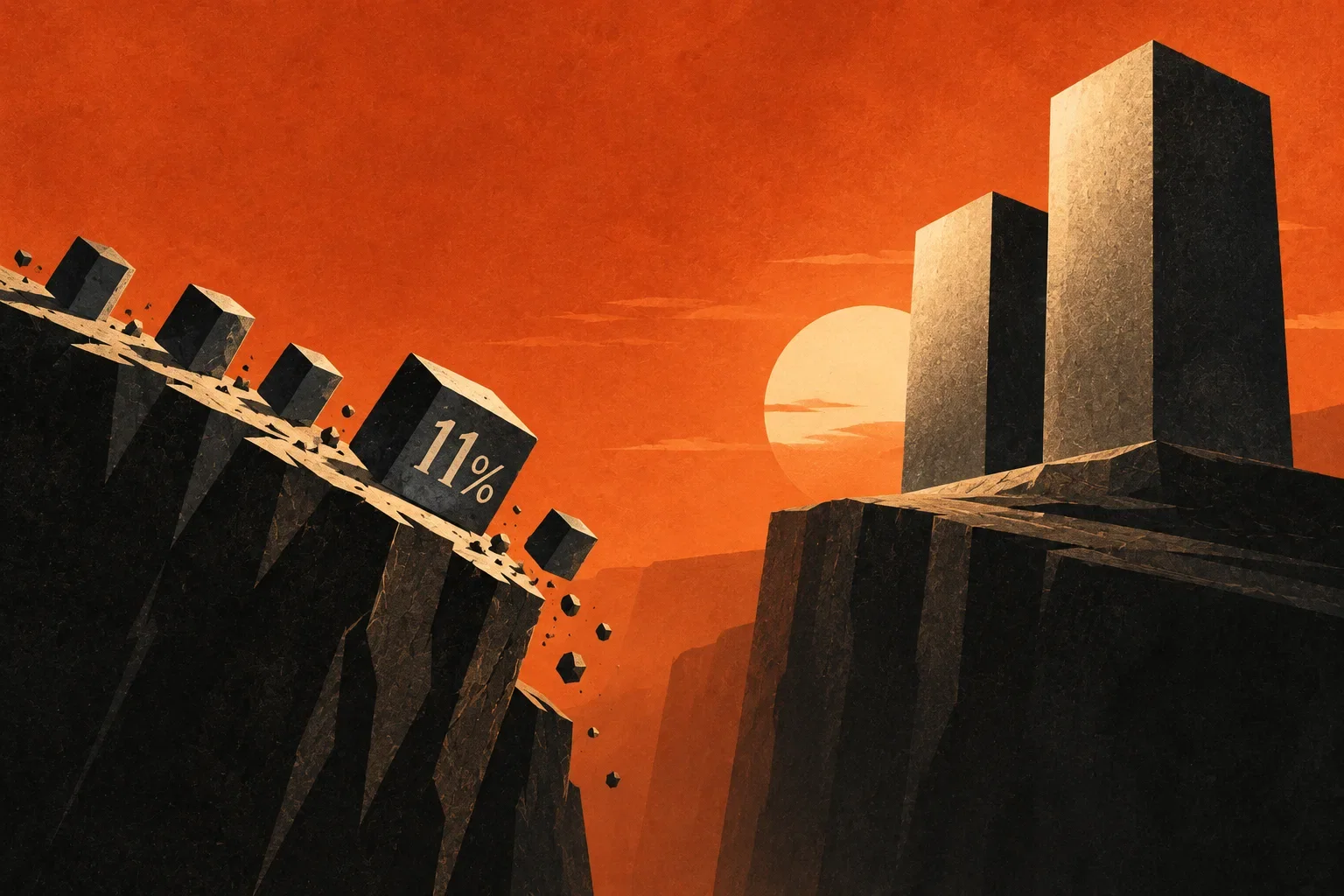
Why are small stocks falling 11%, while large ones are breaking records?

Russell 2000 is in correction, S&P 500 a few percent below record. Same rates, same inflation, opposite result. The difference isn't in resilience, but in who got the bill for more expensive money first - and who has it still ahead.
Key points
Russell 2000 dropped 11% from August record, while S&P 500 is 1.3% below high and reads the same macro data
Goldman Sachs points to the difference between 30% and 7%, which decides who gets the bill for more expensive money first
Loss-making companies from the index grew 154% in a year, profitable only 34%, and now the reversal is coming
Jamie Dimon admitted on conference call that the bank is tightening credit, and allowed a scenario that market doesn't expect
Correlation 0.51 shows that popular small-cap ETF today isn't what most investors hold it for
Two markets under one roof
Wednesday, October 14, looked on the American market like two different days. The small-company index Russell 2000 fell 1.93% to 2,729.53 points and officially entered correction: from August record 3,068.42 points it loses 11%. For every rising stock in the index there were five falling. It's already the second correction of small companies this year.
Large S&P 500 on the same day lost 1.11% to 7,718.94 points. It was its first drop of more than a percent since July and from the record of October 6 (7,818.93 points) it is separated by only about 1.3%. Two sets of stocks, same economy, same central bank, yet one falls and the other just shrugs.
The trigger was the same for both. September inflation climbed to 3.7%, core component without food and energy to 2.6%, both above estimates. The yield on 10-year US government bond rose to 5.28% and bets on further Fed rate increase at the meeting on October 27-28 shortly after publication jumped to about 54%, during the day they calmed, but the probability of another increase by year-end remained around 90% and higher.
So why did the same news hit small companies five times harder than large ones? The answer isn't in what companies do, but in how they borrow.