JPMorgan: Bitcoin will outperform stocks and gold over the next decade, but there’s a catch

America’s largest bank has included bitcoin in its outlook for the next decade for the first time, giving it the highest expected return of any asset. But it still won’t let it into client portfolios. The reason is 55 percent.
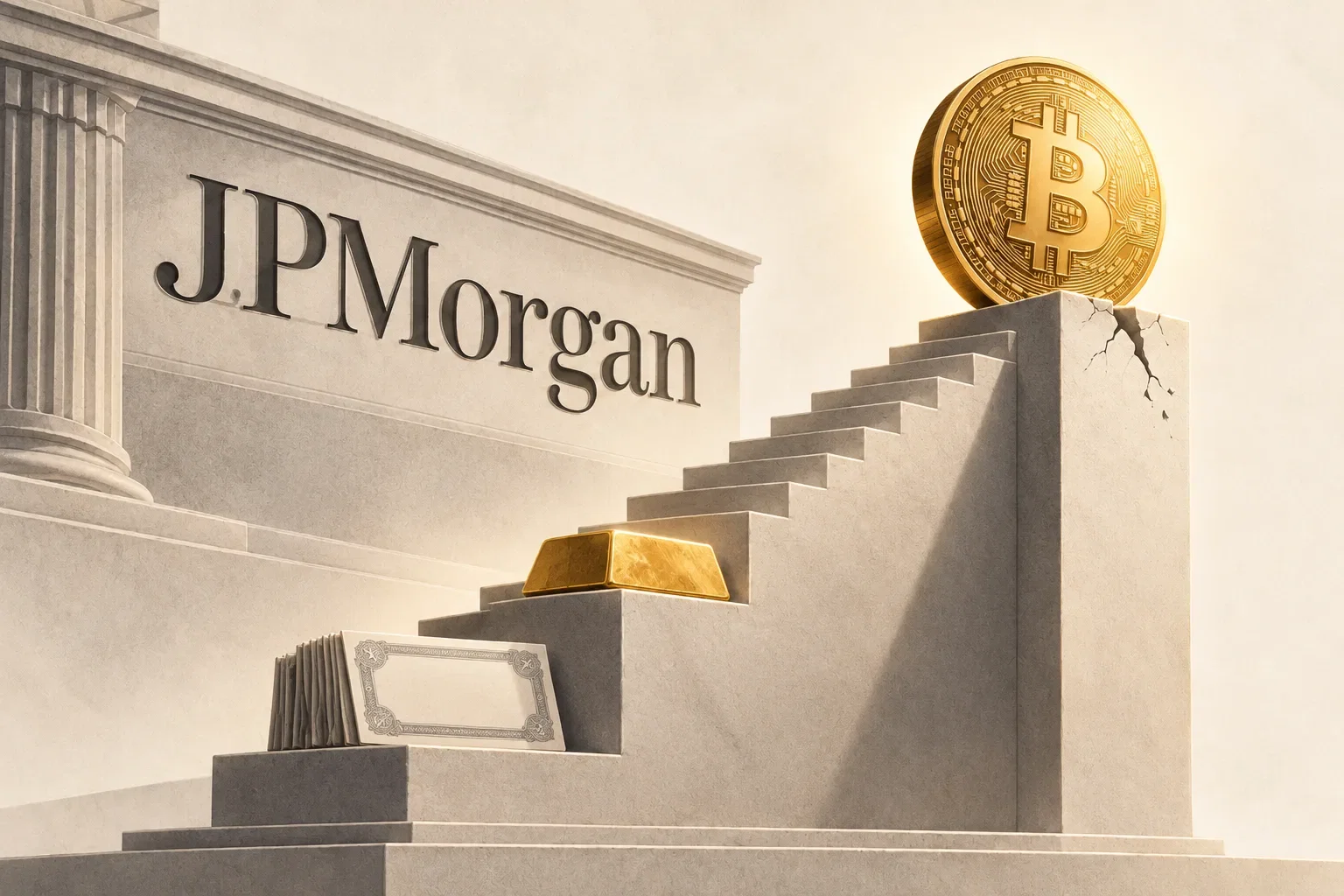
When asset manager J.P. Morgan Asset Management $JPM published the 31st edition of its long-term outlook for the next 10 to 15 years on Monday, October 19, one new entry appeared in its table of more than 200 assets. Bitcoin. For the first time in the history of this publication, the firm, which manages $4.8 trillion, assigned it its own return estimate.
And the number is surprising: 10% a year in the base-case scenario. No other asset in the entire table came close. U.S. large-cap stocks are at 7.5%, gold at 5.5%, and a classic portfolio made up of 60% stocks and 40% bonds at 7.0%. Even private equity, the usual king of return tables, came in slightly lower at 9.8%.
But in the very next sentence, the bank adds that it does not include bitcoin in its model portfolios. And that contradiction is the whole story.
The highest figure in the table, but one you can’t use
Asset | Expected annual return (10 to 15 years) |
|---|---|
Bitcoin | 10.0% |
Private equity | 9.8% |
U.S. large-cap stocks | 7.5% |
Global stocks (in USD) | 7.5% |
60/40 portfolio | 7.0% |
Gold | 5.5% |
U.S. intermediate-term government bonds | 4.6% |
To put the bitcoin estimate in perspective, as recently as last year the bank expected U.S. stocks to return 6.7% a year. This year it raised that estimate by 0.8 percentage points, thanks to profit margins above 15% and the expected benefits of artificial intelligence. Even after that revision, bitcoin is 2.5 percentage points higher.
The bank also set a range around its base-case scenario. In the pessimistic case, it expects a loss of about 10% a year; in the optimistic case, a gain of around 17% a year. The calculation took into account bitcoin supply growth relative to money supply growth, its possible role alongside gold, and the pace of network adoption. In other words, even the authors don’t know whether you’ll have twice as much or a third as much in ten years.
“We believe it is premature to consider bitcoin a diversifier in a balanced portfolio. However, if volatility continues to decline and its correlation with other assets stabilizes, that could change in the future, especially as regulation becomes clearer and liquidity and price discovery continue to improve.”
Tim Lintern, Thushka Maharaj and Sean Daly, report authors, J.P. Morgan Asset Management
Why 55% volatility eats into returns
Here’s the catch. The bank assumes annual volatility of 55% for bitcoin. For U.S. large-cap stocks, it’s 18%; for gold, around 17%. Bitcoin therefore fluctuates more than three times as much as the stock index.
Why does that matter so much? Because wild swings chip away at your final gains, even when the average looks good. The report itself shows why: the simple arithmetic average of bitcoin’s annual returns comes to 20.9%, but the compound return—the amount you’d actually have left in your account—is only the aforementioned 10%. The gap between the two figures is the price of volatility.
A simple example: you invest 100 crowns, earn 100% in the first year, and have 200. In the second year, you lose 50% and are back to 100 crowns. The average of your two returns is a lovely +25% a year, and yet you haven’t made a single crown. The bigger the swings, the wider the gap.
And bitcoin showed what that looks like in practice over the past year:
On October 6, 2025, it hit a record above $126,000
On February 5, 2026, it plunged below $70,000 and briefly dipped below $61,000
Today it trades around $82,000, roughly 35% below its peak
Anyone who bought a bitcoin ETF at the peak and held on was down as much as 50% at the bottom. And you can’t recover from a 50% loss with a 50% gain—you need 100%.
“Bitcoin mostly trades as a high-beta risk asset that tracks global money supply growth, though at times it is treated as digital gold.”
Sheena Shah and Dennis Cristallo, J.P. Morgan Asset Management
The bank whose boss called it a fraud
The report is all the more interesting given who published it. JPMorgan CEO Jamie Dimon called bitcoin a fraud that would eventually blow up at a conference in New York in September 2017, adding that he would immediately fire any trader at the bank who traded it. Since then, he has softened his skeptical stance in tone, but not in substance.
But in the meantime, the bank has taken a different path. It operates its own digital token, JPM Coin, which it launched for institutional clients on the public Ethereum network on the same day the outlook was published. And the report acknowledges what it sees among its own clients: one in ten respondents holds cryptocurrencies in their portfolio, and about 17% say they plan to prioritize them. The clearer regulation that has emerged in the U.S. in recent years has also helped.
The crypto industry was quick to react.
“First they ignore you, then they laugh at you, then they fight you, and then they add you to their long-term capital market assumptions report and predict you’ll be the best-performing asset of the next decade.”
Matt Hougan, chief investment officer at Bitwise, on X
A seat at the table, but a chair in the corner
But the excitement shouldn’t obscure what the bank actually wrote about bitcoin. It sees it as a speculative asset and a hedge against monetary easing—that is, a bet that central banks will keep printing money. For now, it assigns it no other strategic role in a portfolio.
The fundamental problem is its unstable correlation. One month bitcoin behaves like a tech stock and falls alongside the Nasdaq; another month, it acts like gold. For a portfolio manager, that’s a nightmare, because they can’t count on bitcoin rising when stocks fall. That’s why it remains outside the bank’s main correlation matrix and gets only a small table of its own alongside selected assets.
So when JPMorgan advises clients on how to improve a classic 60/40 portfolio, it turns elsewhere: to hedge funds, whose estimate it raised by 1.4 percentage points to 6.7%, and to real assets such as real estate and infrastructure. With 30% allocated to these alternatives, it projects a return of 7.5% a year and a one-fifth improvement in the return-to-risk ratio. Bitcoin doesn’t feature in that recipe.
If the base-case scenario comes true, bitcoin would rise from today’s $82,000 to around $213,000 in ten years. But according to the bank itself, the road to that figure will involve drawdowns that most investors won’t be able to stomach. JPMorgan has given bitcoin the best grade in the class while seating it in the back row.
Stocks mentioned