


Data Centers Need a Lot of Electricity. These 5 Companies Could Profit

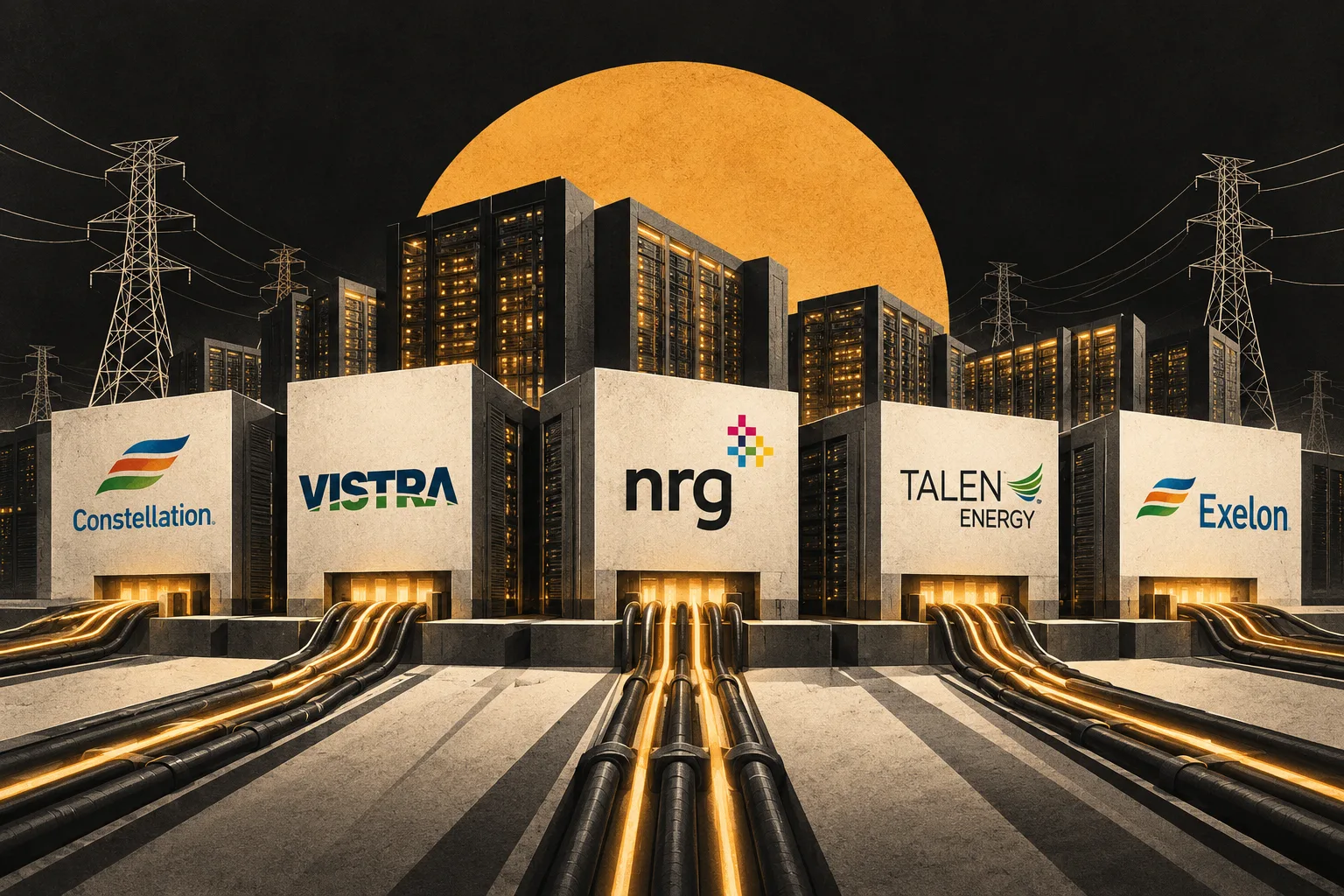
U.S. electricity consumption is returning to growth after fifteen years of stagnation, with data centers as the main driver. But higher demand does not automatically mean higher profits. Who actually benefits from the boom depends on the generation mix, long-term contracts, regulation, and available capacity. Five energy companies show how differently the same trend can affect financial results and stock valuations.
Key points
U.S. electricity consumption is heading for record highs, and data centers are becoming one of its main sources of growth.
Rising demand does not necessarily mean higher profits. What matters is whether a company owns reliable capacity and can sell it on favorable terms.
The most certain benefits go to companies that have already signed long-term contracts. Others benefit mainly from market prices or are still waiting for future projects to deliver.
Regulated utilities earn returns on investments in the grid. Their growth is slower, but the most predictable.
Political interventions in electricity prices and delays in connecting new loads during 2026 significantly reduced the optimism built into stock valuations.
The U.S. energy market is undergoing a transformation unlike anything seen since the turn of the millennium. After fifteen years of flat consumption, a new wave of demand is emerging, driven by artificial intelligence, cloud computing, and industrial electrification. But for investors, something other than consumption growth itself is crucial: who can turn it into higher profits and cash flow. Constellation, Vistra, NRG, Talen, and Exelon occupy very different positions in the energy value chain. Some sell electricity from their own power plants at market prices, others have presold it for twenty years, and one does not generate electricity at all—it distributes it for a regulated return. These differences determine how much of the boom reaches shareholders and how painful a slowdown would be.
Why data centers are changing the energy market
Consumption is growing, but forecasts keep changing
According to the EIA’s October Short-Term Energy Outlook, U.S. electricity consumption will rise to 4 288 TWh in 2026 and 4 356 TWh in 2027. In the third quarter of 2026, total consumption was 4 % higher than a year earlier, while commercial consumption was up 5 %. The commercial sector, which the EIA also counts data centers in, is expected to reach 1 549 TWh this year and surpass residential consumption of 1 541 TWh for the first time.
The EIA does not publish an exact share of the increase attributable to data centers in its short-term outlook. The commercial sector is the closest available proxy. Forecasts have also fluctuated: the July outlook projected 4 399 TWh for 2027, the September outlook 4 349 TWh, and the October outlook 4 356 TWh. A range of about 50 TWh is equivalent to the annual consumption of a smaller U.S. state and illustrates how uncertain estimates of the pace of construction remain.
Consumption, peak demand, and price are not the same
To evaluate energy companies, it is necessary to distinguish three measures:
Total consumption (TWh) determines the volume of electricity sold. It is growing by a few percent annually.
Peak demand (GW) determines how much capacity must be available during the busiest hour of the year. It is what drives capacity prices. In its January 2026 Long-Term Reliability Assessment, NERC projects summer peak demand to grow by 224 GW over ten years, or 24 % compared with 2025. The forecast is 69 % higher than a year earlier.
Electricity prices depend on whether supply keeps pace with peak demand. The EIA expects an average wholesale price of 52 USD/MWh in 2026, 11 % higher than in 2025, with extreme weather fluctuations as the main cause.
Data centers are especially demanding on the grid because they draw an almost constant load 24 hours a day. Model training and cloud services cannot tolerate outages, so operators need guaranteed capacity, not just “green” megawatt-hours generated when the sun is shining. That is why installed capacity alone is not enough to watch. What matters is capacity that can be relied on at peak times—and nuclear and gas plants excel at that.
PJM and Texas: the two hotspots
The greatest strain is concentrated in the PJM grid, operated by the eponymous operator across 13 states from Virginia to Illinois, and in Texas’s ERCOT. PJM includes Northern Virginia’s “Data Center Alley,” Meta’s Prometheus supercomputer in Ohio, and Amazon’s twenty-billion-dollar campus in Pennsylvania. PJM’s capacity auction for 2028/2029 ended in July 2026 at the regulatory cap of 325 USD/MW per day in all zones, with capacity 6 831 MW below reliability requirements. Without the cap, PJM’s simulation put the price at 554,72 USD, and at 776,69 USD in the ComEd zone. Yet the auction secured just 525 MW from new resources and capacity increases.
ERCOT has around 474 GW of large-load interconnection requests, about 90 % of which are for data centers. But only 65 GW has passed preliminary screening as a credible baseline load. The gap between requests and actual projects is enormous.
Why supply is falling behind
Several bottlenecks are holding back new generation at once: grid interconnection queues, lengthy permitting processes, long lead times for gas turbines, and delays in transmission-line construction. NRG’s new combined-cycle gas plant project in Texas is expected to take about three years from the investment decision planned for the end of 2026 to launch at the end of 2029, and cost around 2 700 USD per kW. NRG has secured turbine and supplier capacity through 2032. A data center can usually be built much faster. This timing mismatch is at the heart of the investment thesis: existing power plants are valuable because new ones cannot be brought online quickly enough to replace them.
Politics enters the picture
2026 brought a series of interventions that complicated the thesis. In January, the White House and governors of PJM states signed a set of consumer-protection principles, including an extension of the capacity auction price cap. In August, Texas Governor Greg Abbott suspended approvals for new data centers in ERCOT pending completion of an audit. In late September, FERC then postponed PJM’s extraordinary capacity procurement (the so-called Reliability Backstop Procurement) until February 28, 2027. According to S&P Global Market Intelligence, shares of Vistra, Constellation, NRG, and Talen lost 30 %, 22 %, 41 %, and 28 % respectively in the 12 months through September 28.
Constellation Energy
The largest nuclear fleet in the U.S.
Constellation operates the largest nuclear fleet in the United States and completed its acquisition of Calpine in January 2026, adding a substantial gas portfolio, especially in Texas and California, to its nuclear assets. In the second quarter of 2026, its nuclear fleet generated 40 TWh and ran at over 99 % utilization during the July heat wave. Refueling outages averaged 23 days, 40 % shorter than the industry average. Fuel accounts for only a small share of a nuclear plant’s costs, so almost every additional megawatt-hour generated flows directly into the margin.
Contracts with technology companies
Constellation has the broadest portfolio of contracts with major technology customers so far:
Microsoft $MSFT: a twenty-year agreement to purchase all output from the restarted Three Mile Island 1 unit, renamed the Crane Clean Energy Center (835 MW). The restart is planned for 2027. In March 2026, a PJM study suggested interconnection could be delayed until 2031, but in the second quarter FERC approved the transfer of interconnection rights from the retiring Eddystone plant, and the NRC approved the fuel license.
Meta $META: a twenty-year agreement for all output from the Clinton plant in Illinois starting in June 2027, including a 30 MW capacity increase.
CyrusOne: electricity supply for a data center next to the Thad Hill gas plant in Texas, agreed while it was still part of Calpine. Another agreement concerns a data center next to the Freestone plant.
About 920 MW of additional long-term contracts were added in the second quarter, with an average term of 18,5 years. Long-term contracts now cover about 30 % of carbon-free baseload generation.
Prices under these contracts have not been disclosed. Investors therefore cannot accurately calculate the premium Constellation is earning over market prices.
Financial performance and outlook
For the second quarter, it reported adjusted operating earnings of 2,55 USD per share, while GAAP earnings were only 1,42 USD. The difference is mainly due to the revaluation of hedging derivatives and acquisition-related expenses. Management raised its 2026 adjusted earnings outlook to 11,50–12,50 USD per share, representing growth of 28 % at the midpoint compared with 9,39 USD in 2025. Some of that growth, however, comes from the Calpine acquisition, not data centers.
The acquisition changed the balance sheet. Long-term debt rose from 7,25 to 19,11 billion USD, and total debt stood at 24,7 billion USD as of June 30. Operating cash flow for the first half (1,55 billion USD) did not cover capital expenditures (2,52 billion USD), reflecting the Crane restart, capacity increases, and integration. The company has nevertheless repurchased 2,2 billion USD of shares this year and has another 2,8 billion USD available. The share count is still 13 % higher year over year because part of the Calpine purchase price was paid in stock.
What is priced in
At 253,45 USD (as of 23. 10.), the stock trades at roughly 21 times the midpoint of its 2026 earnings outlook. That is a premium to regulated utilities. At the end of 2025, however, the stock traded at about 40 times trailing earnings; today, it is around 28 times. The market is therefore no longer assuming that every nuclear megawatt will find a technology-company buyer at a large premium. The main risk to the thesis is political pressure on PJM capacity prices and the timing of the Crane restart.
Vistra
Nuclear, gas, and retail under one roof
Vistra combines electricity generation with extensive retail sales in Texas. Its fleet exceeds 44 GW, with gas plants accounting for roughly 59 %. It also owns four nuclear power plants: Comanche Peak in Texas and Beaver Valley, Perry, and Davis-Besse in PJM, acquired through the purchase of Energy Harbor. The retail business acts as a natural hedge. When wholesale prices rise, generation earns more and retail earns less, and vice versa.
Contracts with Meta and Amazon
Vistra has about 3,8 GW of nuclear capacity under long-term contracts:
Meta $META: twenty-year contracts for 2 609 MW from the Perry, Davis-Besse, and Beaver Valley plants. Of this, 2 176 MW comes from existing generation and 433 MW from future capacity increases. Deliveries begin in late 2026 and reach full volume in 2034. The contracts allow applications to extend operating licenses by another 20 years.
Amazon $AMZN: a twenty-year contract for 1 200 MW from the Comanche Peak plant in Texas.
According to management, the Meta contract for existing capacity requires no additional investment, and Comanche Peak does not require significant spending either. This is a crucial difference from building new generation: additional revenue flows almost directly into free cash flow.
Hedging and price sensitivity
As of August 3, Vistra had hedged approximately 100 % of its expected generation for 2026, 94 % for 2027, and 72 % for 2028. Short-term fluctuations in electricity prices will therefore have little impact on earnings. The risk shifts to 2028 and beyond, when the price at which new generation can be hedged will matter.
Financial performance and outlook
The 2026 adjusted EBITDA outlook is 6,8–7,6 billion USD (2025: 5,91 billion USD), and adjusted free cash flow before growth investments is 3,925–4,725 billion USD. For 2027, management gives an indicative range of 7,4–7,8 billion USD, excluding the Cogentrix acquisition (5,5 GW of gas plants for a net cost of roughly 4 billion USD) and any contribution from the Meta contracts. GAAP results fluctuate sharply: in the first quarter, unrealized hedge revaluations unrelated to operating performance increased net income by 1,3 billion USD.
Sustainability of profitability
Since November 2021, Vistra has repurchased 6,5 billion USD of shares and reduced the share count by 30 %. At 140,16 USD (as of 23. 10.), the midpoint of its free cash flow outlook equates to a yield of around 9 % of market capitalization. But some of today’s margins reflect high PJM capacity prices and a hot summer in Texas. Management itself says that data centers’ impact on the supply-demand balance will become “meaningful” only in late 2027 or early 2028.