


The Future of Cars Is Being Shaped by Technology Suppliers. Which Stocks Are Worth Watching?

Cars are evolving from mechanical machines into electronic platforms, and value within the supply chain is shifting along with them. But more electronics, software, and electrification do not by themselves mean higher profits for suppliers. What matters is how difficult a product is to replace, how much bargaining power automakers have, and how companies allocate capital.
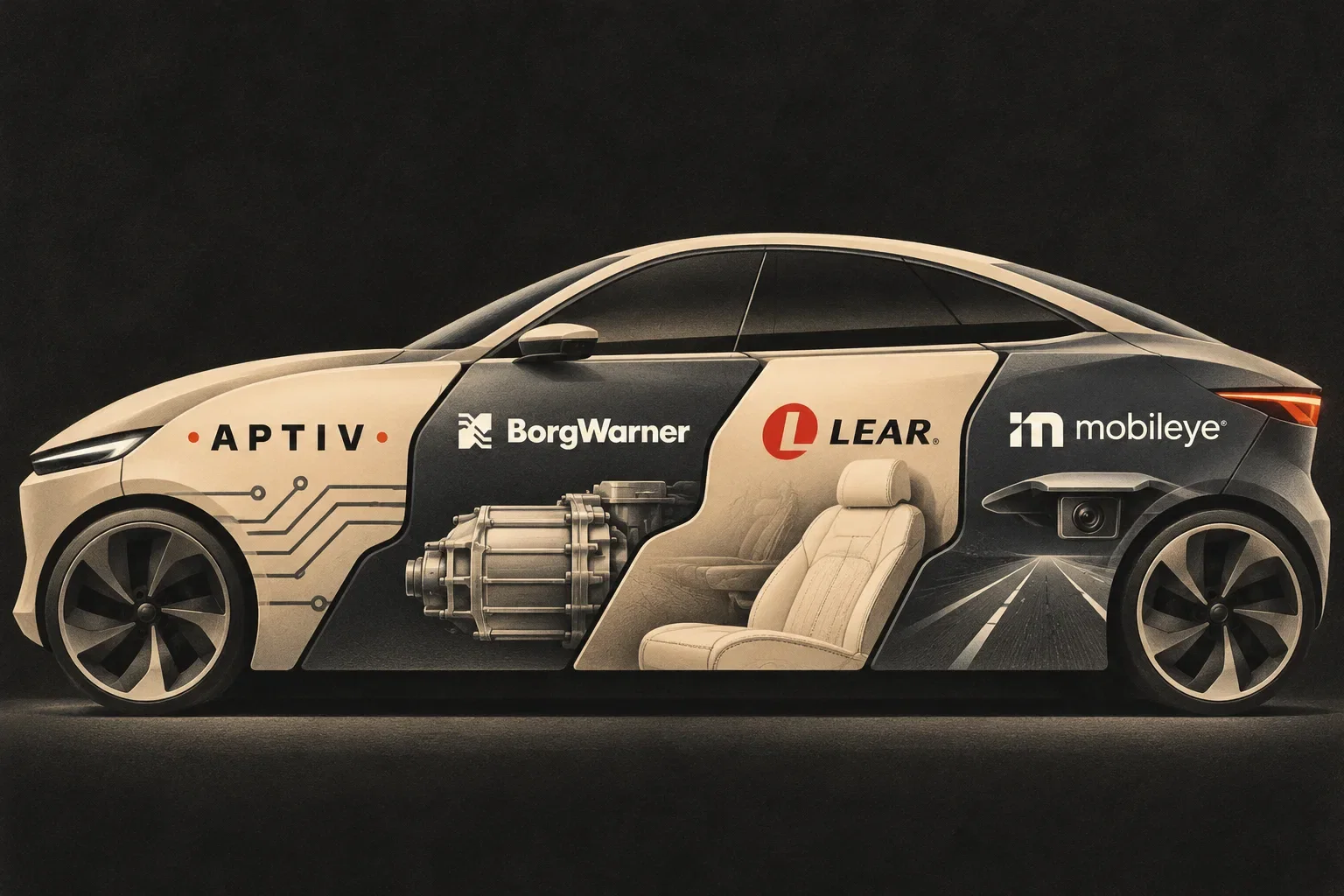
Key points
The value of electronics and software in each car is increasing, but the number of cars produced in 2026 is expected to edge down. Suppliers therefore need to grow through content, not volume.
Electrification is progressing very unevenly. Europe and emerging markets are accelerating, EV sales are falling in the US, and hybrids are so far the biggest winners in the transition.
The highest margins are maintained by companies with products that are difficult to replace and require long-term certification—not by those that supply the most technology to a car.
The sector trades at single-digit earnings multiples and with free cash flow yields mostly between 7 and 10%. The market is therefore pricing in risk more than growth.
Technological importance does not guarantee returns for shareholders. The key question is how much of a product’s added value remains with the supplier after automakers put pressure on prices.
The automotive industry is changing
The economics of a car are shifting from sheet metal and engines to electronics. A modern vehicle contains dozens of control units, cameras, radars, high-voltage wiring, and ever more software that is updated even after the sale. Automakers are moving to so-called zonal architecture, in which a smaller number of powerful computers replaces dozens of separate units. For suppliers, this means two things: there is more of “their” value in every car, but at the same time, who controls that value is changing.
Volume alone does not drive growth. According to S&P Global Mobility, global light-vehicle sales are expected to fall by about 2.7% in 2026 to 89.4 million units, mainly due to weak domestic demand in China. Suppliers that want to grow therefore need to increase content per vehicle, gain market share, or expand beyond the automotive industry. All four companies covered here are doing at least one of these things.
Where the opportunity lies—and where the trap is
A long-term opportunity lies in the growing share of sensors, computing power, and electrical components in a vehicle’s price. Driver-assistance systems are also becoming standard equipment because safety regulations require them, for example in the EU. The risk, by contrast, is that automakers face fierce competition from Chinese manufacturers and are responding by cutting costs. That pressure is passed on to suppliers first and fastest.
Chinese automakers also often develop electronics and software themselves or work with domestic suppliers that are cheaper and faster. Chinese brands accounted for 30% of the European EV market in Q1 2026, according to Counterpoint Research. Western suppliers therefore lose out twice: their traditional customers sell fewer vehicles, and new Chinese players need them only where they lack their own solutions.
Four companies, four distinct positions
Aptiv
Aptiv underwent a major transformation this year. On April 1, 2026, it spun off its Electrical Distribution Systems (EDS) division into a standalone company, Versigent, which trades under the ticker VGNT. Shareholders received one Versigent share for every three Aptiv shares, and Aptiv retained no stake in it. So anyone buying Aptiv today is not buying the wiring business, historically its largest source of revenue, but a smaller company with higher margins.
The “new Aptiv” has two segments. Engineered Components makes connectors, high-voltage busbars, and other components for electrical architecture. In Q2 2026, it had revenue of USD 1.8 billion and an adjusted EBITDA margin of 22.4%. Intelligent Systems supplies radars, cameras, computing units for driver-assistance systems, and software, including the Wind River platform. Segment revenue was flat at USD 1.5 billion, and its margin fell to 14%.
Connectors are the most economically attractive part of the business. They are small, inexpensive, but critical components, and their failure can bring an entire car to a halt. Automakers do not replace them after certification, which is why their margins are far above the sector average. Aptiv is also expanding sales beyond autos into aerospace, defense, data centers, and industry. Non-automotive revenue rose 12% year over year in Q2.
Intelligent Systems is the weak spot. Some software and driver-assistance contracts have been delayed, and the company cut its full-year revenue outlook by USD 300 million to USD 12.6–12.8 billion due to weakness in China and delayed production launches. Its adjusted EPS outlook was lowered to USD 5.60–5.80.
BorgWarner
BorgWarner is a traditional powertrain supplier trying to navigate the energy transition without sacrificing profitability. It sells turbochargers, timing chains, transmission and drive systems for combustion-engine vehicles, as well as electric motors, inverters, and other components for hybrids and EVs. In Q3 2026, its Turbos & Thermal and Drivetrain & Morse segments together accounted for 78% of revenue.
Its strategy is pragmatic: get the most out of its combustion-engine portfolio and electrify only where contracts are profitable. Revenue from electric products for passenger vehicles rose 33% in Q3 to USD 630 million, while the battery segment plunged 41% to USD 78 million, and the company had already exited charging stations. In 2025, it recorded USD 624 million in impairments—extraordinary write-downs in the value of assets—as a result.
A new development is its entry into energy systems for data centers. BorgWarner secured a framework agreement to supply turbine generators to TurboCell and is developing products for industry. These are still small investments, amounting to tens of millions of dollars, but they show an effort to put its manufacturing know-how to use beyond autos.