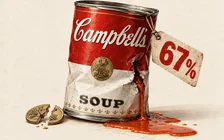
Dividend 25%. Will you get a return on your investment in 4 years?

I like writing about dividend stocks because it's one of the best legitimate ways to work towards passive income. But things are definitely not as rosy as they seem. And we'll use this example to show why!

Are high dividends "free" money?
Imagine finding a company with a dividend of, say, 25%. Or even 50%! After all, that means the company pays out half of its purchase price for the year. So, by simple math, we arrive at the fact that in two years we are at zero and can no longer lose money! At first glance, this looks interesting and in theory it is true. But the reality is often quite different. Let's take a look at why this is so.
But we have to start at the beginning.
A dividend is how companies return capital to shareholders. It is the portion of net profits for a given period that is paid out to shareholders. The decision to pay a dividend is made by the company's board of directors, usually from the previous period's profits.
The dividend is usually expressed as a dollar amount per share; the total dividend to a shareholder depends on the number of shares he or she owns. The dividend rate is the ratio of the dividend paid to the share price, e.g., at a dividend rate of 3%, the shareholder received $0.03 for each $1 share held
So if you have $100 worth of company stock with a 50% dividend, then you get paid $50 in one year and $50 the next year as well. So after two years you have recovered the amount you invested while still having $100 worth of shares left. That's great! Well, isn't it...
There's always a risk that the dividend will go down. And we're not talking about the 50%, which is exceptional. We're not even talking about a 25% dividend. Even say 10% to 15% should get your attention. And why?
Because there are many dangers associated with such a high dividend.
It can signal growth problems - If a company doesn't have many growth or investment opportunities, it can use most of its profits to pay high dividends. However, over the long term, companies need to grow and innovate. Too high dividends can indicate a lack of opportunity.
Limited cash reserves - High dividends take a lot of cash out of a firm, which can limit its ability to put cash on the sidelines, invest and take opportunities right away. It can easily put it at risk in the event of shocks or recessions.
Lack of alternatives - If a firm sees no better alternatives to its free cash than high dividends, it may signal problems with strategy or market position.
In terms of sustainability, firms with dividend yields of around 25% often manage to maintain that level of payout for several years. However, over longer time horizons, especially during recessions or adverse economic conditions, they usually run into problems and are forced to reduce their payout ratio. And quite often quite drastically. You may then find that not only do you not have a high dividend, but you also own "worthless" shares that have no other potential. In general, the higher the dividend, the more difficult it is to sustain it over the long term.
If a company is paying a high dividend (above 10%), it is certainly worth considering what its cash reserves, debt levels, growth prospects and potential to sustain dividend payments are. In any case, a high dividend alone does not necessarily imply risk. Other factors influencing the sustainability of its payment should also be analysed. And then there is another option.
What is the link between an extremely high dividend and a fall in share price?
The dividend yield increases when the share price falls, because the dividend yield is calculated as the ratio of the dividend paid to the share price. So when the share price falls, the dividend yield automatically rises even though the amount of dividend paid does not change. Let's look at an example.
Suppose a firm pays a dividend of $1 per share and the price of one share is $100. The dividend yield is then 1% ($1 divided by $100).
Now the stock price falls to $50. The firm still pays a dividend of $1 per share. The dividend yield is now 2% ($1 divided by $50). Although the amount of the dividend paid has not changed, the dividend yield has increased from 1% to 2% because the stock price has fallen.
This mechanism works automatically - if the stock price falls, the dividend yield rises because the denominator of the ratio (stock price) changes while the numerator (dividend paid) remains the same.
Simply put, because of the drop in investor confidence and the drop in share price, shareholders will receive more money from the dividend in the form of a higher dividend yield. It's a way to compensate for the decline in their share price.
Quite often the first mechanism goes hand in hand with the second. A stock is in trouble or facing risks - look at $PBR and its geopolitical risks, for example. Alternatively, maybe it's struggling with profitability, FCF, debt, etc. Investors see this and dump the stock, driving down its price. Thus, the second mechanism increases yield, which can be driven to dizzying heights. But as I mentioned - this is rarely sustainable.
Conclusion
So what can we take away from this? Could high yield be a brilliant opportunity to go into the black in just a few years? Yes, it can. But there's a huge trade-off for taking a big risk. A company with a 25% yield can sustain that dividend for 4 years, in which case you're really at zero. But you're also risking that soon after you buy, the dividend will fall and so will the share price - and your investment will lose value. Adventurous active investors can take advantage of this, but you certainly can't say that high yield is quick money for free, so keep that in mind.
Disclaimer: This is in no way an investment recommendation. This is purely my summary and analysis based on data from the internet and other sources. Investing in the financial markets is risky and everyone should invest based on their own decisions. I am just an amateur sharing my opinions.
Stocks mentioned