
The opening quarter of Microsoft’s fiscal year reveals a company operating at a new, accelerated rhythm — one defined almost entirely by artificial intelligence. With demand for AI infrastructure exploding and enterprises racing to modernize their workflows, Microsoft has positioned itself at the center of the ecosystem: the place where compute, software and enterprise integration converge. The result is one of the strongest quarterly showings in recent memory, signaling that the company’s AI expansion still has significant room to run.

What stands out is not just breakthrough technology, but the coherence of the business strategy behind it. Cloud, AI services, productivity software and even the consumer divisions are expanding in tandem, each reinforcing the other. This level of alignment is rare in Big Tech, and it is precisely why Microsoft continues to widen its competitive moat — technologically, commercially and financially.
How was the last quarter?
Microsoft opened the new fiscal year extremely strong. Revenues reached $77.7 billion, up 18 percent. More notable than the numbers themselves, however, is the structure - much of the growth was driven by Microsoft Cloud, which jumped to $49.1 billion thanks to growing demand for AI. Azure's 40 percent growth is one of the fastest rates in recent quarters and confirms that customers are not only migrating to the cloud, but are beginning to move heavily to AI-powered computing models. This dynamic is significantly changing the economics of the entire segment.
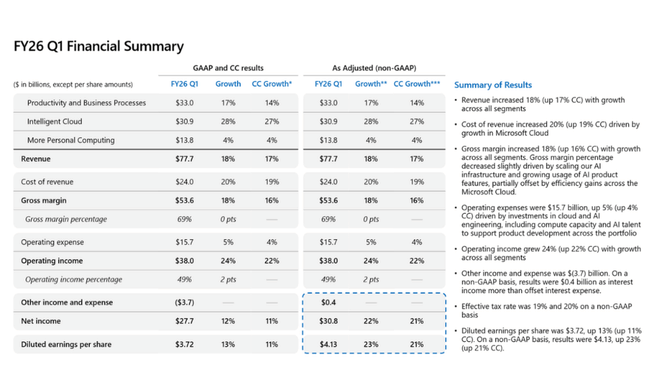
Operating profit grew 24 percent to $38 billion, marking a significant improvement in margins across key segments. Net income on a GAAP basis grew to $27.7 billion, while non-GAAP results reached $30.8 billion. The difference is primarily due to the accounting treatment of investments and holdings in OpenAI, which, while impacting margins in the short term, open up strategic opportunities for Microsoft in the long term with near-monopoly access to today's most advanced foundation models.
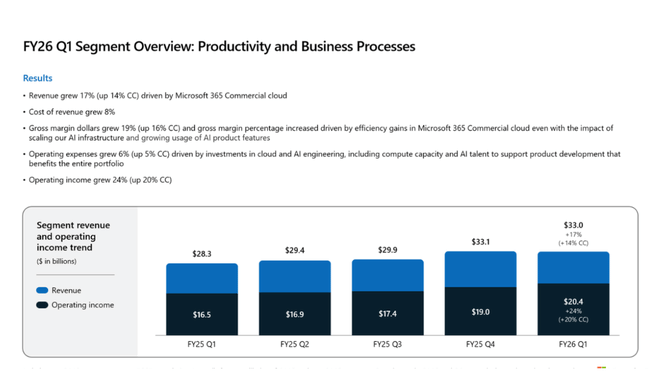
The Productivity and Business Processes division has also been a significant driver of growth, with $33 billion in revenue, continuing to build a robust ecosystem around Microsoft 365. Enterprise customers are rapidly adopting Copilots and generative AI features that add a whole new value to traditional products like Excel, Word and Teams. And even the consumer arm of this division, Microsoft 365 Consumer, has posted very respectable double-digit growth of 26 percent.
Intelligent Cloud, however, is the segment that is pulling Microsoft into the new era most strongly. Azure's 40 percent growth is not only the result of aggressive investment in AI infrastructure, but also the growing interest of enterprises to integrate AI directly into operational processes. With this expansion, Microsoft is confirming that its cloud layer is not just infrastructure, but increasingly the technology backbone of all enterprise IT.
CEO comment

Satya Nadella highlighted that Microsoft $MSFT is at the forefront of a "planet-scale cloud and AI factory", an infrastructure on a scale unparalleled in the technology world. In his comments, he made it clear that the company's strategy is based on the gradual expansion of Copilot into various areas of productivity, entertainment, software development, healthcare and industry. Nadella also hinted that Microsoft is not going to settle for the current pace - investments in AI infrastructure will continue to increase and will be focused primarily on performance, capacity and connectivity.
CFO Amy Hood added that the combination of strong demand for cloud and fast-growing AI services has allowed the company to beat expectations across key financial metrics. Her comments also highlighted that capital discipline remains in place even in a period of massive investment, which is a key signal to investors.
Outlook
Microsoft enters the next period with exceptionally strong fundamentals and several strong catalysts. Azure continues to increase its market share and AI computing represents a growth space in the tens of billions of dollars per year. Given the continued boom in AI models, the increase in both training and inference workloads, and the adoption of Copilot, it is very likely that the current momentum will be sustained in the coming quarters.
Growth will remain driven primarily by the cloud, but the More Personal Computing segment is also starting to stabilize after several weak years. The advertising business is expected to grow double digits due to the integration of AI into search, while Xbox will remain a stable, albeit less dynamic segment. Microsoft also continues to expect high levels of free cash flow, which will allow it to continue generous buybacks as well as dividend increases.
Long-term results
Microsoft's long-term development shows the company in a very unique position. Over the past four years, revenues have grown from $198 billion to $281.7 billion, an increase of nearly 42 percent. More interesting than the revenue growth itself, however, is the fact that Microsoft has also managed to massively increase its operating profit, which has reached $128.5 billion. This shows the company's exceptional ability to scale its services - in fact, cloud platforms allow it to increase revenue faster than costs.
Margins are also trending very strongly. Gross margins for the past year reached $193.9 billion, representing steady growth and confirming that Microsoft's core products can maintain pricing power even in a competitively exposed environment. Operating expenses are growing significantly slower than sales alone, creating massive operating leverage. This gap is even more pronounced in the context of growing investment in AI, meaning that new services generate margins that may be even higher in the future.
Net profit rose to more than $101 billion and the positive impact of product mix can also be seen here. Microsoft is no longer a Windows or Office-dependent company - it is becoming primarily a cloud and AI player, with most of the value being created in the Microsoft Cloud layer, i.e. Azure, Microsoft 365, Dynamics and others.
In addition, Microsoft is very good at managing the number of shares outstanding, which is holding steady and only slightly declining thanks to buybacks. EPS is thus growing faster than net income itself and is one of the most reliable indicators of long-term shareholder value growth.
- Azure's rocketing growth of 40 percent confirms the accelerating adoption of AI workloads.
- Microsoft Cloud broke the $49 billion mark for the first time in the quarter.
- Microsoft 365 Consumer grows at its fastest pace in years thanks to Copilot features.
- The company returned $10.7 billion to investors in dividends and buybacks.
Shareholder Structure
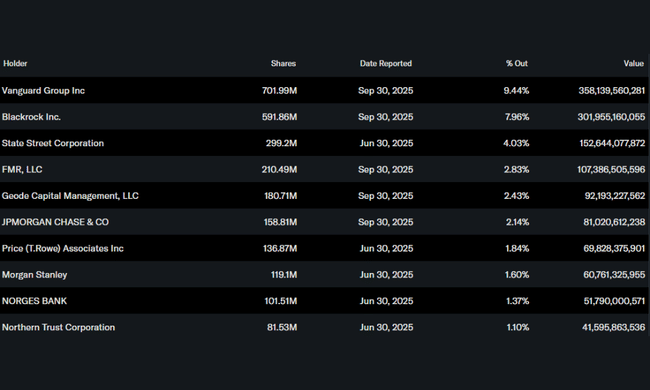
Microsoft has one of the most stable and institutionally held shareholding structures in the world. Institutions own more than 75 percent of the company, reflecting the high confidence of long-term investors and funds. The largest shareholders include Vanguard Group, BlackRock, State Street and Fidelity (FMR), which together hold a significant stake and accumulate additional shares over the long term.
High institutional holdings also mean that Microsoft shares are considered one of the pillars of global investment portfolios. The firm's position in the S&P 500 or Nasdaq 100 indices provides it with very stable demand for its shares, which translates into low volatility even in the face of significant movements in the broader technology market.