Moderna’s Post-Pandemic Balancing Act: Revenue Resilience Meets a Returning Loss

Moderna’s third-quarter results paint the picture of a company still navigating the long shadow of its pandemic-era success. While demand for COVID-related products continues to fade, the company is working aggressively to build a more diverse revenue base by scaling its respiratory vaccine portfolio and slashing operational costs. The result is a quarter marked by sharply lower sales but noticeably improved operational efficiency, signaling that Moderna is gradually regaining financial stability even as headline numbers remain volatile.

At the same time, the updated full-year guidance gives investors a clearer sense of direction. Moderna is shifting from a single-product pandemic beneficiary to a multi-platform mRNA developer, with programs in flu, RSV, oncology and rare disease advancing through the pipeline. Q3 is therefore less about revenue contraction and more about whether the company can redefine its long-term identity in an increasingly competitive biotech landscape.
How was the last quarter?
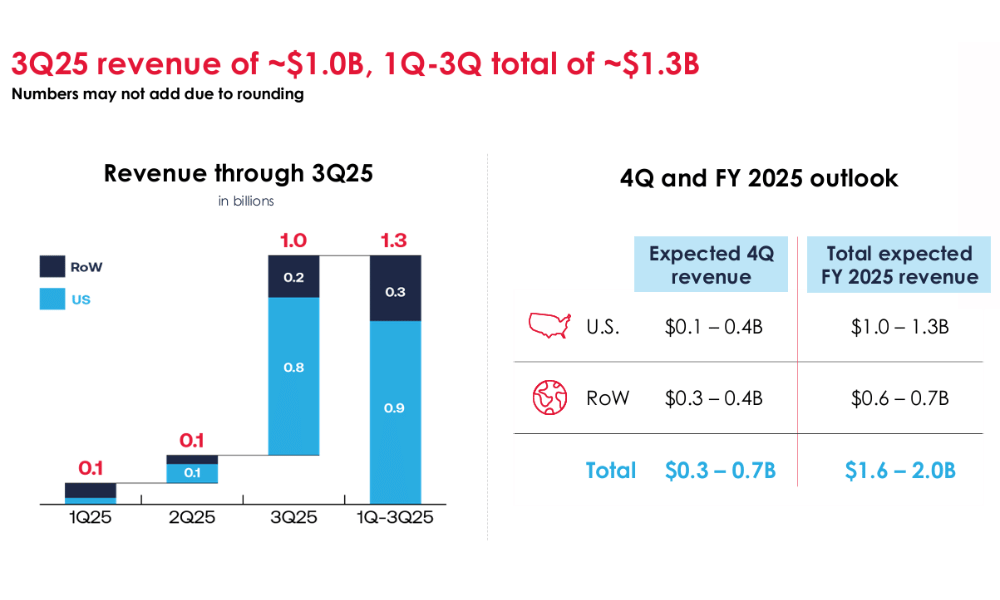
The third quarter brought in revenues of $1 billion, a deep 45% year-over-year decline. The main factor was lower sales of COVID vaccines in the US, where public interest weakened again and where the 2024 comparative base included positive one-time adjustments of $140 million. However, despite the downturn, Moderna was able to benefit from the launch of the commercialisation of mNEXSPIKE, its next generation COVID vaccine, which has expanded the target population and opened up new clinical and commercial opportunities.
Gross margin improved thanks to significantly lower inventory write-downs and a reduction in unused production capacity - this was one of the most problematic areas in the previous eight quarters. Cost of goods sold declined 60% to $207 million, although it included $67 million of amortization. The biggest structural change, however, came from a dramatic reduction in R&D spending, which fell 30% year-over-year. The company continues to strictly prioritize clinical programs, with the biggest savings coming from improved trial efficiency and deferral of select projects. Nevertheless, the operating loss widened as the revenue base was too low to absorb fixed costs.
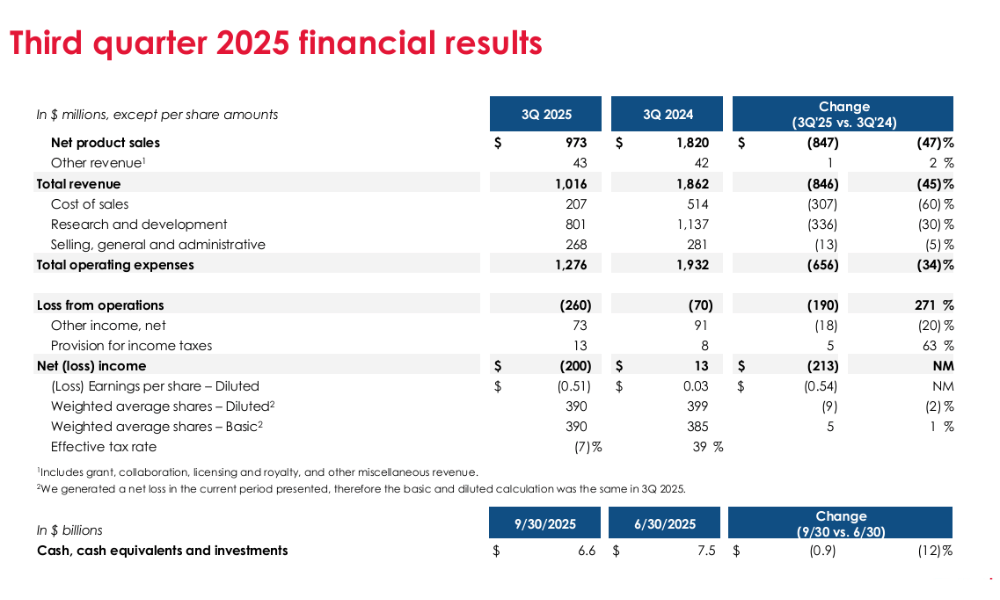
The net loss of $200 million contrasts with a modest profit last year. Nevertheless, the company closes the quarter with $6.6 billion in cash, a sufficient cushion to fund its extensive clinical infrastructure as well as further investment around seasonal respiratory vaccines. The upgraded year-end outlook confirmed a strong focus on cash discipline, with expected cash reserves raised to $7 billion.
CEO commentary

CEO Stéphane Bancel highlighted that the company's Q3 performance was underpinned by "strong commercial performance of its next generation COVID vaccines and deep reductions in operating costs". Bancel said Moderna "remains fully committed to operational excellence, financial discipline and progressive portfolio building beyond COVID-19". Crucially, his comments confirm that Moderna no longer plans to grow through massive investment, but through precise allocation and phased pipeline launches.
Outlook
Moderna $MRNA has narrowed full-year revenue guidance to $1.6-2.0 billion, a slight increase on the low end and a slight narrowing on the high end. The trend shows that the company is already better at estimating the seasonality of demand for COVID vaccines and the impact of international contracts. Operating costs are expected to be reduced by up to $700 million from original plans, one of the most aggressive hits to the cost base across the sector.
As a result, the expected year-end is shaping up to be more stable - the cash position should reach $6.5-7 billion. The company's capitalization is thus not at risk, which is key given that full commercialization of future vaccines (flu mRNA-1010, combination mRNA-1083 and norovirus mRNA-1403) will not come until 2026 at the earliest. The outlook thus rests on two pillars: a short-term stabilizer in COVID vaccines and a long-term driver in the form of a diversified pipeline.
Long-term results
Moderna's long-term financial trajectory shows the extreme volatility that has arisen since the end of the pandemic period. Revenues for 2024 were $3.2 billion, a decline of more than half from 2023. This follows a decline of nearly 64% in 2023, when mass demand for COVID vaccines was ending and the company did not yet have alternative revenue sources. 2022 was the last "pandemic" year with nearly $19 billion in revenues.
Cost of sales dropped drastically between 2022 and 2024, but only 2025 shows that the restructuring of production is having the desired effect. R&D costs were rising until 2023, when the company funded a massive pipeline, but they start to stagnate from 2024 onwards and drop significantly in 2025. This means only one thing: the firm has adapted to the post-pandemic reality and moved from expansion mode to disciplined optimization mode.
Net income has declined in three consecutive years, with 2024 delivering a deep loss of $4.7 billion. The loss in 2025 is smaller, showing that the combination of lower operating investment and better working capital is starting to work. EBITDA is still negative, but the reporting structure shows that the closer new vaccines get to commercial approval, the more room there is to return to positive cash flow.
News
Moderna strengthens commercialization of COVID-19 portfolio including new mNEXSPIKE
Company further expanded approval of RSV vaccine mRESVIA in more than 40 countries
mRNA-1010 (seasonal influenza) to be submitted for approval in the US and EU by January 2026
Combination vaccine mRNA-1083 awaits FDA and EMA decision
Norovirus vaccine mRNA-1403 extends phase 3 due to lack of cases
mRNA-1647 (CMV) has been discontinued after failure in Phase 3
Oncology studies of mRNA-4157 and mRNA-4359 continue
Shareholding structure
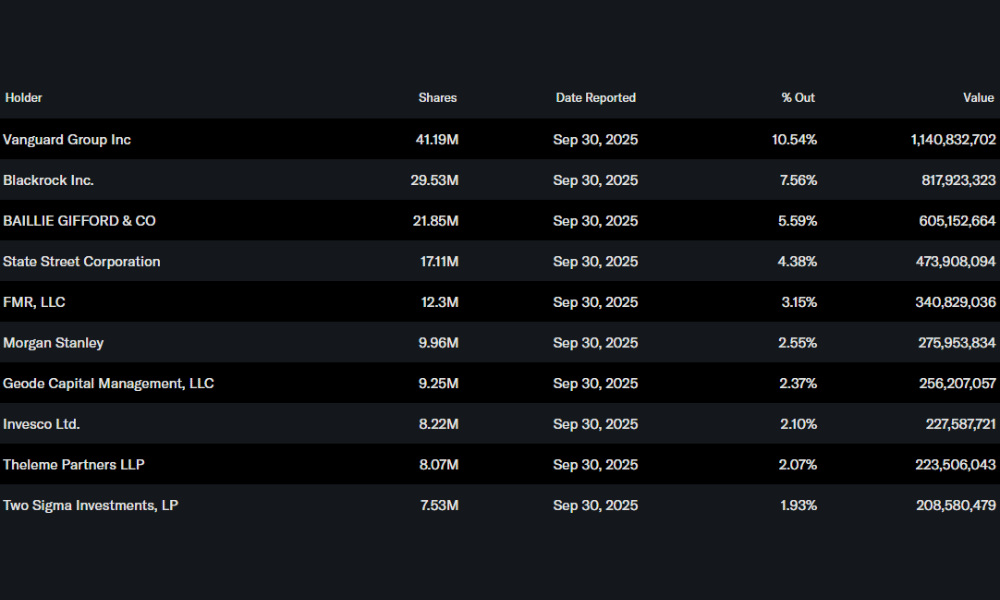
Institutional investors own over 71% of the shares, a solid long-only capital base for a high volatility biotech company. Vanguard Group remains the largest shareholder with a 10.5% stake, followed by BlackRock (7.6%) and Baillie Gifford (5.6%), which holds one of the most consistent positions in Moderna since 2021. Approximately 7.2% of the stock is held by insiders, which is relatively high and demonstrates management's strong commitment to the long-term development of the company.
Analysts' expectations
The most recent available analyst commentary comes from JPMorganwhich reaffirmed a 2025 rating on Modern on November 4. Neutral and a target price $90. The analysts said the Q3 results "provide clear evidence of a disciplined transformation" but also cautioned that "the commercialization of the mRNA-1010 influenza vaccine is a key catalyst for 2026, without which valuation will remain capped by the COVID portfolio's fundamentals." JPMorgan also highlights that the arrival of combination vaccines could create a new revenue peak in 2027-2028.
Fair Price
Stocks mentioned