Micron’s Cycle Looks Different This Time

Micron’s opening quarter of fiscal 2026 signals more than just another upswing in the memory market. What stands out is how strongly AI-driven demand is reshaping the company’s earnings profile. Growth is no longer defined purely by pricing momentum in DRAM and NAND, but by a mix of higher-value products, disciplined supply management, and customers willing to pay for performance at scale.
For investors, this marks a meaningful shift in perception. Micron is increasingly viewed not as a pure cyclical bet, but as a beneficiary of structural demand from data centers and AI workloads. Expanding margins and accelerating cash generation suggest that this phase of the cycle is supported by fundamentals that extend well beyond short-term memory pricing dynamics.
How was the last quarter?
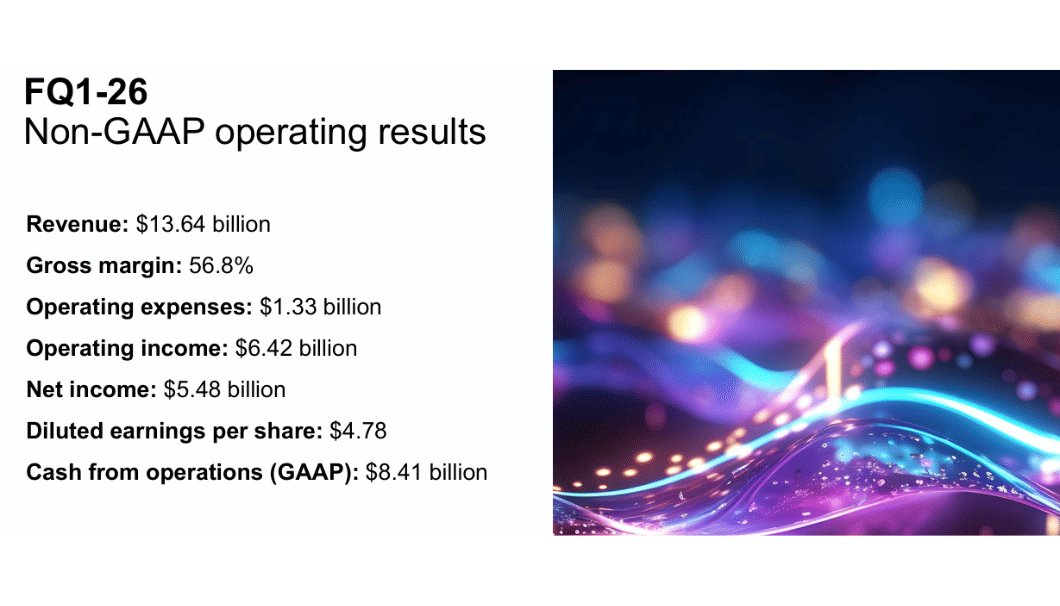
Micron $MU achieved $13.64 billion in revenue in the first fiscal quarter of 2026, marking strong quarter-over-quarter and year-over-year growth. Profitability improved across the board, with gross margin rising to about 56% on a GAAP basis and even higher on a non-GAAP basis. Operating margins moved into a range that Micron has historically only achieved during the strongest phases of the memory cycle.
GAAP net income was $5.24 billion and earnings per share were $4.60. On a non-GAAP basis, the result was even slightly stronger. Cash performance also improved very significantly, with operating cash flow jumping to $8.41 billion, a dramatic shift from prior periods. Despite high capital expenditure of USD 4.5 billion, the company was able to generate approximately USD 3.9 billion of free cash flow.
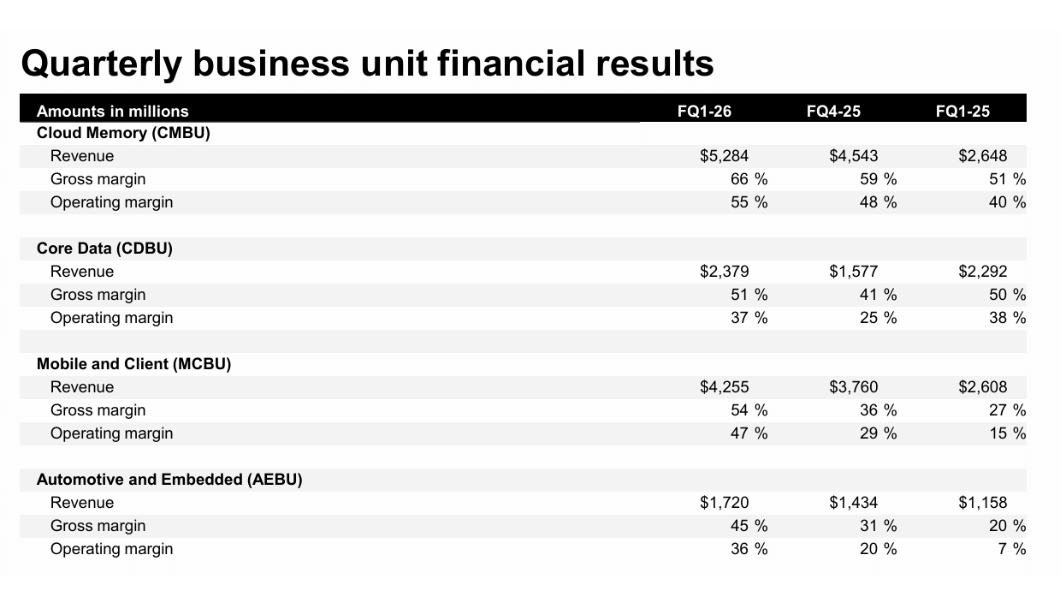
From a business-by-business perspective, it is evident that growth is broad-based. The cloud memory division is growing fastest, benefiting from demand for HBM and other AI accelerator memories. However, very strong margin improvement is also seen in mobile, client and automotive solutions, confirming that the overall pricing environment in the memory market is improving.
CEO commentary

CEO Sanjay Mehrotra called the quarter a record one, highlighting that Micron not only achieved its highest ever revenue, but also its highest ever free cash flow. He said margins improved significantly across all business units and the company is poised for further acceleration during fiscal 2026. A key theme of his comments was Micron's role as a key supplier of memory for AI infrastructure.
Mehrotra also stressed that Micron is investing with a focused approach and with an eye on return on capital. He said the company does not want to repeat the mistakes of past cycles, where over-investment led to a supply glut. This time around, the strategy is built on technological leadership and disciplined capacity management.
Outlook
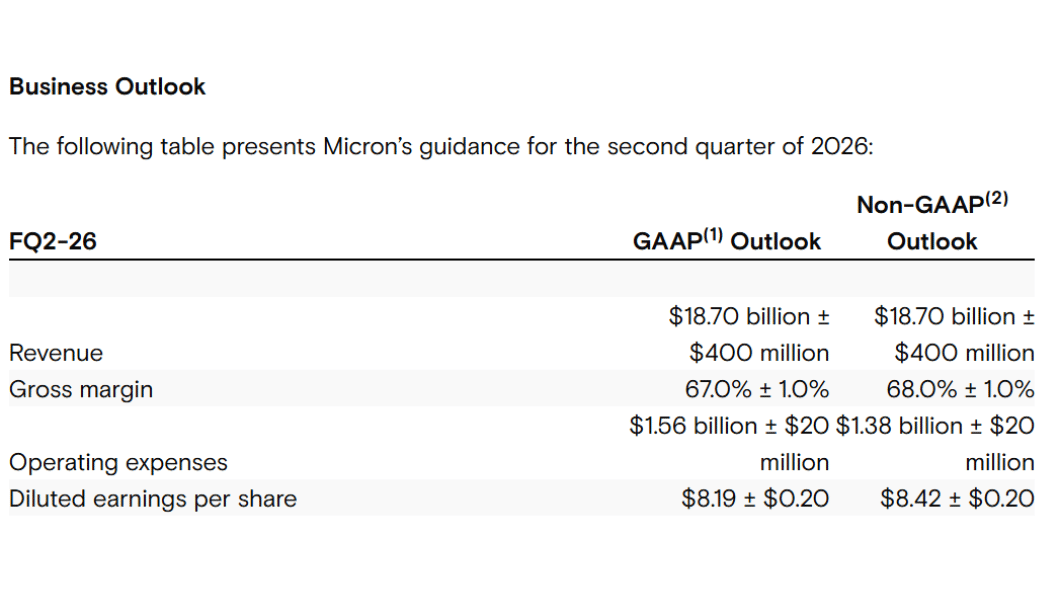
The outlook for the second fiscal quarter of 2026 is extremely strong. Micron expects sales of around $18.7 billion and further significant margin improvement, with gross margins expected to be in the upper 60s percent or so. Earnings per share expectations suggest that profitability should continue to grow significantly quarter-on-quarter.
Management has also indicated that it expects performance to continue to strengthen throughout fiscal 2026. AI infrastructure remains a key driver, but positive developments are also expected in more traditional segments such as personal computers, mobile devices and automotive.
Long-term results
A long-term view of Micron's performance shows the typical cyclical nature of the memory business, but also a significant shift in the quality of results in recent years. After a very weak 2023, when the company generated a loss, there was a sharp turnaround in 2024 and especially in 2025. Revenues have recovered significantly and profitability has returned to high levels.
Gross profit and operating profit showed extreme improvement, reflecting a combination of higher memory prices, better product mix, and lower unit costs. Net income was again in the billions of dollars in the last fiscal year, contrasting with the deep loss two years earlier. This development clearly shows how sensitive Micron is to the cycle phase, but also that the current phase is one of the strongest.
From a balance sheet perspective, it is important that the company can generate massive cash in strong years, which it can use to reduce debt, fund investments and return capital to shareholders. It is this ability to survive weak years and significantly strengthen its financial position in strong years that is key for long-term investors.
News
Micron announced a continuation of its regular dividend in the last quarter, while confirming a high level of investment in manufacturing capabilities and advanced technologies, particularly in HBM memory. The company also continues to strengthen its relationships with key customers in the AI and data center space, increasing visibility of future revenue.
Shareholding structure
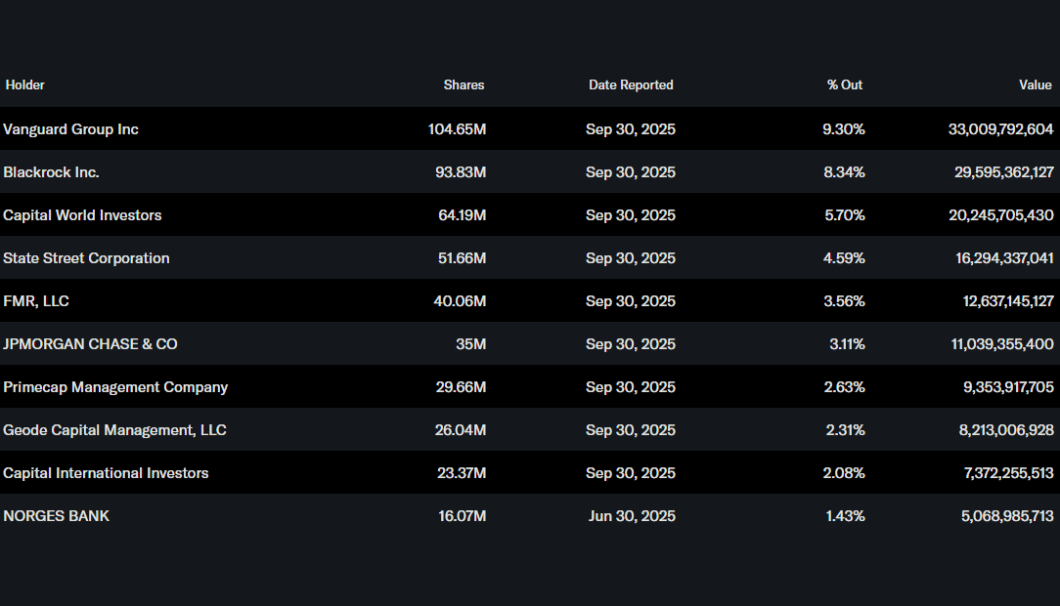
Micron's shareholder structure is strongly institutional. The largest shareholders include Vanguard Group, BlackRock, Capital World Investors, State Street and Fidelity. The presence of these long-term investors indicates the market's confidence in the company's current strategy and its ability to manage the cyclical nature of the memory market.
Analyst expectations
Analysts currently view Micron as one of the purest bets for AI infrastructure growth in the memory space. The focus is primarily on the evolution of margins, the sustainability of high free cash flow, and whether the company can maintain discipline in investments even in times of strong demand. If these assumptions hold true, Micron has the potential to remain one of the most interesting titles in the semiconductor sector for years to come.
Stocks mentioned