
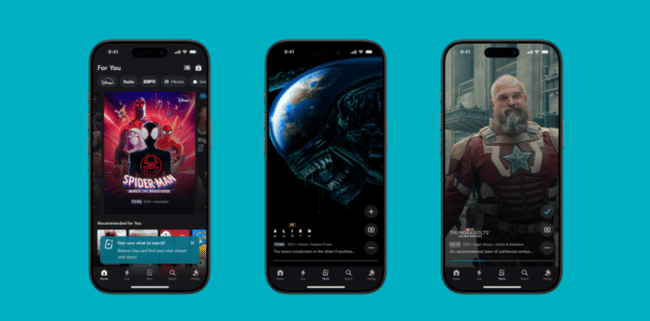
Disney+ is rolling out Verts, a vertical short video feed in its US mobile app that lets users swipe through bite-sized scenes from movies and series in a TikTok or Reels style interface. The goal is to get people opening the app more often, pull in younger mobile-first viewers and surface more of Disney’s 100 year catalog that might otherwise stay buried in menus.
Disney says early tests of Verts on Disney+ and ESPN in August led to measurable increases in user engagement, which it attributes largely to a new recommendation algorithm that personalizes the clips each viewer sees. For now the feed focuses on promotional snippets from existing content, but the plan is to add creator-driven videos, new formats and more personalized experiences, which could turn Verts into a meaningful way to monetize time in the app through ads, partnerships and future bundled offers rather than just another discovery gimmick.
What Verts can bring to Disney+ in numbers
How Verts works: instead of static previews, it launches a stream of short clips straight away. This has several direct effects.
Increases time spent in the app (more swiping, more clips before leaving).
improves the conversion from "browse" to "watch" by instantly going from clip to full playback.
Increases depth of catalog usage by pulling out older and less visible titles.
Disney has already reported from internal tests that Verts leads to additional engagement(user engagement rate) on both Disney+ and ESPN, suggesting a higher number of running titles or longer watches per user. In an environment where the streaming business is fighting for every minute of attention, and where ARPU is stagnant, such an increase in in-app time is essential for any additional monetization.
Monetization: from retention to advertising to licensing
In the short term, the most important thing is that Verts can boost subscriber retention. A user who opens the app for just a few minutes a day and "proscrolls" a few clips is more likely to remain a subscriber than one who only turns on the service occasionally for a single series. Higher retention directly reduces churn and increases customer value without having to increase the price.
The second level is advertising monetization. Disney+ already has an advertising tariff in the US and short vertical videos are an ideal format for:
Short, unskippable spots between clips.
Sponsored vertical "moments" (linking brands to specific IP, e.g. Marvel, Star Wars).
Dynamic product placement and interactive elements in the future.
Once Verts collects enough data on clip viewing, Disney $DIS can add targeting by fandom: a different mix of content and ads for the Marvel fan, another for families, another for the sports audience via a link to ESPN. This brings Disney closer to the social networking model, where the feed is the primary ad inventory.
The third level is licensing and cross-promo. Verts can serve as a storefront not only for titles on Disney+, but potentially for:
cinema releases (trailers, "first look" clips).
Parks and experience products (short spots from Disneyland and Disney World).
merchandising (viral moments promoting sales of toys and other products).
This allows Disney to shift some of the marketing budget to its own ecosystem, rather than paying external platforms like TikTok or Instagram to distribute clips.
Vertical video as a ticket to a younger audience
Disney+ isn't the only streamer testing a vertical feed, Netflix $NFLX is following a similar approach , but Verts is significantly more inspired by the TikTok model. The goal is clear: to reach younger users who typically spend time in the short clip feed and have a higher barrier to entry for classic long formats.
Disney has a major advantage in the strength of its brands. A short vertical clip with brand certainty (Star Wars, Marvel, Pixar, Disney Animation) has a much higher chance of grabbing attention than anonymous content. If Verts can:
Turn a short clip into a follow-up to an entire movie or series.
While keeping the experience safe and predictable for families.
It can become an addictive "elevator" to the catalog of movies and series for a generation that otherwise lives in foreign apps. This is an indirect but very important way to increase lifetime value among younger generations who may become long-term subscribers.
How big a contribution can Disney make to growth
There is no direct number yet on how much Verts will add to Disney's revenue. But the logic of the effect looks like this:
Higher engagement per user increases the likelihood of long-term subscriptions.
Higher retention reduces marketing costs to acquire new customers.
more in-app time increases advertising inventory on Disney+ with ad rates.
In an ideal scenario, Verts can add a few percentage points to the average time spent on Disney+, which in turn translates into higher ARPU per user with an ad tariff and lower churn across the base. For a company the size of Disney, this is not a revolution in one quarter, but a structural shift that will manifest itself over a period of years in the form of a more stable and better monetized streaming business.
In addition, Verts is creating the technology and data foundation for other forms of monetization:
Personalized fan experiences.
Connections to ESPN sports content and future packages.
testing short original formats that can live only in the feed without the high cost of full-length series.
Risks and limits
The main risk is user fatigue with vertical feeds. Unless Verts is significantly different from TikTok or Reels, users may prefer to open "original" and Disney+ will remain primarily a long-form content app. In that case, the benefit to growth will be limited.
Another risk is the balance between short and long content. If a feed of short clips starts to "cannibalize" the time users spend watching full movies and series, this could negatively impact the perceived value of subscriptions. Thus, Disney needs to carefully manage the algorithm so that Verts acts as a ramp-up, not a substitute for long-form content.
From a monetization perspective, how quickly and how aggressively Disney integrates advertising into the feed will be key. Too early or intrusive formats can harm the user experience, while an overly cautious approach will reduce the financial benefit.
What to watch next
The following signals are important to investors:
Whether Disney starts sharing specific engagement metrics (time in feed, transitions to full titles) with Verts.
How quickly and in what form Verts will expand outside the U.S. and to other devices.
when and how ad formats and possibly sponsored content will appear in the feed.
what place Verts will have in Disney's communication to the market (whether it will remain a "feature" or become one of the main pillars of the streaming strategy).
The most important variable is whether Verts will become a true attention hub within Disney+, picking up time and recommending content in a structured way, or just another add-on in the already crowded world of vertical videos. If the former scenario succeeds, it could contribute to more stable ARPU growth and reduced churn over the next few years, which is key to valuing the streaming part of Disney today.