


Why Have Corporations Replaced Consumers as the Engine of U.S. Growth?

For a whole decade one rule governed the American economy — the consumer pulled the train. Two-thirds of GDP was made up purely by consumers with a credit card, a mortgage, and a taste for shopping. Economists treated it like a law of nature. Then Q1 2026 arrived and quietly buried that belief.
For the first time in the modern era, corporate investment — especially in artificial intelligence — contributed more to GDP growth than household spending. This is not a coincidence but a shift that is rewriting the rules of the U.S. economy.
The Era When Railroads Dominated the 19th Century
To understand why this moment is so significant, we need to go back about 130 years.
In the 1890s, America was in the midst of a railroad boom. Private capital poured into building tracks, telegraph lines, and industrial infrastructure at an unprecedented pace. Consumers were not the engine of growth then — industrial capital investment was. Firms built, invested, and expanded as much as they could. The result was that the U.S. overtook Britain as the world’s largest economy.
Then the electrical revolution came in the 1920s and 1930s, and the same story repeated. $GE, $T massively invested in infrastructure that the market initially didn’t understand and called a gamble. In hindsight, it proved to be the foundation of prosperity for decades to come.
Today we are witnessing a third such wave. Only instead of rails, data infrastructure is being laid.
What Actually Happened in Q1 2026
U.S. GDP grew by 2% in the first quarter. On the surface, a solid number. But you need to look under the hood.
Corporate investment contributed 1.48 percentage points to growth. Consumer spending contributed just 1.08 points. This is a historic reversal. The consumer, who accounts for 68% of the entire U.S. economy, has lost the role of growth driver.
Consumers slowed because of geopolitical fear. The war in Iran created an energy shock, oil prices jumped, households started to tighten their belts, and goods spending fell by 0.03 percentage points. Moody's analysts described it precisely: household spending is "more exposed to the risk from energy price pressures due to the Middle East conflict."
This is exactly the type of geopolitical risk I have been warning about repeatedly. The conflict in Iran is a direct hit to the American consumer’s wallet. If the war escalates or drags on, that 1.08 percentage points from consumption could shrink further.
But back to the good news.
The corporate side is holding — and strongly. $META, $MSFT, $GOOG and $AMZN together announced in their Q1 results that their planned spending on AI infrastructure for 2026 exceeds $725 billion. A figure analysts were estimating at about $670 billion just a quarter ago.
An increase of $55 billion in just a few months.
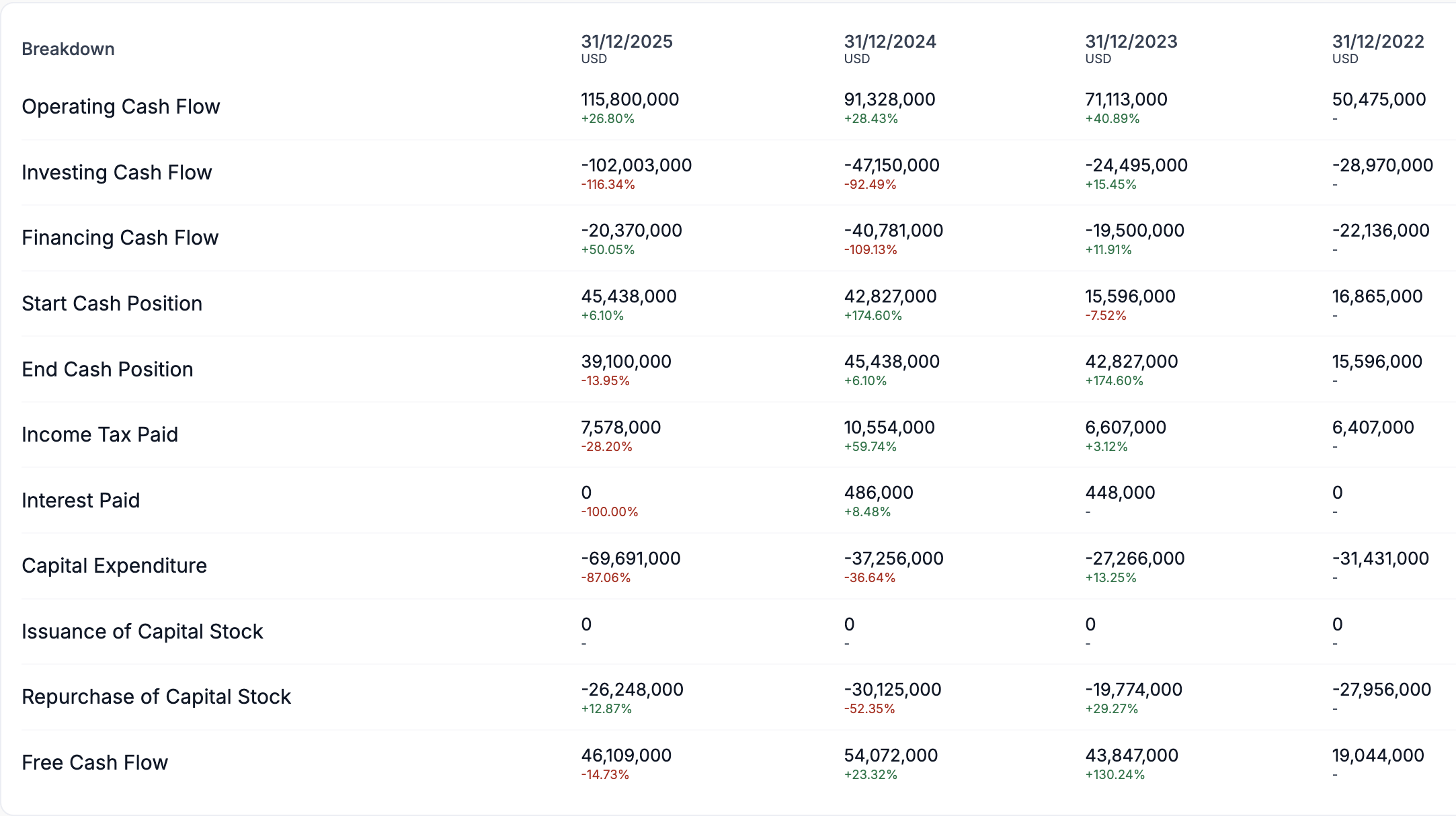
Capital expenditures of $META.
To put it into perspective — $725 billion is larger than the GDP of the Netherlands or Saudi Arabia. It's one of the largest waves of private infrastructure investment in human history, unfolding in real time.
And economists are taking note. Jeffrey Roach, chief economist at LPL Financial, pointed to a parallel with the late 1990s. His words: the economy has "more to go here if the late 90s is any guide."
What Does This Mean for the Fed and Inflation?
Here’s the complication I have to call out plainly.
The PCE index — the inflation gauge the Fed watches most closely — rose 3.5% year-over-year in March. Core inflation, excluding food and energy, stands at 3.2%. Both figures were in line with expectations, so markets didn’t panic. But they are still clearly above the Fed’s 2% target.
What does this mean? The Fed won’t rush to cut rates. The geopolitical shock from Iran is pushing energy prices higher, and consumer inflation remains sticky. Paradoxically, a massive AI capex boom can add to inflation in the short term because it heats up the labor market in certain segments.
Vojta's Thoughts
I’ll admit this data point didn’t surprise me, but it did please me, because it finally confirms something I’ve been following for much longer.
The market has been divided for a long time. One camp said: "AI is just hype, similar to the dot‑com bubble." The other said: "This is a transformational technology that will change the productivity of the entire economy." I was and remain in the second camp — not because I’m naively optimistic, but because I’ve seen how much money is physically flowing into data centers, infrastructure, and chips.
And now we see it in the macro data too. Corporate investment is pulling GDP more than the consumer.
What truly keeps me alert, though, is the war in Iran. The energy shock is real and consumers will feel it. If the conflict expands or oil stays expensive, we’ll get a scenario where AI infrastructure grows but consumers pull back. That points to a mildly stagflationary undertone — a moment when GDP is "artificially" inflated by corporate investment while inflation rises and consumers buy more expensive goods.
That’s why I bet on diversification. $AMZN is a key position in my portfolio. It’s exactly the kind of company that sits on both sides of this story. AWS powers AI infrastructure. Its retail and consumer segments depend on a healthy consumer.
For now, AI capex is winning. And that’s enough for me to stay in position.
The American economy is undergoing a quiet transformation. The consumer is handing the baton to corporate investment in AI infrastructure. Historical parallels with the industrial revolution are clear: these structural transitions tend to be lengthy, winding, and full of short‑term pain. But in the end they rewrite the rules of the entire economy.
But I’m curious — which side are you on? Do you believe in an AI boom, or are you skeptical and think AI is just hype?