
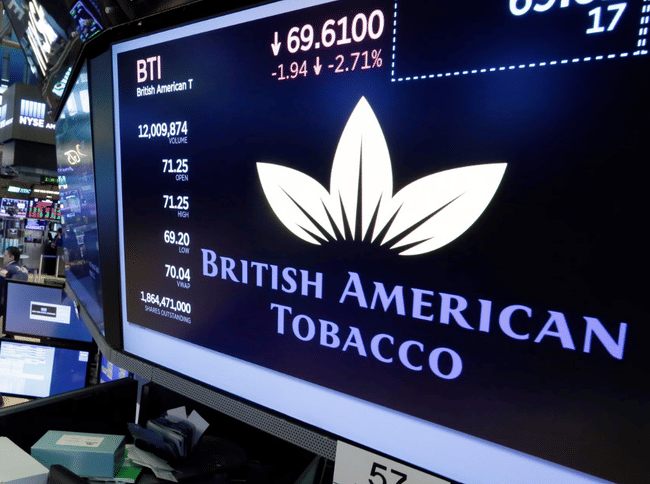
British American Tobacco is once again demonstrating why tobacco stocks have long been among the most attractive dividend-paying stocks on the market. Although the company operates in an industry facing regulation, declining cigarette sales, and social pressure, it continues to generate massive cash flow, increase its dividend, and scale its growth.
A company that still knows how to raise prices
$BTI owns brands such as Lucky Strike, Dunhill, Pall Mall, Kent, Vuse, Velo, and glo. Its greatest strength lies not in rapid sales volume growth, but in pricing power. In other words, even though fewer traditional cigarettes are being sold worldwide, the company is able to raise prices so significantly that it offsets part of the volume decline.
This is the main reason why tobacco companies have historically survived even in an environment that would be extremely challenging for most other sectors. Consumers are heavily dependent on the product, brands enjoy high loyalty, and margins remain very high. For an investor, this means one thing: BAT is not a growth stock in the style of tech companies, but rather a cash cow.
New categories are driving growth
The most important news in recent years is the shift in management’s outlook on new categories. BAT now expects revenue from products like Velo, Vuse, and other alternatives to traditional cigarettes to grow at a rate in the high double digits by 2026. Previously, the company had anticipated only low double-digit growth.
This is crucial because it is precisely these new categories that will determine whether BAT remains merely a dividend stock from the old tobacco world or manages to transform itself into a more modern nicotine company. The Velo nicotine pouches are attracting the most attention, growing across regions and, according to the company, further strengthening its global share in the modern oral category .
Dividend
$BTI is not a stock that investors buy primarily for double-digit annual revenue growth. Its main appeal lies in the combination of dividends, share buybacks, and stable cash flow.
The company announced a dividend of $3.28 per share for 2025, to be paid in four equal quarterly installments of $0.82. In addition, there is a share buyback plan totaling approximately $1.74 billion (1.3 billion pounds) in 2026.
The dividend yield alone is over 5%, but when buybacks are factored in, the total return on capital is even higher. It is also important to note that the company expects an operating cash conversion rate above 95% and aims to reduce debt to a target range of 2.0 to 2.5 times net debt to adjusted EBITDA by the end of 2026.
Comparison with Competitors
BAT’s closest competitors are Philip Morris $PM International and Altria $MO. Philip Morris is currently considered the leader in smoke-free products, mainly thanks to IQOS and Zyn nicotine pouches. Its advantage lies in the fact that it has already shifted a large portion of its business from cigarettes to alternatives.
Altria, on the other hand, is more focused on the U.S. market, and its main investment appeal lies in its very high dividend. According to Barron’s, Altria became one of the highest-yielding dividend stocks in the S&P 500 last year, with a yield of nearly 8%.
BAT falls somewhere between these two companies. It has stronger global diversification than Altria, but it lags behind Philip Morris in the smoke-free transformation. On the other hand, it offers a higher dividend yield than most typical defensive stocks, and its valuation still does not appear extremely expensive.
The problem with traditional cigarettes hasn’t gone away
The risk of a decline in traditional cigarette volumes remains. BAT itself expects global volumes in the cigarette industry to fall by roughly 2.5% in 2026, which is worse than the previous estimate of a 2% decline.
This means that pricing power, in the form of price increases, must continue to work at full capacity. If regulations, taxes, or consumer behavior were to accelerate the decline in volumes faster than the company can raise prices and grow in new categories, the stock could weaken.
Strategic View
The company is a typical stock for investors seeking high cash yields who are willing to accept sector-specific risks. A yield exceeding 5% is no coincidence. The market is thus pricing in the uncertainty surrounding regulation, litigation, the decline in smoking, and the long-term future of the tobacco business.
At the same time, however, few companies have such a strong ability to generate cash. Even with modest revenue growth, BAT can pay a high dividend, buy back shares, and reduce debt. This is a combination that, in an environment of higher interest rates, may appeal more to investors than the stories of companies dependent on cheap capital.
However, the company’s shares have managed to strengthen significantly in recent years and, following the 2018 slump and a long period of sideways movement, have sparked a new upward trend. Given that the share price is currently 70% higher than it was at the beginning of 2025, the stock is currently overvalued, according to the Fair Price Index on Bulios.
British American Tobacco remains a controversial but financially very strong stock. On one hand, there are regulations, declining smoking rates, and ethical concerns. On the other hand, there is a dividend yield above 5%, tremendous pricing power, strong cash flow, share buybacks, and accelerating growth in nicotine alternatives.
It is precisely this combination that makes BAT an attractive stock for investors who are not looking for a trendy growth story, but rather a stable cash flow. The shift toward products like Velo and Vuse will determine whether the company can transform itself from the tobacco giant of the past into the nicotine leader of the future.