
Elon Musk's rocket company went public last week in the largest IPO in stock market history, raising $85.7 billion and vaulting SpaceX past Amazon into the world's top five most valuable companies. Then, before the dust even settled, SpaceX announced a $60 billion all-stock acquisition of Cursor, an AI coding assistant used by 64% of Fortune 500 companies. The deal marks the largest acquisition of a VC-backed startup on record. Paying in freshly inflated stock, Musk is moving fast and the market is moving with him.
The Largest IPO in History—and a Surprise on Day One
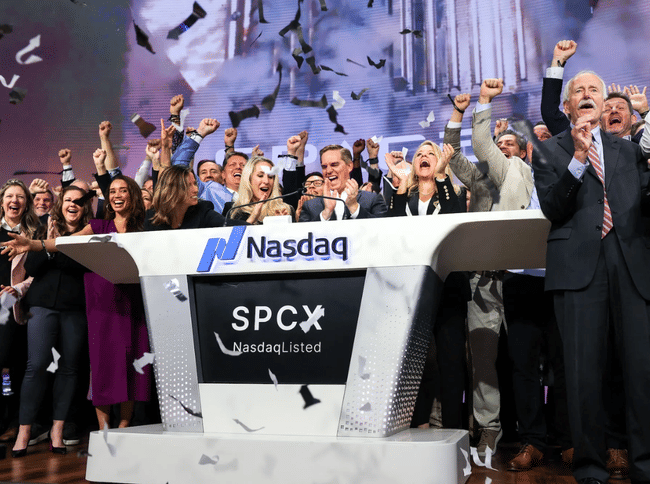
When SpaceX went public on the Nasdaq on June 12 under the ticker symbol $SPCX, no one doubted it would be a major event. Few, however, expected it to turn into such a frenzy. The IPO was priced at $135 per share, raising $75 billion —and underwriters immediately exercised the greenshoe option, causing total proceeds to jump to $85.7 billion. They broke the record set by Saudi Aramco in 2019.
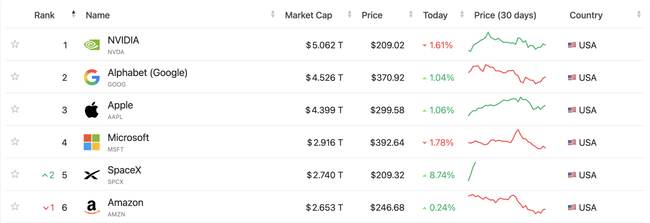
On the very first day, the stock rose 19% and closed at $161. On the second day, they gained another 14%, with the price exceeding $220 and market capitalization approaching $2.85 trillion. Neither Amazon ( $AMZN) nor Microsoft ( $MSFT)—which SpaceX briefly surpassed during the day—could match that.
How a Rocket Company Becomes a Tech Giant
For a long time, SpaceX was seen as a space company that “just happened” to launch satellites. The key growth sector is Starlink — satellite internet with more than 7,500 satellites in orbit and hundreds of millions of potential customers in areas without fixed-line connectivity.
Over the past twelve months, the company reported revenue of $19.3 billion, with Starlink driving that growth. Analysts estimate that the satellite division could account for a significant portion of the global broadband market by 2030 in areas where other infrastructure is lacking.
It is interesting to note how investors value SpaceX compared to its competitors:
Price-to-sales (P/S) ratio at a $2 trillion valuation: 104x
Rival $ASTS AST SpaceMobile: 409x revenue
$RKLB Rocket Lab: 123x revenue
SpaceX is therefore relatively “cheap” compared to smaller players in the industry —even though it generates many times more revenue than both of the aforementioned competitors combined.
"One of the things that makes SpaceX so valuable is precisely its high valuation. The acquisition of Cursor results in significantly less dilution of shares thanks to its high market capitalization."
Bill Ackman in his post on X.
Cursor: A $60 Billion Bet on AI
Four days after the IPO, a surprise emerged. SpaceX announced the acquisition of Anysphere —the creator of the popular AI coder Cursor —for $60 billion in stock. The entire transaction is an all-stock deal: SpaceX is not paying cash but will issue new shares, with the exact number depending on the average price $SPCX over the seven days prior to the closing of the deal.
Musk’s AI division, xAI, had essentially fallen apart by June 2026— all 11 co-founders had left by March, and Musk himself admitted that xAI “wasn’t built right and is being rebuilt from the ground up.” Instead of organic growth, the company bet on quickly buying its way into the market.
Yet Cursor is more than just hype. The 2022 startup surpassed $100 million in annualized revenue last year, reached $2 billion this year, and, as of the acquisition announcement , was generating over $4 billion in annualized revenue with rapid growth in the enterprise segment. Meanwhile, Anysphere had just finalized a funding round from Andreessen Horowitz, Thrive, and NVIDIA at a $50 billion valuation—SpaceX outbid them by $10 billion.
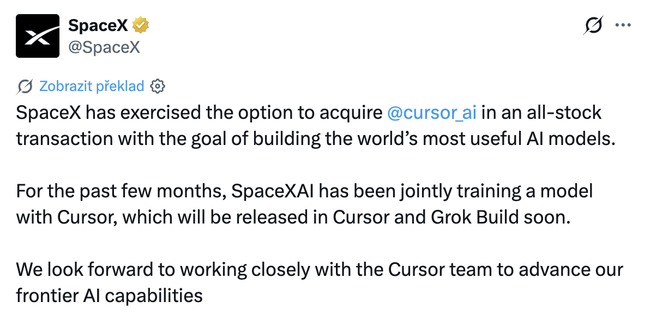
The transaction is expected to close in the third quarter of 2026. Cursor will become part of the xAI division, and its models will be trained on Musk’s Colossus infrastructure.
"In today’s announcement, SpaceX is launching SPCX options trading, offering investors another tool to bet on the future of the newly listed stock."
CBOE, press release, June 16, 2026
Locked-Up Shares and What Comes Next
The euphoria of the first few days has one catch: only about 4% of SpaceX shares are currently freely tradable. Musk’s stake is locked up for 366 days. A broader release of shares will begin after the release of Q2 2026 earnings —at that time, up to 20% of the so-called "Early Release Eligible Shares" may be released, with an additional 10% unlocking if the stock closes at least 30% above the IPO price on 5 of the last 10 trading days prior to that date.
At the current price of over $220 (i.e., 63% above the IPO price of $135), the second condition is realistic —but the release of these shares will put downward pressure on the stock price. How strong that pressure will be depends on market appetite.
Also on the horizon is inclusion in the Nasdaq-100, which would make SpaceX accessible to index funds and passive capital —an estimated additional $7–10 billion in purchases.
The only thing SpaceX hasn’t managed to leapfrog yet are the three companies with valuations exceeding $4 trillion: Nvidia $NVDA, Apple $AAPL, and Microsoft $MSFT in full force. But the pace at which Musk’s company is rewriting the rankings suggests that even that may not last forever.