
Beyond Meat once promised a revolution both on the plate and on the stock market. Today, its stock is trading for less than a dollar, and the CEO says, “This just isn’t the right time for plant-based meat.”
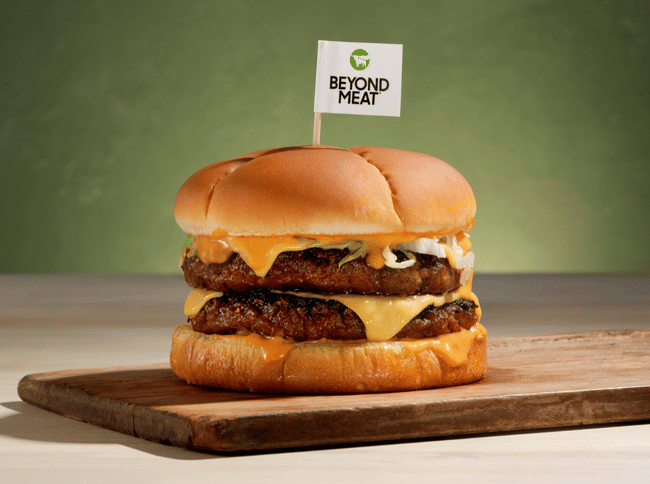
The best IPO in two decades was followed by a free fall
In May 2019, Wall Street embraced a new era of food. $BYND Beyond Meat debuted on the Nasdaq with an offering price of $25, but on its first trading day, the stock soared to $65.75—a 163% increase. It was the strongest IPO by an American company in nearly two decades. By July of that year, the stock had reached nearly $235. Its market capitalization exceeded $13 billion. Investors, celebrities, and food giants like Tyson Foods were betting that plant-based burgers would replace beef.
On paper, it made sense. Global interest in meat alternatives was growing; a pea-based burger could actually resemble the real thing, and McDonald’s was testing the McPlant. Beyond Meat’s revenue in 2020 reached $407 million, up 37% year-over-year. It seemed like the story was writing itself.
Today, the stock is trading below one dollar. Over the past seven years, it has lost over 99% of its value.
The COO Who Bit a Customer on the Nose
The company didn’t just lose investor favor—a bizarre scandal straight from the executive suite also contributed to its loss of reputation. In September 2022, Doug Ramsey, then COO of Beyond Meat, was arrested. According to the police report, he punched the rear window of a stranger’s car in a parking garage after an American football game—and then physically assaulted the driver and bit him on the nose so hard that he injured the soft tissue.
Beyond Meat immediately suspended Ramsey. The irony of the situation was impossible to overlook: the chief operating officer of a company whose entire brand was built on humanity and ethics was charged with making terrorist threats and third-degree assault. Ramsey left the company shortly thereafter.
The scandal came at the worst possible time. By 2022, the stock had already fallen by more than 70%; the company was announcing mass layoffs, and other top executives were also leaving.
"Beyond Meat is currently facing an exceptionally challenging combination of problems—a slowdown in demand for plant-based meat, growing doubts about the health profile of its products, and internal failures at the management level. This is a very difficult situation to turn around."
Alexia Howard, analyst at Bernstein Research
Why Customers Stopped Buying
The reasons for the decline aren’t limited to a single scandal.
Taste: Critics and consumers have repeatedly pointed out that Beyond Meat’s products failed to meet taste expectations despite intense marketing.
Price: The plant-based burger was more expensive than beef without offering adequate value in the eyes of most customers.
Health Concerns: The products are highly processed, which began to clash with the “clean label” trend and skepticism toward ultra-processed foods. CEO Ethan Brown himself says the company is facing a disinformation campaign from the meat industry —but some consumers have simply stopped believing that plant-based burgers are healthy.
Macroeconomics: Rising food prices have prompted customers to seek out cheaper alternatives, and plant-based proteins were not among them.
Revenue for 2025 fell to $275.5 million —a 15.6% year-over-year decline and roughly back to 2019 levels, when the company was just going public. For the full year, the company posted an operating loss of over $330 million. In the first quarter of 2026, revenue fell another 15.3% to just $58.2 million—the weakest quarterly figure since the IPO.
Billions in Debt and the Threat of Delisting
A debt problem cast a long shadow over the entire company. In 2021, Beyond Meat issued over $1 billion in convertible bonds maturing in March 2027.However, these bonds were trading on the secondary market for roughly 17 cents on the dollar —the market had bet from the start that the company would not be able to repay even a portion of them.
In September 2025, the company announced a debt restructuring: it exchanged more than $800 million in old bonds for new ones, maturing as late as 2030, in exchange for issuing hundreds of millions of new shares. For existing shareholders, this meant massive dilution. The stock fell 17.7% that day. By the end of 2025, the company’s share price had fallen below one dollar, and it must now fight to meet the requirements for remaining on the Nasdaq.
Was the Renaming a Rescue or a Surrender?
In March 2026, the company took a step that many view as a symbolic admission of defeat. Beyond Meat rebranded itself as Beyond The Plant Protein Company. The word “meat” disappeared from the name.
The company is banking on a new product—the functional protein drink Beyond Immerse, a carbonated beverage containing 20 grams of plant-based protein.It targets athletes, users of GLP-1 medications, and the younger generation. Distribution has so far begun in New York.
“We believe that our brand and technology can bring the value of plant-based proteins to a much broader range of categories than just meat.”
Ethan Brown, founder and CEO of Beyond Meat, Q1 2026 earnings call
Whether this will be enough is a question to which the numbers provide an unfavorable answer: the operating margin in the first quarter of 2026 reached -70.6%. The company generates a loss of seven dollars for every ten it earns.
A meme stock with a value close to zero
Spring 2025 was also an interesting chapter, when Beyond Meat briefly became a meme stock. The stock soared by more than 1,600% over four trading days, driven by coordinated buying by retail investors on social media —much like GameStop $GME or AMC $AMC a few years earlier. But the short-term momentum, lacking any fundamentals, quickly fizzled out. Short sellers returned, the dilution from the debt restructuring weighed on the stock, and the share price returned to its previous levels.
Today, $BYND is trading around $0.70. Analysts have a consensus “Sell” recommendation. The company has fewer than 600 employees. When asked whether the promise made seven years ago at the time of the famous IPO has been fulfilled, CEO Brown replies, “We still have a long way to go.”