
When the U.S. Federal Reserve announced today that it was keeping its benchmark interest rate in the 3.5% to 3.75% range, it seemed at first glance to be a dull meeting without any major surprises. The market had anticipated this, and the decision itself didn’t catch anyone off guard. Nevertheless, stocks fell sharply. What did investors read between the lines?
As recently as March, most Fed members anticipated at least one rate cut this year. However, the new projections revealed fundamental shifts. Nine out of eighteen members of the Monetary Policy Committee now expect rates to rise by the end of the year.
This is a dramatic shift in just a few months. The markets reacted immediately. Investors began to factor in the possibility of further monetary tightening, and stock prices headed lower. The scenario of cheaper money, which the markets were still betting on back in the spring, is beginning to unravel.
What Changed the Fed’s Mind
Once again, the main reason is inflation.
Since the outbreak of the conflict in the Middle East, energy and oil prices have risen sharply. These higher costs have gradually trickled down into the entire economy, andU.S. inflation rose to 4.2% in May—the highest level in the last three years. The Fed has therefore significantly revised its outlook.
While in March it expected this year’s inflation to be around 2.7%, it now forecasts a rate of 3.6%. Core inflation, which excludes energy and food prices, is also projected to remain above 3% according to the new projections . This is still well above the central bank’s 2% target.
At the same time, the Fed has slightly lowered its economic growth forecast and continues to expect unemployment to hover around 4.3%. This creates an uncomfortable combination of a slower economy and higher inflation—an environment in which central bankers find it most difficult to make decisions.
Some relief came with the weekend announcement of a ceasefire between the U.S. and Iran. The price of oil fell immediately, and normal traffic in the Strait of Hormuz is expected to resume. The question remains whether this decline will come quickly enough to change the Fed’s inflation outlook.
New Chair Brings a New Style
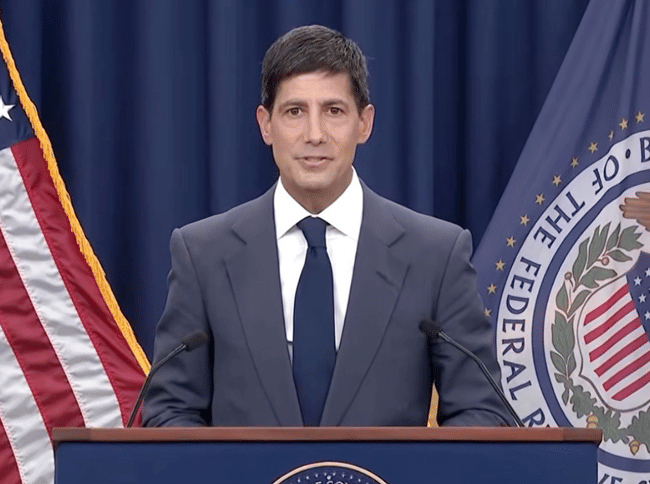
At the same time, this was the first meeting chaired by Kevin Warsh, who replaced Jerome Powell as head of the Fed last month.
During his tenure, Powell regularly prepared the markets for the central bank’s future moves. Investors often knew in advance the direction monetary policy was likely to take.
Warsh is taking the opposite approach. He has repeatedly criticized the market’s overreliance on so-called forward guidance and has indicated that the Fed will not hold investors’ hands. He has not even published his own forecast for future interest rate movements in the traditional dot plot and has refused to confirm that he will hold a press conference after every meeting.
He draws inspiration from former Fed Chair Alan Greenspan, who was renowned for deliberately providing the markets with only minimal guidance.
“The Fed will ensure price stability. Our commitment to this is strong, unanimous, and unquestionable.”
Kevin Warsh, Fed Chairman
This emphasis on inflation was the main message of his first press conference. The paradox of the whole situation is that Warsh was nominated for the position with the expectation that he would support the economy through a more accommodative monetary policy. Instead, he is taking office at a time when the Fed is once again beginning to discuss the possibility of higher rates.
The markets received a clear message
The reaction of the financial markets was textbook. The S&P 500 index fell by more than one percent following the release of the forecasts. The yield on the two-year U .S. Treasury note jumped by approximately 16 basis points to 4.21%, its highest level in more than a year. The dollar also strengthened, while gold lost over 2%.
This was not a reaction to the decision itself to keep rates unchanged. Investors were surprised primarily by the Fed’s tone.
The central bank made it clear that fighting inflation remains its top priority and that it is prepared to sacrifice some economic growth if necessary to restore price stability.
“Markets were prepared for higher rates, but the new projections suggest that the Fed may remain hawkish longer than investors expected.”
Analyst Bret Kenwell from the eToro platform
So it’s not that the Fed didn’t change rates. It’s that just a few months ago, the market was expecting them to fall, while today it is once again bracing for the possibility of the opposite scenario.
For global investors, this means one thing: as long as the U.S. central bank is willing to keep rates high—or even raise them further—U.S. bonds and the dollar will attract capital from around the world. This puts pressure on stocks, cryptocurrencies, and other risky assets.
The coming months, therefore, will not be all about the Fed. Oil, inflation, and developments in the Middle East will be just as important. If energy prices fall back down, the debate over rate cuts may reopen. If not, this meeting will be remembered as the moment when the market definitively bid farewell to the idea of cheap money coming anytime soon.