
Amazon is no longer just a customer of Nvidia—it wants to become its competitor. Sales of Trainium chips to third-party companies could generate up to $50 billion a year.
When your biggest customer starts doing the same thing you do
Nvidia $NVDA has been profiting for years from a simple fact: anyone who wants to train large AI models has to pay for its GPUs. This logic worked with almost mathematical precision— cloud giants bought chips worth tens of billions of dollars and passed the costs on to their customers. Amazon $AMZN was one of the largest buyers.
That is now changing. Amazon is in talks to sell its own Trainium chips to external customers—that is, companies that would run them in their own data centers, outside of the AWS infrastructure. Amazon CEO Andy Jassy has called this “entirely possible,” and according to available information, negotiations with potential partners are already at an advanced stage.
For Nvidia, this represents a qualitatively new type of competition. Until now, it has faced rivals such as AMD $AMD or Intel $INTC —that is, other chip companies. Now, a company with its own cloud infrastructure, its own customers, and direct access to the world’s largest AI projects is entering the fray.
What Trainium Can Do and How Much It Costs
Amazon develops Trainium chips through its Annapurna Labs division, which it acquired in 2015. What began as modest processors for simple computations have, over several generations, evolved into tools capable of training the most demanding AI models.
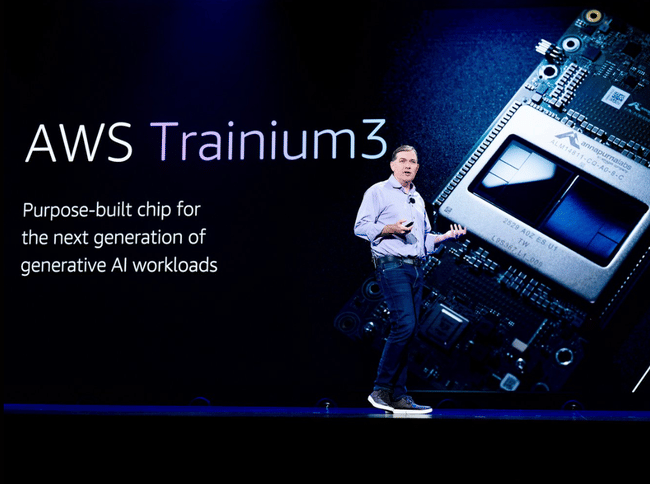
The third generation— Trainium3 —began shipping at the turn of 2025 and 2026. Amazon claims it is four times more powerful than its predecessor , Trainium2, and reduces training and inference costs by up to 50% compared to conventional GPUs. The fourth generation, Trainium4, which is set to arrive in about 18 months, will also be able to work directly with NVIDIA chips—not to replace them, but to complement them.
A key figure from an investor’s perspective: Amazon’s chip division (Trainium, Graviton, Inferentia, and Nitro combined) exceeded an annual run rate of $20 billion in the first quarter of this year, with triple-digit year-over-year growth. Jassy estimated that if sold externally at market prices, the chips alone could generate annual revenue of around $50 billion.
One developer recently publicly compared Trainium2 to the NVIDIA H100 and measured cost savings of around 35%. That’s a figure that will give any data center operator pause.
Customers Who Have Already Made the Switch
Amazon aren’t just talking for the sake of it. Among the customers actively using Trainium are names no one expected:
Anthropic operates over 500,000 Trainium2 chips as part of the Rainier project and plans to expand to more than one million units for both training and inference
OpenAI has committed to purchasing capacity equivalent to two gigawatts of power from Trainium’s infrastructure on AWS starting in 2027
Meta $META uses Trainium and Inferentia for production-scale AI inference
Uber $UBER was one of the first external partners to adopt Trainium3
Apple $AAPL is testing Trainium2 for pre-training its proprietary models
Total committed Trainium orders from clients have reached $225 billion, with virtually all Trainium3 capacity for 2026 already sold out.
"Demand is so high that we have to decide how to allocate capacity," Jassy said during the earnings call.
Andy Jassy, CEO of Amazon
What this means for Nvidia
Nvidia still holds roughly 80% of the AI accelerator market, according to IDC data.Its data center revenue exceeded $194 billion in the last fiscal year, and its outlook for 2026 and 2027 includes a backlog exceeding $1 trillion for the Blackwell and Vera Rubin architectures.
Therefore, there is no immediate threat in the short term. The CUDA ecosystem, which Nvidia has been building since 2006, is deeply embedded in every modern AI framework—switching to alternative hardware requires rewriting software stacks, a process that takes months or years. Although the market share of custom chips is growing— from 20.9% in 2025 to an estimated 27.8% in 2026 —the overall market is expanding so rapidly that it hasn’t hurt Nvidia in absolute terms yet.
"Nvidia will maintain its premium positioning thanks to its software ecosystem, but Amazon is systematically undermining its pricing power among cost-sensitive customers."
Ben Barringer, Head of Technology Research at Quilter Cheviot
The real threat is more structural. If the world’s largest data center operators —Amazon, Google $GOOG, and Microsoft $MSFT — invest heavily in their own silicon and start selling it externally, Nvidia will lose a portion of its most lucrative segment: high-volume contracts with hyperscalers. These companies are both its biggest customers and, now, its competitors.
This benefits Amazon in two ways
Amazon’s strategy has a two-pronged logic. First, in-house chips significantly reduce AWS’s operating costs —Jassy estimates savings in the tens of billions of dollars annually in capital expenditures and hundreds of basis points in operating margin compared to purchasing from Nvidia. This is an important signal for investors: Amazon plans $200 billion in capex this year, while free cash flow has plummeted from $38 billion in 2024 to $11 billion in 2025. The growing penetration of Trainium should reverse this trend.
Second, external chip sales add a new revenue stream that is unrelated to cloud services margins. Chip hardware is sold with different economic characteristics than cloud computing—and for Amazon, this would mean entering a segment currently dominated exclusively by Nvidia.
The question isn’t whether Amazon can displace Nvidia. It likely can’t—at least not in the foreseeable future. The question is how many billions of dollars in revenue it can divert from Nvidia to itself over the next five years. And that number could be large enough to impact both stocks.