


Intel stock rose by 170%. Now it bets on a chip without the most expensive part

Intel introduced a data center GPU that lacks expensive memory, liquid cooling, and kilowatt-level power draw. That very absence may be its strength—and at the same time the reason the market hasn’t yet bet a single dollar on it.
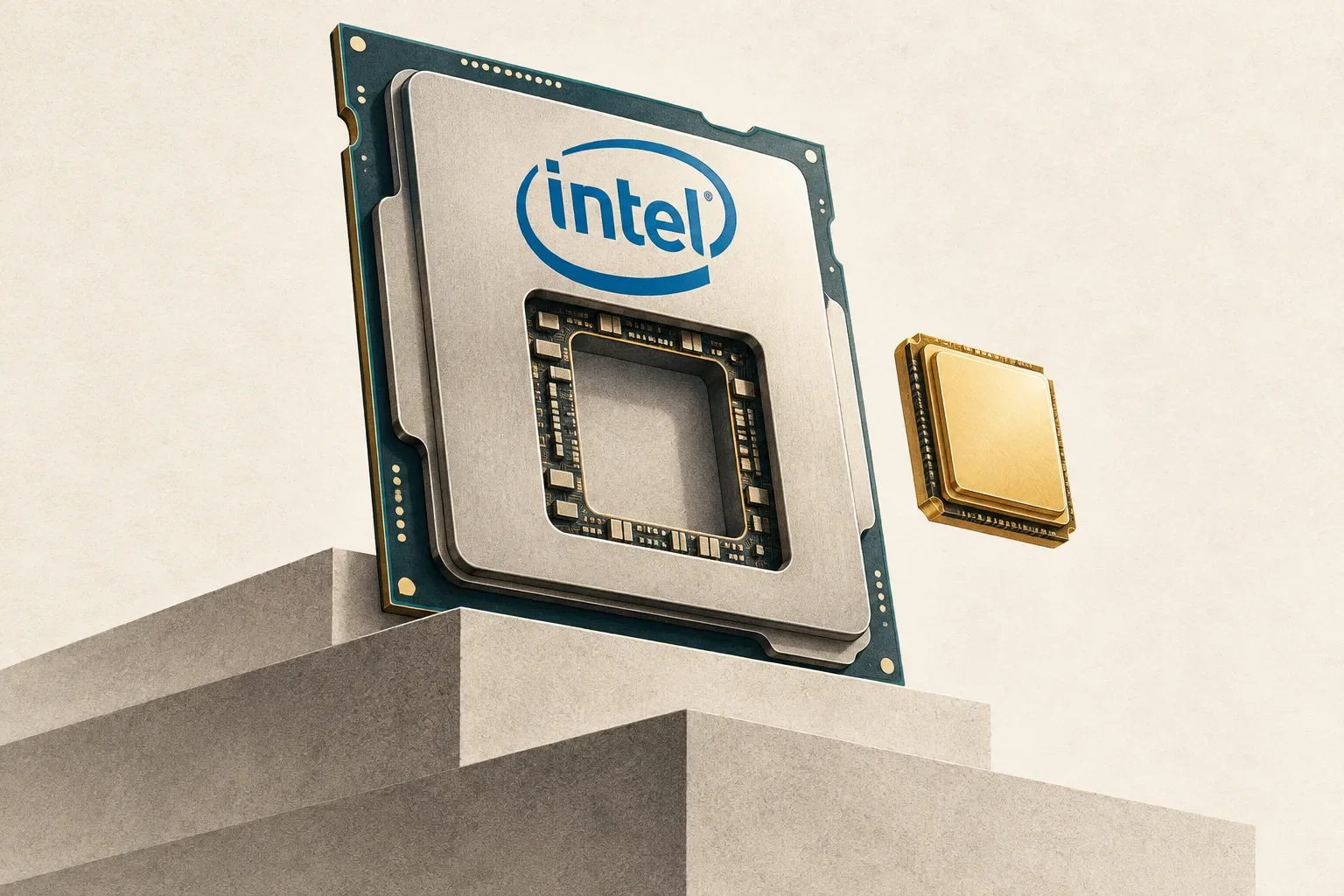
Key points
Intel introduced a data center GPU that lacks everything that currently makes AI chips expensive.
Two-thirds of AI compute in 2026 is heading somewhere other than where most investors are looking.
Nvidia first announced the same chip concept, then quietly removed it from its roadmap and brought it back in a completely different form.
Intel’s biggest competitor is also its most successful shareholder, with a stake worth about $22 billion.
Intel posted an $11 billion loss for the second quarter, for a reason that may not be obvious at first glance.
The chip whose greatest weapon is what it lacks
On October 12, Intel $INTC gave a name at the OCP Global Summit to a chip it had talked about for a year only under the codename Crescent Island. It is officially called the GPU D-series, and according to Intel’s announcement it offers up to 480 GB of LPDDR5X memory (the Intel-branded card 160 GB, larger capacities from partners), 1.5 TB/s bandwidth, and 1.3 PFLOPS peak FP8 performance. All in a PCIe card drawing 350 W, air-cooled.
At first glance, those are weak numbers. The revived Rubin CPX from Nvidia $NVDA is expected by analyst Ming-Chi Kuo of TF International to draw up to 2,300 W per chip, plus liquid cooling and a rack costing tens of millions of dollars. Intel instead chose slower but far cheaper LPDDR5X memory, the kind found in laptops, and gave up HBM, liquid cooling, and high power draw.
Think of it as the difference between a race car and a delivery van. The race car wins every sprint—that is, model training. But running a finished model is a delivery route: what matters is how much you can load, not how fast you cross the finish line. Intel claims a single D-series card can hold a model with roughly 300 billion parameters, and an eight-card server can handle over a trillion. For hyperscalers currently scrambling for HBM memory at any cost, that is an argument that cannot be ignored.