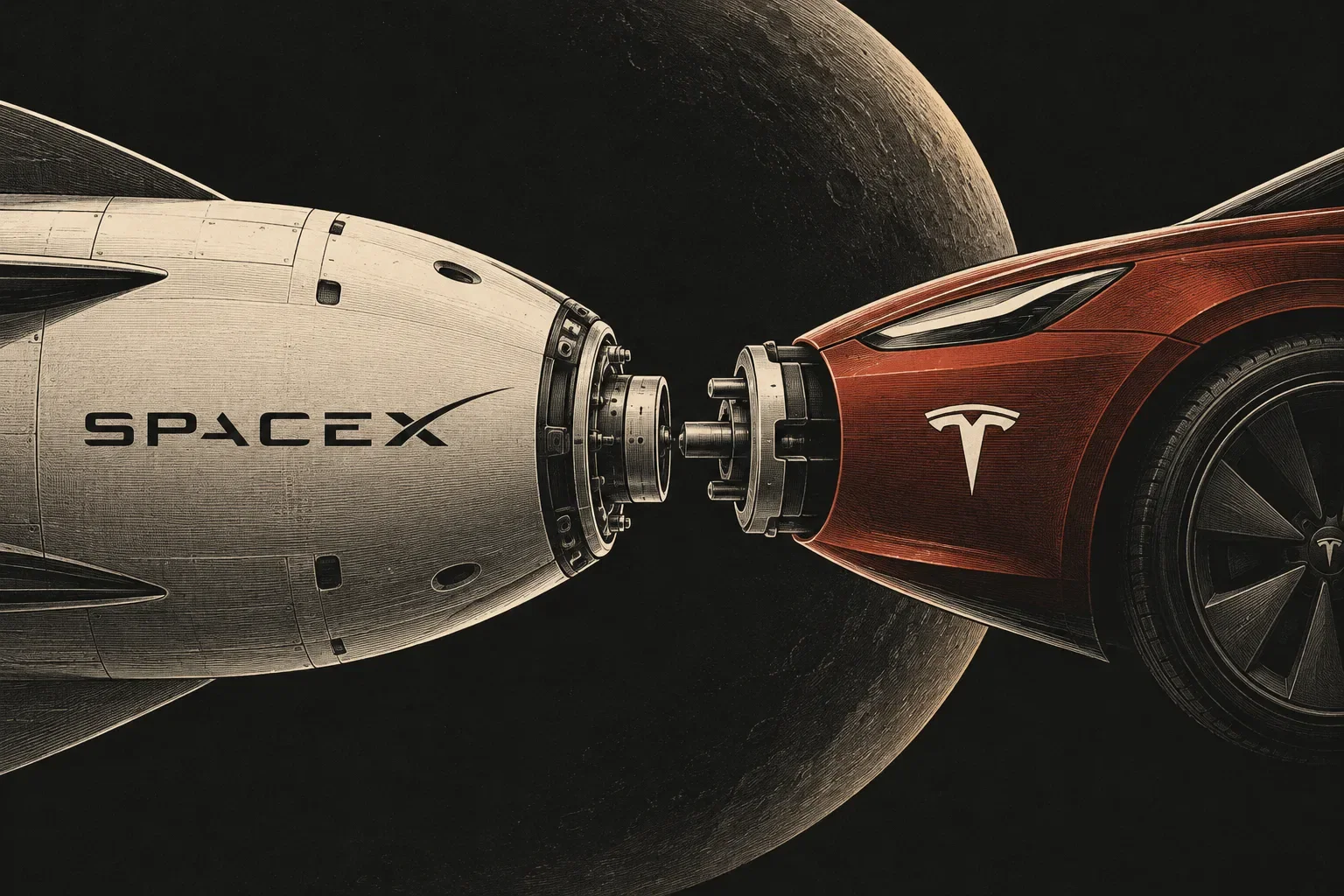
Wall Street now takes a SpaceX-Tesla merger as a given. It would create a giant valued at 3 trillion dollars

The merger of Musk's two largest companies is now viewed by Wall Street as the base case scenario. The timing of Tesla's shareholder meeting could be decisive. What would the merger mean for people who currently hold Tesla shares and would hold SpaceX shares tomorrow?
Key points
Tesla must call an annual shareholder meeting no later than December 6, and according to Barclays, this is the deadline by which the largest merger in stock market history could be decided.
In the combined company worth more than 3 trillion dollars, Musk would control 56% of the votes, more than double the stake he has long sought in Tesla.
Tesla shares would be converted into shares of SpaceX, a company that lost nearly 5 billion dollars last year. The final say belongs to shareholders who hold 80% of Tesla and do not belong to Musk.
Why December 6 is being discussed now
Tesla $TSLA called last year's annual meeting for November 6. The company has been headquartered in Texas since 2024, and local law requires shareholders to meet no later than 13 months after the previous meeting. That gives the date of December 6, 2026, which is now being mentioned on Wall Street more often than any other.
Barclays analyst Dan Levy wrote in a client note on Wednesday that the merger of Tesla and SpaceX $SPCX is increasingly becoming a consensus market expectation. He added timing logic. The regular shareholder meeting is, in his view, the most natural opportunity for Tesla shareholders to vote on the merger. However, to meet that deadline, the proposal would have to be on the table within a few weeks. If the announcement slips to late October or early November, this year's meeting will be missed and the vote will be postponed by six to twelve months. Completion of the merger itself would then take additional months even after shareholder approval.
Why should Musk care about speed? According to Levy, the current US administration plays a role, as it does not throw obstacles in the way of large mergers. But no one knows how long such a favorable environment will last.
The largest merger in history, in numbers
At a share price of around 363 dollars, Tesla has a market value of roughly 1.43 trillion dollars. The stock has lost over 19% since the start of the year. SpaceX, which sold shares at 135 dollars in June in the largest IPO in history, raising 75 billion dollars, is now trading around 146 dollars and has a value of just under 2 trillion dollars. Together, a company worth more than 3.3 trillion dollars would be created, one of the most valuable in the world.
Barclays assumes that the acquirer will be SpaceX, paying with its own shares. For a retail Tesla shareholder, that means one thing: their Tesla shares would be converted into SpaceX shares at a certain ratio. The owner of an automaker would become a co-owner of a rocket, satellite, and AI company without buying anything.
The key to the entire transaction lies in how much of what Elon Musk owns:
Tesla | SpaceX | Combined company (Barclays calculation) | |
|---|---|---|---|
Musk's equity stake | approx. 20% | approx. 48% | approx. 37% |
Musk's voting rights stake | approx. 20% | approx. 82% | approx. 56% |
Market value | 1.43 tril. USD | approx. 1.9 tril. USD | approx. 3.3 tril. USD |
Musk does not have a majority in Tesla and has long said he would like at least 25%. In SpaceX, thanks to Class B shares with ten times the voting rights, he has practically absolute control. The merger would give him 56% of the votes in the combined entity, more than double what he ever demanded in Tesla.
Musk no longer says no
Ten years ago, Musk described the ties between the two companies as very loose. This year he speaks differently. When asked on July 22 during the second-quarter earnings conference call by a Wells Fargo analyst whether he sees synergies in merging the companies, he replied that the overlap is growing, especially due to the Terafab project. He added that merger talks cannot be discussed on such a call and must go through a proper process.
Less than two months later, on September 15, he received a similar question at the All-In Summit in Los Angeles. Why are Tesla and SpaceX still two separate companies?
"With all that collaboration at so many levels, everyone can imagine what step one might take when the collaboration is that close in so many areas."
Elon Musk, CEO of Tesla and SpaceX, All-In Summit, September 2026
SpaceX President Gwynne Shotwell admitted on the day of the IPO that a merger could make Musk's life a bit easier. Investor Gene Munster of Deepwater Asset Management raised his estimate of the likelihood of a merger to 90% after the July call. On the prediction platform Kalshi, traders give a roughly two-thirds chance of a merger before 2028.
Terafab: the project that makes two companies behave as one
What physically binds the two companies is Terafab. In August, Tesla and SpaceX announced the location of their joint chip factory in Grimes County, Texas. The first phase is expected to cost 16.8 billion dollars, and the building with an area of over 100 million square feet (roughly 9 million square meters) would be the largest building in the world. The chips are intended to power Optimus robots, Cybercab robotaxis, and data centers that SpaceX wants to launch into orbit.
Every decision about Terafab currently must be approved by two boards. Musk himself admitted that it takes a long time. Such an operational friction point is a typical argument for a merger.
But there are more overlaps. Starlink is heading into all Tesla vehicles, the Grok chatbot into their onboard system, and SpaceX buys Cybertrucks. Tesla also holds a sub-one-percent stake in SpaceX, and in the second quarter, revaluation of that stake added a billion dollars to net income. Without it, second-quarter results would have looked worse: revenue rose 26% to 28.2 billion dollars, but earnings per share of 0.33 dollars significantly missed the expected 0.55 dollars, and free cash flow turned negative for the first time in more than two years.
What a Tesla shareholder would gain and lose
For Tesla shareholders, the merger has two faces. The first was described by law professor Ann Lipton of the University of Colorado when she was asked by an investment website in May:
"Tesla shareholders might prefer the merger because Musk's attention would not be divided between two companies. They wouldn't have to worry about how he allocates resources. They would lose control, but investors in Musk's companies seem not to value it highly."
Ann Lipton, law professor, University of Colorado
The other face was summarized by corporate finance expert Michael Ewens of Columbia Business School in the same interview:
"Long-term risks are a more complex company with greater Musk control, greater exposure to related-party transactions, weaker tools for minority shareholders to defend themselves, and dependence on the growth of the part of SpaceX unrelated to Tesla. On the other hand, SpaceX's governance structure is similar to Tesla's: Elon Musk rules there. Tesla shareholders have already accepted this deal."
Michael Ewens, professor of corporate finance, Columbia Business School
Specifically, it comes down to this. According to its own prospectus, SpaceX does not have to have independent directors and resolves shareholder disputes through arbitration, not courts. If Tesla were to cease to exist through the merger, shareholder lawsuits over Musk's compensation would disappear with it. And dilution: Musk's compensation package in Tesla could bring him additional shares at a high transaction price, which would be converted into SpaceX shares in the new company. The stakes of others would shrink accordingly.
The nature of the business is also changing. SpaceX had revenue of 18.7 billion dollars last year and a net loss approaching 5 billion, with Starlink being the only profitable segment. A Tesla shareholder, today an owner of a profitable automaker, would become a co-owner of a company that is currently losing money and spending tens of billions on rockets, satellites, and data centers.
The final say belongs to those who do not belong to Musk
One fact remains in the whole equation that gets forgotten when talking about Musk's control. He does not have a majority in Tesla. The merger would be voted on by shareholders who collectively hold about 80% of the company, and they can reject the proposal if they do not like the terms.
The next opportunity for Musk to be asked about the merger again will come on October 21 with the release of third-quarter results. If Barclays is right, by December 6 we will either learn that the largest merger in stock market history is going to a vote, or the whole question will move to 2027.