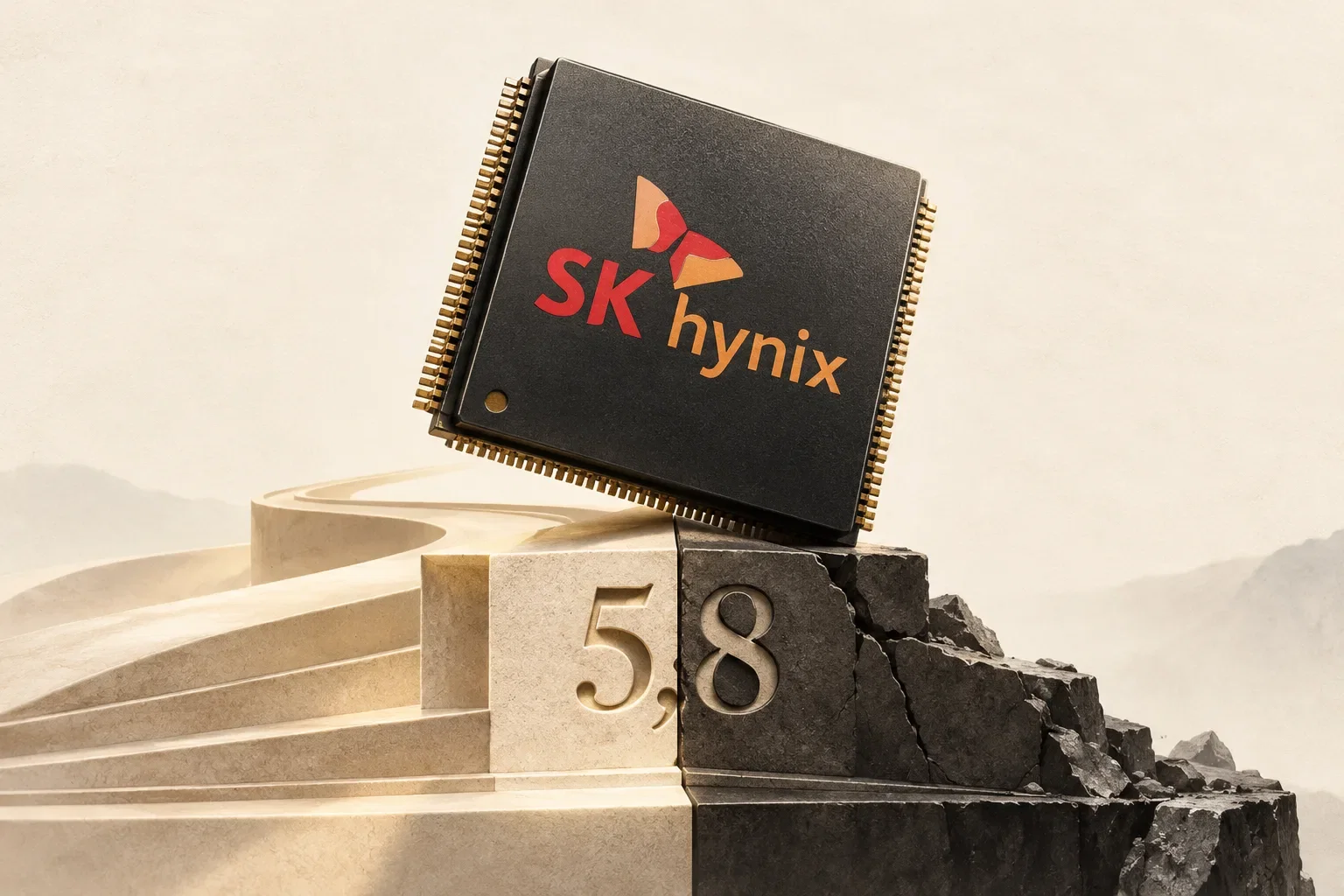
Is SK hynix’s 5.8 P/E a Bargain or a Warning?

The AI memory maker has lost a third of its value in seven sessions and is trading at less than six times earnings. The last time it was this cheap, its earnings fell 87% in a year. This time, though, it has something it didn’t have in 2018.
Key points
SK hynix shares lost 31.5% of their value between October 6 and 15, and its market capitalization fell from $1 trillion to around $700 billion.
The last time the stock was this cheap, the company’s operating profit fell 87% in a year.
Earnings over the past twelve months are inflated by a one-off item worth 63.3 trillion won, without which the valuation looks different.
Management has signed five-year contracts with ten customers, including advance payments—in 2018, nothing like that existed.
The part of the business talked about least accounts for the largest share of today’s earnings, and no long-term contract covers it.
Seven days that erased a third of its value
Between October 6 and 15, SK hynix shares $SKHY fell 31.5% in Seoul, from 1,841,000 to 1,262,000 won. The Korean Kospi index lost 21% over the same seven sessions, and on October 15 trading was halted by a circuit breaker for the first time since late July. The company, which surpassed a market capitalization of $1 trillion in May, is now worth around $700 billion.
There were three triggers, and they came one after another:
October 13: Chinese manufacturer ChangXin Memory (CXMT) announced progress in developing a denser 4F² DRAM architecture. SK hynix shares lost more than 9% that day.
October 14: U.S. inflation jumped to 3.7% in September, and the market began seriously pricing in another Fed rate hike. That same day, bonds issued by CoreWeave, a highly indebted company building AI data centers, plunged.
October 15: Reuters reported that Anthropic had slowed its quarter-over-quarter revenue growth from around 147% to 45%. Seoul responded with a 11.06% drop in SK hynix shares and a 9.5% drop in Samsung shares.
Friday, October 16, brought only a cautious bounce of 0.79% to 1,272,000 won. But U.S.-listed ADRs fell another 6.6% that same day, to $136.49—and that’s a detail we’ll come back to.
Why a low P/E for memory chips is more of a warning than a discount
For most companies, a P/E of around 6 signals that the market is overlooking something. For memory makers, historically, the opposite has been true. Memory is a commodity: when it’s in short supply, prices soar, earnings explode, and the P/E shrinks. But high earnings attract new capacity, prices fall, and earnings disappear. So the P/E is lowest precisely when earnings are at their peak.
SK hynix has been here before. At the end of 2018, its shares were trading at around three times annual earnings. It looked like a gift. A year later, the company’s operating profit had fallen 87% to 2.7 trillion won, and its operating margin had plunged from 52% to 10%. As recently as the third quarter of 2023, the company had a gross margin of 0.71%. In the first quarter of this year, it was 79%. That’s how wildly a business can swing when the market is valuing its earnings at less than six times. Morgan Stanley put it plainly in a comment on October 13: a forward P/E of around 3 to 4 for Samsung and SK hynix may not be a bargain, but a sign that a cyclical peak is approaching.
Today’s 5.8 figure is also distorted by two factors. Earnings over the past twelve months are inflated by a one-off gain of 63.3 trillion won from the sale and revaluation of its stake in Kioxia—which is why the company had a net margin of 118% in the second quarter, meaning net income was higher than revenue. Without this effect, the P/E comes out closer to 8. But if analyst consensus for the full year 2026 holds, with operating profit around 266 trillion won, the forward P/E falls below 5.
Bulios’s fair value remains at $80.37, or 41% below the market price even after the one-third plunge. The model simply doesn’t assume that a 76% margin will last. And that’s exactly what the whole debate is about.
Since we will expand capacity flexibly in line with confirmed customer demand, we do not believe our medium- and long-term investment plans will immediately lead to excess supply.
Song Hyeon-jong, President of the Corporate Center, SK hynix (Q2 2026 earnings call)
What’s different this time: five-year contracts and customer advances
In 2018, SK hynix sold memory from quarter to quarter at spot prices. When a customer stopped buying, the company found out within weeks. The customer relationship looks different today. On the second-quarter earnings call, management described long-term agreements (LTAs) signed with around ten customers: the standard term is about five years, pricing mechanisms are designed to cushion market fluctuations, and the agreements include advance payments to ensure the customer takes delivery of what it ordered.
Imagine a landlord who used to rent out an apartment month by month at the current market rate, but now has signed five-year leases with security deposits. Their income won’t disappear just because apartment prices fall. That’s exactly the change a low P/E for a memory company has never reflected before.
Competitors confirm the same trend. On its September 30 call, Micron said that most of its 2027 HBM volume had already been sold, at significantly higher prices than this year. TrendForce cites estimates of HBM contract prices rising by more than 50% in 2027. Meanwhile, SK hynix has started mass production of HBM4, plans a full ramp-up in the second half of the year, and expects HBM4E to arrive in 2027.
The company is becoming something between a commodity maker and a subscription business. The market isn’t pricing this in yet because it remembers the commodity behavior of 2019 and 2023—and because it’s looking at a different part of the business.
The China threat is aimed somewhere other than the market thinks
CXMT president Cao Kanyu announced at a conference in Shanghai that the company would introduce DDR5 RDIMM server modules built on 4F² architecture by the end of 2026. No specifications, no yield data, no qualified customers. According to secondary sources, Citi does not expect mass production before 2028, and a week later SK hynix confirmed that it is also developing its own 4F² technology.
But another nuance matters more. CXMT isn’t attacking HBM—the memory that everyone bought SK hynix shares for. It’s targeting conventional server DRAM. And that’s what has driven earnings higher over the past six months: in the second quarter, the average selling price of DRAM rose by around 30% and NAND by more than 50%, bringing the operating margin to 76%. Five-year contracts cover only a limited share of this revenue.
This creates a paradox. HBM, which gets the most attention, is better protected than ever in the company’s history. Conventional DRAM, which gets the least attention, accounts for the largest share of today’s earnings and isn’t covered by any contract. Chinese competition and concerns about AI capex are aimed squarely at it.
We see this development not as a sign of slowing investment in AI, but rather as a shift toward greater utilization of AI infrastructure that has already been built at scale, and an acceleration of efforts to monetize it.
Kim Woo-hyun, CFO, SK hynix (Q2 2026 earnings call, in response to a JPMorgan question about slowing AI investment)
Customers borrowing to buy chips
SK hynix ended the second quarter with net cash of 69.4 trillion won and plans to invest tens of trillions this year. The company itself can afford to weather a market downturn. The problem is on the other side of the table.
The Fed is holding rates at 3.75 to 4%, and after September’s 3.7% inflation reading, the probability of another hike at the October 28 meeting jumped to around 42%. That same day, CoreWeave bond yields climbed to around 15% and the company’s shares plunged. CoreWeave is a typical end-of-chain customer: it borrows money, buys servers with Nvidia chips and SK hynix memory, then rents out computing power. When debt gets more expensive, every data center gets more expensive—and so does every memory order.
Then came the news that Anthropic had slowed quarter-over-quarter revenue growth to 45%. That’s still an extraordinary pace, but the market read it as a sign that demand for computing power may not grow forever. In July, SK hynix’s CFO described this as a shift toward making better use of infrastructure already built, not a slowdown. But for investors, another point matters: SK hynix’s strong balance sheet is useless if its customers can no longer get credit.
The recent sharp declines in Samsung Electronics and SK hynix are an excessive correction, driven more by a lack of buying power in the Korean stock market and weakened investor sentiment than by deteriorating fundamentals.
Kim Dong-won, Head of Research, KB Securities (analyst report cited by The Korea Times, October 16, 2026)
October 28: two verdicts in one day
Analysts expect third-quarter revenue of around 98.5 trillion won and operating profit of 77 to 78 trillion, for a margin close to 80%. The number itself won’t settle anything—everyone knows it will be a record. What matters is what management says about 2027. And a few hours later, the Fed will deliver its verdict.
Scenario 1: a new earnings baseline. Management confirms that HBM prices for 2027 are above 2026 levels, announces a shareholder return program (promised by year-end), and conventional DRAM prices continue to rise in the fourth quarter. In that case, a 5.8 P/E really was a gift, and the market valued a cyclical company by the old rules.
Scenario 2: a cyclical peak. Guidance for bit shipments below 10% growth, the first mentions of customer inventories, and capex growing faster than contracted volumes. These are the signals seen in 2018, and a low P/E will once again be a warning.
Scenario 3: an external shock. The Fed raises rates, another AI debt issuer runs into trouble, or CXMT demonstrates qualification with a major server customer. HBM contracts will hold, but conventional DRAM, which is driving margins today, will be hit first.
And finally, a warning for anyone looking to bet on Scenario 1 through the U.S. market. One ADR represents one-tenth of a Seoul-listed share, and on October 16 it traded at a premium of around 40% to the Seoul price. That premium began to narrow on Friday: Seoul rose, while ADRs fell. So an investor buying through ADRs is making a second bet alongside the one on the memory cycle—that the premium will hold. The first bet may pay off even if the second doesn’t.
Stocks mentioned