


4 ETFs from a sector nobody wanted for three years—and now everyone is buying

It was one of the worst bear markets in the history of the entire industry. Stock prices fell for 30 months, hundreds of companies traded below the value of the cash on their balance sheets, and many investors left the sector. Today, the situation is the opposite. Big pharmaceutical companies are spending tens of billions on acquisitions to fill the gap left by expiring patents, and the sector is among the top performers in the U.S. market. Anyone looking to profit from the turnaround without betting on individual clinical trials will probably turn to ETFs. But the funds differ more than they might seem at first glance.
Key points
Just three years ago, hundreds of biotech companies were trading below the value of the cash on their balance sheets. Today, billions of dollars are flowing into the same sector, and some ETFs have gained more than 60% this year.
Pharmaceutical giants face the loss of patent protection on drugs with sales of more than $300 billion. This threat could be one of the strongest drivers of further growth in biotech stocks.
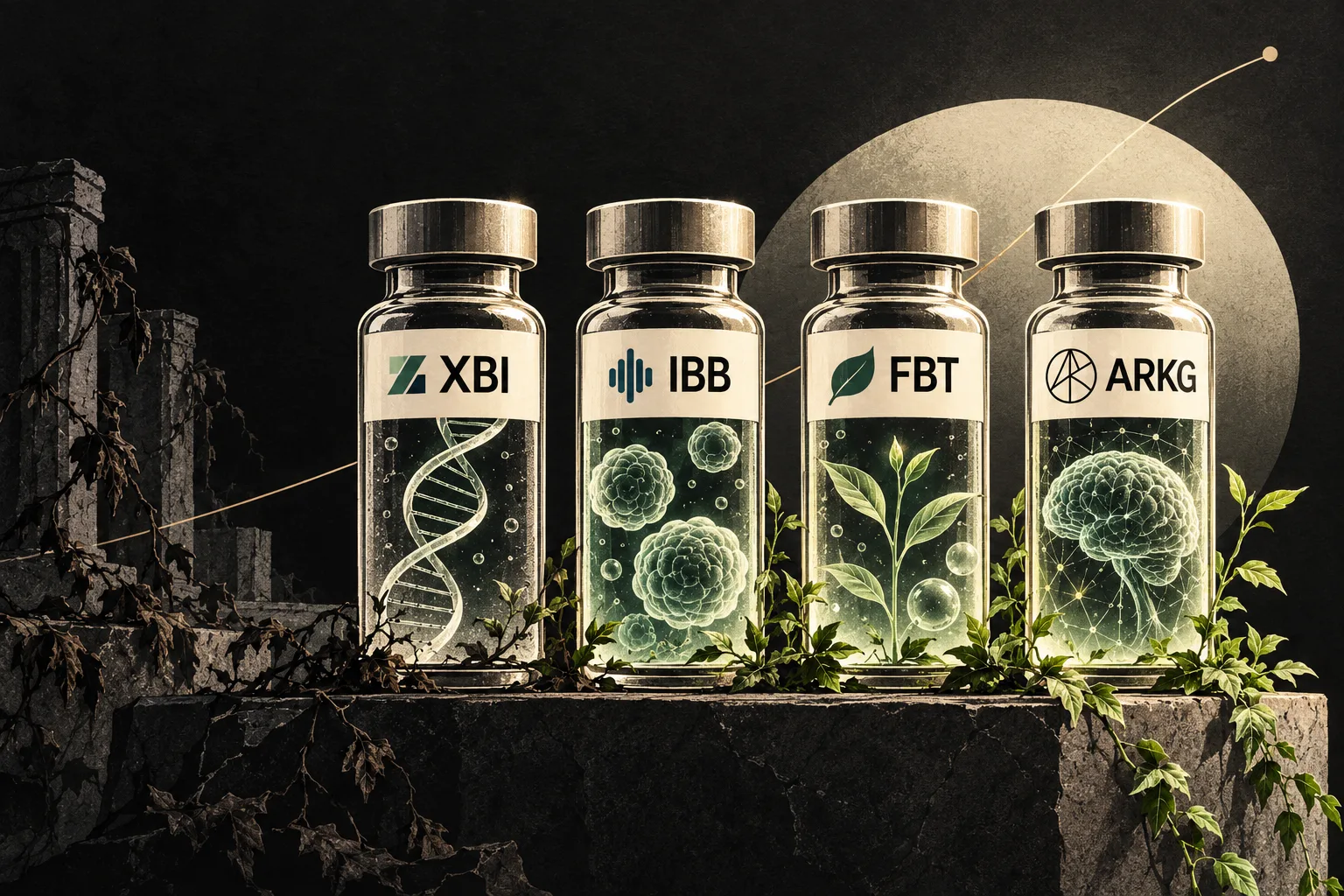
Four ETFs invest in the same industry, but their five-year results differ dramatically. While one fund returned more than 10% a year, another lost money every year over the same period.
This year's best-performing ETF is also one of the biggest long-term disappointments. Even a gain of more than 60% wasn't enough to erase losses from previous years.
The cheapest fund isn't necessarily the safest, and the most expensive isn't necessarily the most profitable. What matters most is how stocks are selected and weighted, which can completely change an investment's risk profile.
Biotechnology went through a classic boom-and-bust cycle after the pandemic. In 2020, the success of COVID vaccines and zero interest rates pushed valuations to extremes. Companies with no clinical data at all went public with valuations in the billions of dollars. But a reversal came in February 2021. According to Janus Henderson, the sell-off lasted about 30 months, with the bottom reached in late October 2023. At that point, 232 biotech stocks were trading below the value of the cash on their balance sheets.
The performance of the best-known sector fund $XBI is illustrative. From a peak of around $170 in February 2021, it fell to about $63 in fall 2023, a drop of more than 60%. The recovery that followed wasn't straightforward either. The fund traded sideways for much of 2024, and in spring 2025, tariff shocks and uncertainty around U.S. drug policy dragged it back toward its lows. For most investors, those were three lost years.
What changed
From April 2025 through the end of the year, $XBI rose about 80%, and it has gained another 22% this year. The turnaround is driven by a combination of three factors:
Acquisitions: The value of biotech acquisitions reached $84 billion in the first quarter of 2026, compared with $44.4 billion a year earlier. It was the strongest start to a year since 2019. If the pace continues, the full-year total could exceed $250 billion.
The patent cliff: William Blair analysts estimate that drugs with sales of more than $300 billion will lose patent protection over the next 5 years. For example, Merck's Keytruda, which accounts for more than half of the company's revenue, will lose exclusivity in 2028.
Lower rates: Biotech companies without profits finance development with capital. Fed rate cuts lower financing costs and increase the present value of future revenue.
Pharmaceutical companies are therefore buying aggressively. Eli Lilly $LLY spent more than $35 billion by the end of April 2026 alone, while Gilead $GILD and Merck $MRK have also been particularly active. Every takeover means a premium for the acquired company's shareholders—and therefore for the funds that hold its shares. Which of them are growing the most and are on investors' watchlists?