Amazon Is Sold Out Through 2028. Why Isn’t That Helping the Stock?

Amazon’s CEO is reporting cloud demand the company can’t keep up with, yet the stock lost more than 5% in a week. The market has stopped counting orders and started counting the data center bill. And that bill will determine whether $248 is a bargain or a trap.
Key points
Andy Jassy announced that AWS capacity is sold out through 2028, and the stock reacted in the opposite way the market expected
In a single week, Amazon lost 5.3%, and it is down 13.6% from its August high
Amazon’s free cash flow has been negative over the past twelve months, and analysts say this is just the beginning
Morgan Stanley is targeting $350, while the Bulios Fair Price Index puts fair value at $176—the difference between them has one explanation
The October 29 results will matter less than one sentence Jassy may or may not say on the call
The week good news stopped working
On Thursday, October 22, the technology sector had its worst day since June. The Nasdaq fell 2.6%, the semiconductor index dropped more than 6%, and Meta $META plunged nearly 7%—despite beating earnings estimates. All it took was raising the low end of its investment plan for this year to $135 billion and announcing a new class of shares to fund part of the construction. Neocloud provider CoreWeave $CRWV lost 10%, as Yahoo Finance’s trading-day recap reported, and Tesla cut its capital expenditure plan by a fifth that same day.
Amazon $AMZN started the week euphorically. After Morgan Stanley upgraded it to top pick on Monday, it surged toward $262, then closed Friday at $248. That’s a 5.3% drop in four days and 13.6% below its August high of $287.20.
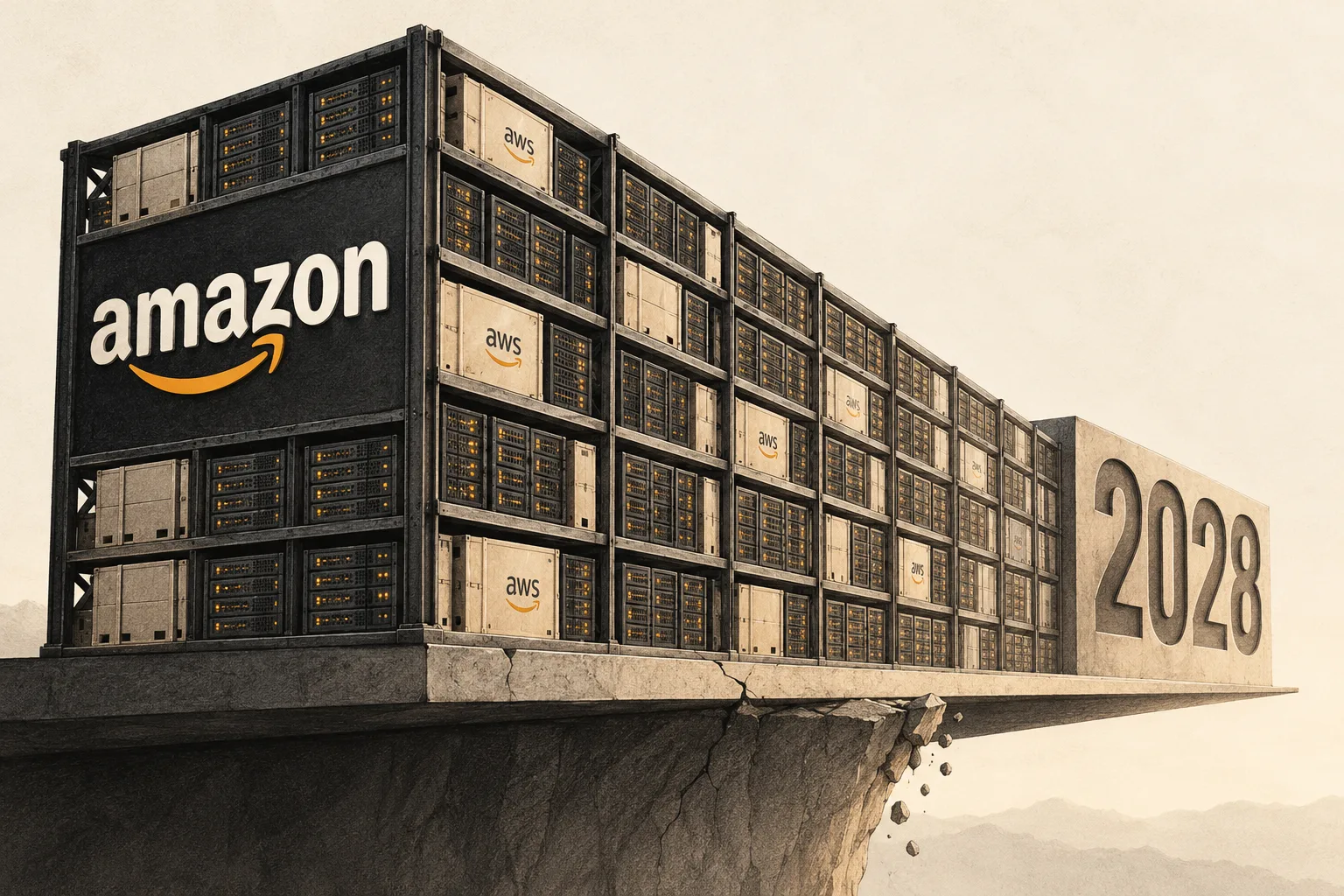
And right in the middle of that week, Andy Jassy made a statement that would have sent the stock higher just a month ago: AWS capacity is sold out for this year, largely sold out for 2027, and a good chunk of 2028 is gone too. The market shrugged. Something has changed in the questions investors are asking.
While AI concerns are nothing new, this sell-off had a distinctly different flavor. It’s about capital expenditure. But instead of the risk that AI hyperscalers are spending too much, the familiar scenario has turned on its head.
Kyle Rodda, Senior Financial Markets Analyst, Capital.com
What exactly does “sold out” mean, and why isn’t it just marketing?
When a cloud company’s CEO says “sold out,” skepticism is warranted. But at AWS, the word is backed up by figures from its latest results. In the second quarter, AWS reported revenue of $42.2 billion, up 37% year over year—the fastest pace in 18 quarters. The division’s operating profit jumped to $16.6 billion and its margin reached 39.4%. Most importantly, the value of signed but not yet invoiced contracts, known as backlog, reached $496 billion—with $132 billion added in a single quarter.
Most AI capacity is sold five or more years in advance. Imagine a hotel with every room booked two years ahead, with guests already having paid deposits. Its revenue is no longer determined by demand. It depends only on how quickly it can add another floor.
Jassy himself admits that adding capacity is proving difficult. There aren’t enough data centers, electricity, or memory chips, and he says this shortage won’t end in 2027. The company is therefore aiming to double its energy capacity by the end of 2027 compared with 2025. For investors, that leads to an uncomfortable conclusion: AWS’s further revenue growth is now a construction problem, not a sales problem.
2026 is, of course, sold out at this point. 2027 is largely sold out. We always hold back some capacity for on-demand and for our Bedrock or EC2 inference service, but all the large blocks are largely sold out. A good chunk of 2028 is sold out.
Andy Jassy, Amazon CEO, on The a16z Show podcast (October 23, 2026)
The bill: $220 billion this year, $355 billion next year
This is where good news turns into the question of who’s going to pay for it. In July, Amazon raised its investment plan for this year from $200 billion to $220 billion, partly because memory chips had become more expensive. The result is visible in its cash: over the past twelve months, the company generated $161.4 billion in operating cash flow but invested $169 billion, bringing free cash flow down to negative $7.6 billion. Analysts’ consensus for all of 2026 is for negative free cash flow of around $34 billion.
And that’s just the beginning. Morgan Stanley, which also calls the stock its top pick, models investment of $355 billion in 2027 and $365 billion in 2028. Free cash flow is expected to fall to negative $89 billion next year, while long-term debt is expected to nearly quadruple by 2028. The market consensus, meanwhile, still assumes capex of around $278 billion—a $77 billion gap is exactly the kind of surprise the market punished Meta for on Thursday.
Amazon has already tapped the debt market twice this year. In March, it sold nearly $50 billion in bonds, including a euro tranche—the fourth-largest corporate bond offering in U.S. history—and added another $25 billion in July. Put that in the context of this week: Meta is issuing a new class of shares to address the same problem, smaller data center operators are borrowing at yields of around 15%, and Nvidia CEO Jensen Huang is talking about demand that is “off the charts” but short on operating capital. The market is logically asking whether the entire chain is built on debt.
Why Amazon isn’t Nebius, even if the market values it that way
That’s the paradox of this week. Amazon’s stock fell alongside companies borrowing at double-digit interest rates to buy GPUs, even though it differs from them in three crucial ways.
A cash machine outside the cloud. The advertising business earned $19.8 billion in a single quarter (+26%), while online retail grew 15%. Overall, the company generates more than $160 billion in operating cash flow a year. Neocloud companies have nothing like that—every dollar spent on servers has to be borrowed.
Investment-grade rating and a queue of lenders. During the July $25 billion bond sale, investor demand reached $62 billion. Amazon borrows at a fraction of what Nebius or CoreWeave pays.
Purchase timing. Buildings and electricity are planned years in advance, but servers and GPUs, which account for most of the bill, are bought only a few months before deployment. The payback period works out to just under three years, with a useful life of 5 to 6 years and five-year customer contracts.
The risks don’t disappear; they just look different. AWS customers are concentrated among a handful of AI labs, and second-quarter profit was inflated by a $53.4 billion accounting revaluation of its stake in Anthropic—so actual profitability is lower than the income statement suggests. Depreciation on new data centers will rise regardless of utilization. And capacity for 2027 and 2028 has to be built and paid for before it starts generating revenue. “Sold out” protects the revenue side, not the cost side.
We typically buy them a few months before they go into service, so we have a strong view of customer demand before we commit the expense. If demand isn’t there, we won’t spend the capital.
Andy Jassy, Amazon CEO, on server purchases during the Q2 2026 earnings call (July 30, 2026)
What’s priced into $248?
With a market capitalization of $2.675 trillion, Amazon looks cheap at first glance: its trailing P/E of around 20 is distorted by the gain on Anthropic. Based on normalized earnings for the next twelve months, the stock trades at around 29 times earnings, well below its five-year average of nearly 49. Amazon has hardly ever been valued this way over the past five years.
Two views of this price differ by more than $170. Morgan Stanley is targeting $350, which corresponds to 21 times its estimated 2028 earnings of $16.56 per share. That estimate is 24% above the consensus of $13.26—the bank is betting that backlog will turn into profit faster than the market expects. At the other extreme is the Bulios Fair Price Index, which puts fair value at $176 because it is based on current cash flow, which is negative, rather than orders that still need to be fulfilled.
The market is valuing Amazon based on the bill, not the orders. That’s both an opportunity and a trap: if $496 billion in backlog turns into invoiced revenue at margins close to 40%, today’s multiple is low. If construction is delayed or becomes more expensive, negative cash flow will last longer than the market can tolerate.
October 29: three scenarios and the signals to watch for
Third-quarter results are due Thursday, October 29, after the market closes. Consensus expects revenue of $202.2 billion and earnings of $1.96 per share; the company itself guided to revenue of $197 billion to $202 billion and operating profit of $22.5 billion to $26.5 billion. AWS growth is expected to be between 30% and 35%. But these numbers will matter less than what Jassy says about 2027.
Scenario A—the market accepts the bill. AWS grows 35% or more, margins hold around 39%, backlog exceeds $496 billion, and management offers its first indication of 2027 capex along with an explanation of the returns. In that case, the market gets proof that orders are actually turning into invoices, and the way back to the $287 high opens up.
Scenario B—a repeat of Meta. AWS is fine, but 2027 capex jumps above $300 billion without new figures on signed contracts, and free cash flow heads further into the red. That’s exactly what the market punished Meta for on Thursday, sending it down 7%, and Amazon—with twice the capex—would fare no better.
Scenario C—the worst case. AWS growth slows below 30%. With capacity “sold out,” that wouldn’t mean weak demand but construction delays—and that would mean Amazon can’t keep up even with what it has already sold, while the bill keeps running.
What to watch on Thursday:
AWS growth compared with 37% last quarter and the size of its backlog,
AWS operating margin: a drop below 37% would mean depreciation is outpacing revenue,
Any mention of 2027 capex or further bond issues,
Whether Jassy repeats that the company “could invest more,” and whether he puts a number to it this time.
If the market said anything this week, it’s that demand alone is no longer enough for AI stocks. Amazon is in the best position in the entire chain to pay the bill. On Thursday, we’ll see whether it’s willing to show the market exactly how much that will be.
Stocks mentioned