Anthropic goes public today. I won't buy it, and here's why

Starting today, shares of $ANT, the company behind the Claude model, are trading on Nasdaq. It's the largest IPO in history and a test of how much the market is willing to pay for a pure bet on artificial intelligence. But I'm more interested in something else: does it make sense to buy a company worth more than a trillion dollars on its first day, or should we instead look at who's making money from Anthropic without buying a single share?
What's happening today
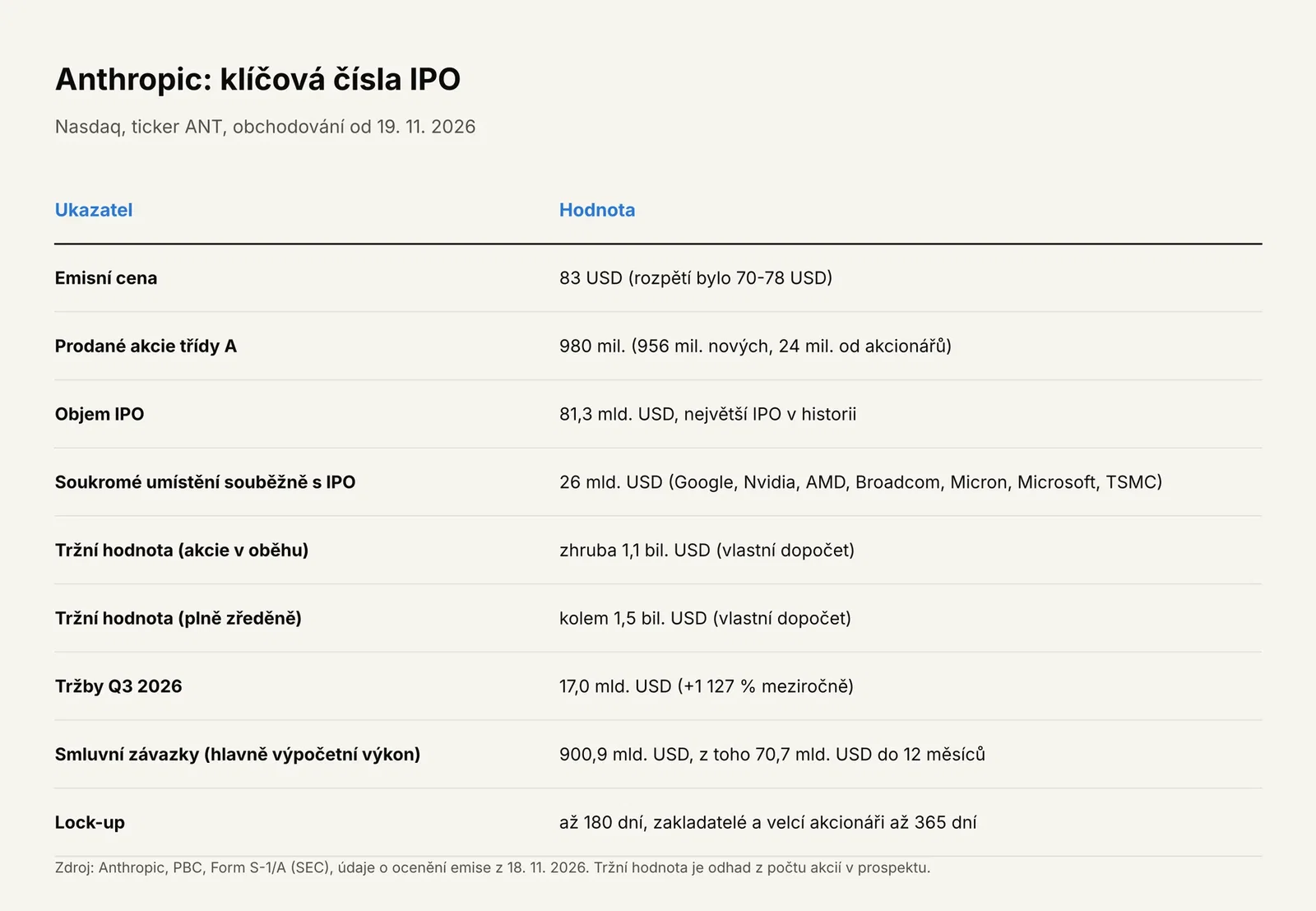
Last night, Anthropic priced its offering at 83 USD per share, above the initially announced range of 70-78 USD. Around 980 million Class A shares were sold, including 956 million newly issued shares from the company and just under 24 million from existing shareholders, for a total of 81.3 billion USD. That surpassed SpaceX's June IPO, which raised 75 billion USD. Alongside the IPO, seven tech companies will also buy Class N shares in a private placement for 26 billion USD, at the offering price). This morning, before the market opened, Nasdaq futures rose around 2%, along with chipmakers' shares.
Based on the number of shares that will be outstanding after the IPO and private placement, the market capitalization at the offering price comes to around 1.1 trillion USD. On a fully diluted basis, including options, employee stock awards and Amazon's convertible notes, it's around 1.5 trillion USD. I calculated both figures from the share count in the prospectus, so treat them as estimates, not exact values. The company's governance is also worth noting: the seven founders hold 50.1% of the votes through just one Class F share, public shareholders collectively have no more than 49.9%, and Amazon and Google hold non-voting shares.
What the market is paying for
Revenue growth is extraordinary. For all of 2025, Anthropic reported revenue of 4.59 billion USD, while in the third quarter of 2026 alone it was 17.0 billion USD, up 1,127% year over year. At the end of October, the company reported an annualized revenue run-rate (current monthly revenue multiplied by 12) of around 81 billion USD. In the second quarter of 2026, it reported an operating profit for the first time, at 974 million USD. Net losses in the first half of 2026 were 80.7 billion USD, but around 72.4 billion USD of that was non-cash revaluation of convertible notes and other instruments, which rose along with the company's valuation.
Then there are the commitments. Anthropic has contractual spending commitments of around 900.9 billion USD, almost all of it for computing power and infrastructure. About 70.7 billion USD of that is due in the 12 months from the end of September 2026, and 451.6 billion USD through the end of 2030 (S-1/A). For the company to pay these costs from revenue rather than more investor funding, it needs to keep growing very quickly.
At a market capitalization of around 1.1 trillion USD, the market is paying roughly 14 times the annual revenue run-rate, or around 18 times on a fully diluted basis. For a company that has grown revenue more than tenfold in a year, that's not unreasonable. But quarter-over-quarter growth is slowing: revenue went from 4.73 billion USD in the first quarter to 11.56 billion USD in the second, an increase of 144%, while growth from the second to the third quarter was already down to 47%. Today's price assumes that high growth will continue for several more years and that margins will rise after computing costs are deducted. If that happens, the valuation could look cheap in retrospect. If growth slows faster, the hundreds of billions in commitments will remain.
Why I'm not buying on IPO day
The first trading day's price is driven mainly by a shortage of shares and excitement, not fundamentals. Demand was so strong that the company increased the number of shares being sold and priced them above the range. Retail investors in the US and other countries were to receive up to 20% of the offering, so many buyers are people who want to own Anthropic right away, whatever the price. That pressure usually fades within a few days.
The supply of shares will also gradually increase. The standard lock-up (the period when existing shareholders can't sell) lasts up to 180 days, and up to 365 days for founders and major shareholders. However, the prospectus also states that employees, former employees, directors and consultants can sell up to 10% of their locked-up shares from the first trading day, and that up to 3.7 billion shares could be released early from the 180-day lock-up. The 26 billion USD of shares from the private placement have no lock-up at all.
SpaceX offers the closest comparison. It went public in June at 135 USD, closed 19% higher on its first day and was as much as 57% above its offering price two days later. But by the end of October, it was trading around 149 USD, only slightly above its IPO price. Anyone who bought in the first few days is still sitting on a loss.
But there are arguments against my view, too. A company this large could quickly make it into major indexes, forcing passive funds to buy its shares. Strong results in the first quarter after the IPO could also support the price after the initial excitement fades.
Feature: Who stands to profit from Anthropic's IPO
You can make money from Anthropic without owning its shares. The companies that benefit from it fall into two groups: shareholders whose stakes are being revalued at today's market price, and suppliers that Anthropic pays for computing power. Many companies belong to both groups.
Shareholders
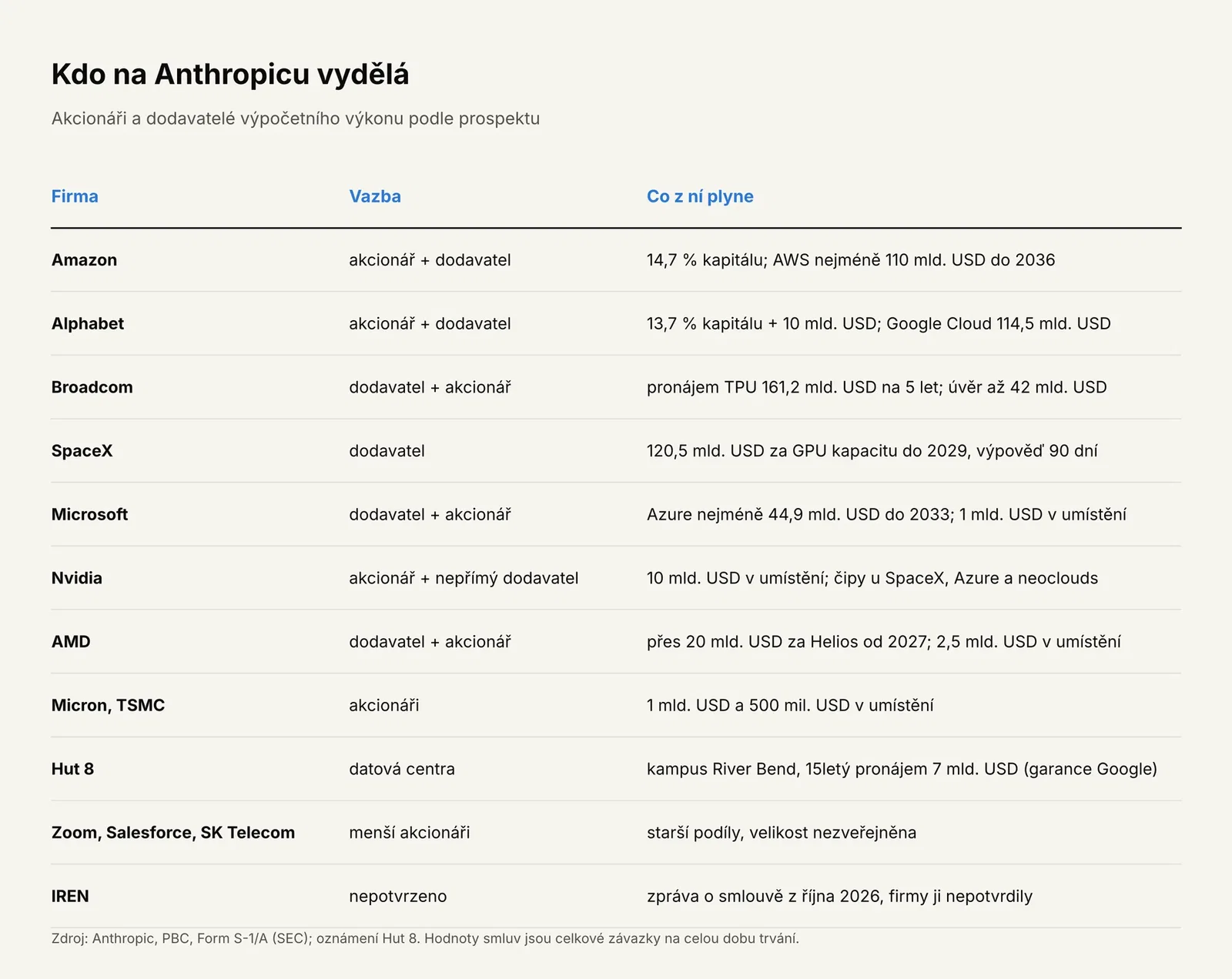
Amazon: $AMZN will hold 14.7% of the share capital after the IPO, rising to as much as 23.8% if the convertible notes are fully converted. At the offering price, its stake is worth around 160 billion USD. Amazon is also a customer: Anthropic has committed to spending at least 110 billion USD with AWS by 2036, including on its own Trainium chips.
Alphabet: $GOOGL will hold 13.7% of the share capital and is also buying another 10 billion USD worth of shares in the private placement. At the offering price, its stake is worth around 147 billion USD. Google Cloud has a commitment from Anthropic for at least 114.5 billion USD through 2033, and much of Anthropic's computing power runs on TPU chips designed by Google.
Private placement participants: In addition to Google, $NVDA (10 billion USD), $AMD (2.5 billion USD), $AVGO, $MU and $MSFT (1 billion USD each), as well as a subsidiary of $TSM (500 million USD), are buying shares at the offering price. Nvidia and Microsoft already had stakes from November 2025, when they announced investments of up to 10 billion USD and up to 5 billion USD, respectively. For all these companies, however, their stakes in Anthropic are small relative to their own market value, so their main benefit comes not from the revaluation, but from orders.
Smaller and earlier stakes: Zoom $ZM invested in 2023 through its Zoom Ventures fund, Salesforce $CRM holds a stake through Salesforce Ventures, and South Korea's SK Telecom $SKM joined in 2023. These companies don't publicly disclose the exact size of their stakes. Zoom is interesting because at today's valuation, its stake could represent a noticeable portion of its own market value, so its share price may react more sharply than Amazon's or Google's.
Computing power suppliers
Broadcom: The largest individual commitment in the prospectus is a five-year lease of TPU chips from Broadcom for around 161.2 billion USD, which can't be terminated except in the event of a breach of contract. Broadcom has also offered Anthropic a loan of up to 42 billion USD at 9% interest. It's a huge contract for Broadcom, but also means a concentration of risk in one customer, to whom it's lending money to pay rent.
Microsoft and SpaceX: Anthropic has committed to spending at least 44.9 billion USD with Microsoft Azure through 2033. It has a 120.5 billion USD contract with SpaceX $SPCX for Nvidia GPU capacity through 2029, but it can be terminated with 90 days' notice. This gives SpaceX a major customer, but for its shareholders the revenue is less certain than under non-cancellable contracts.
Nvidia and AMD: Nvidia benefits indirectly because its chips power capacity from SpaceX, Microsoft and smaller data-center operators. Anthropic has committed to spending over 20 billion USD with AMD on Helios systems using MI450 chips starting in 2027, with an option to spend a similar amount on top of that.
Data centers and neoclouds: Hut 8 $HUT is building the River Bend campus in Louisiana for Anthropic under a 15-year, 7 billion USD lease with Fluidstack, with payments guaranteed by Google. Nscale (a 44.6 billion USD contract with Anthropic) and Lambda (41.3 billion USD) aren't publicly traded yet: Nscale is only now heading for the NYSE, and Lambda plans an IPO in 2027. In October, a report said that Anthropic was the unnamed AI lab in IREN's $IREN August contract, but neither side has confirmed it.
What's the catch?
A large part of these relationships is circular. Suppliers invest in a customer that then pays them for computing power, so their revenue depends on Anthropic continuing to grow quickly and raise capital. Meanwhile, the 26 billion USD private placement accounts for less than 3% of the 900.9 billion USD in commitments. In a November supplement to its prospectus, Nscale itself states that it doesn't yet have firm commitments to finance its contracts with Anthropic.
For large companies like Amazon or Alphabet, today's IPO doesn't change the investment thesis much, because their stake in Anthropic represents only a small part of their value. Smaller companies that depend heavily on a single customer have more upside, but also more risk if Anthropic has to slow its spending on computing power.
My personal view
I won't buy Anthropic shares today. It's not about whether Anthropic is a good company, but about timing. I think sentiment and a shortage of shares, not the numbers, will drive the first few days after the IPO. I think the shares will rise slightly today, then fall. Demand is enormous and the offering was priced above the range, so I see room for a rise on the first day. But once the initial excitement fades and more shares gradually come onto the market, I expect a drop. I don't want to guess how far the price could fall. There's too much we don't know about a stock this new, with no trading history. I don't own Anthropic.