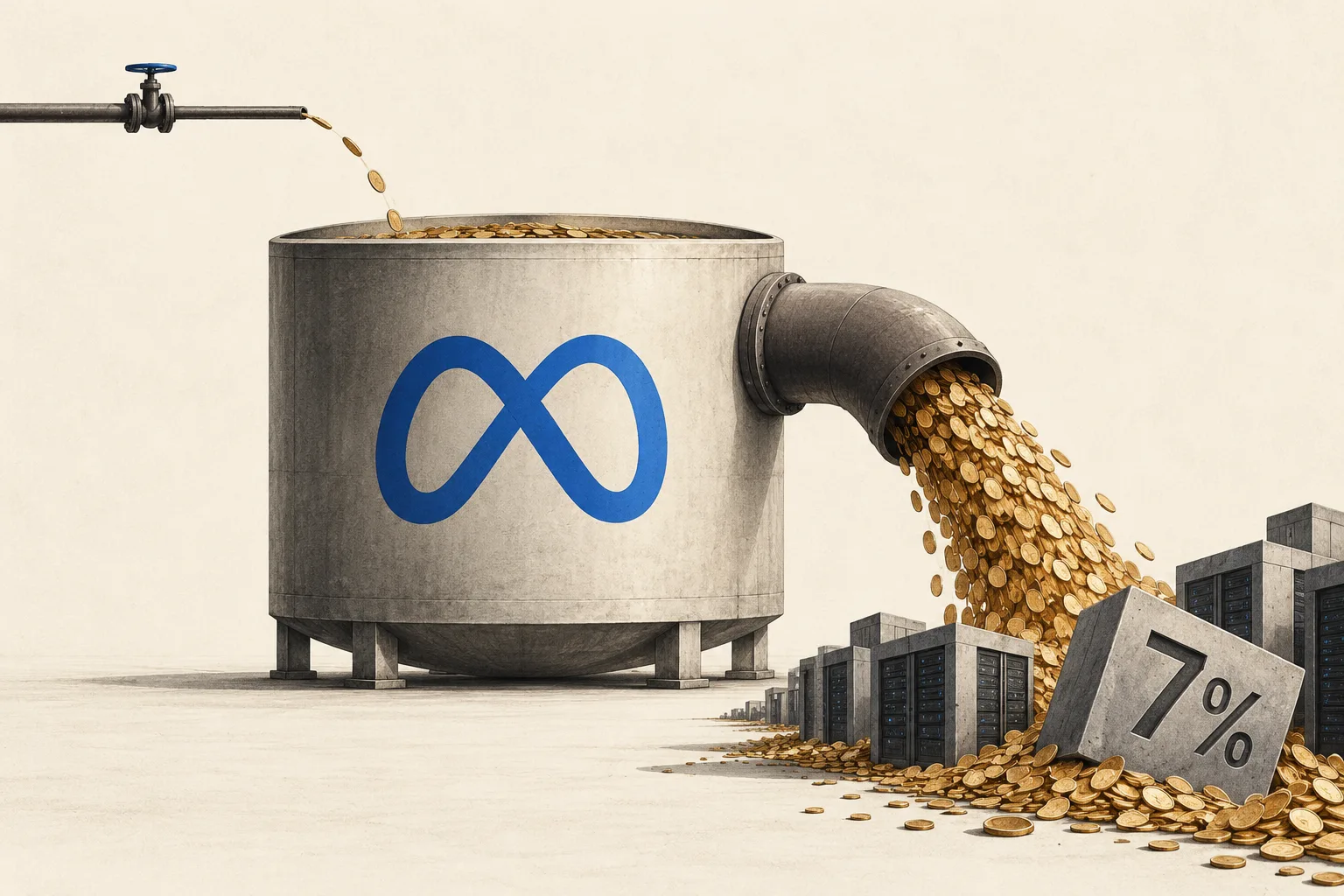
Meta invested more than it earned for the first time since 2012. The stock fell 7% as a result

Advertising is growing 26%, and 10 million people have activated the new AI assistant in six weeks. Yet for the first time since going public, Meta ended up with negative free cash flow. Zuckerberg has found a way to pay the data center bill. The market doesn’t like it.
Key points
Third-quarter revenue jumped 26% to $64.6 billion, but operating cash flow was not enough to cover investments for the first time since the IPO
Akcie Meta $META za týden ztratila 9,4 % a od říjnového maxima je níž o 16 %
Share buybacks have stopped entirely this year, debt has matched cash for the first time, and the company announced a new class of shares without voting rights
Analysts’ average price target is $843, but Wells Fargo models $250 billion in investments for 2027
The next move will hinge on one number Meta won’t disclose until the end of January
A record quarter the market didn’t want to hear about
At first glance, it was a great ride. Meta reported third-quarter revenue of $64.6 billion, up 26% year over year, beating estimates by more than a billion. The company’s apps are used daily by 3.64 billion people, the price of advertising rose 14%, and the number of ads shown increased 10%. For the fourth quarter, the company forecast revenue of $73 billion to $76 billion, above market expectations.
The reaction? On Thursday, October 22, shares fell 6.98% to close at $648.85, then slid further on Friday to $642.62. That’s a 9.4% loss for the week, the fourth losing week in a row, and 17.6% below the 12-month high of $779.82. The company’s market value fell to $1.64 trillion.
Interestingly, after the results were released, the stock initially rose more than 4% in after-hours trading. The turn came during the conference call and a closer reading of the financial statements. The market found three things that weren’t front and center in the press release.
First time since the IPO: investments exceeded cash generated by the business
The first is cash flow itself. Meta generated $32.8 billion from operations during the quarter, but invested $34.9 billion in servers, data centers, and networks. Free cash flow therefore came in at minus $2.1 billion. At this time last year, it was positive $10.6 billion, and for 2025 as a whole, the company generated more than $43 billion in free cash.
The second is share buybacks. In the first nine months of last year, Meta bought back $26.2 billion of its own shares. For the same period this year, that figure is zero. The company did pay a $1.36 billion dividend for the quarter, but effectively out of reserves, not from what it earned during the quarter.
The third is the balance sheet. Long-term debt rose from $58.7 billion at the end of last year to $80.9 billion after the company sold $25 billion in bonds in April, just six months after issuing $30 billion in October. Investors placed orders for $96 billion then, compared with $125 billion in the previous offering, and demanded a higher risk premium. CFO Susan Li summed it up in one sentence on the call: the company is ending the quarter with $82.4 billion in cash and $83.7 billion in debt. Debt has thus exceeded cash, even though at the end of last year the company had $23 billion more cash than debt.
That’s not the whole bill, either. Meta is building some data centers through joint ventures in which it owns only 20%, with partners such as Blue Owl or BlackRock owning the rest. BlackRock borrowed $12.5 billion in July for its Texas campus at a yield of 7.53%, one of the highest for investment-grade data centers. This money won’t show up in Meta’s capex, but the company will pay rent on it for years.
“In my view, we can build superintelligence by scaling, so we’re methodically climbing the ladder. We’re already working on larger models than Muse Wonder, and they’ll be very impressive and capable.”
Mark Zuckerberg, Meta CEO, on the third-quarter 2026 earnings call (October 21, 2026)
Muse: the hottest product the company can’t release to the world
In Meta’s defense, it’s worth saying that, unlike Amazon or Oracle, it isn’t building data centers for outside customers. It’s building them for itself, and the results are already visible. More than 10 million people in the U.S. and Canada activated the personal AI agent Muse in the six weeks since launch; a quarter of them use it every day, most often for shopping, with an average spend of more than $200. Zuckerberg says it has twice the retention Threads had at launch.
The paradox is that Muse still can’t be released to the rest of the world. Zuckerberg admitted that the service is so computationally intensive that the company hasn’t launched it globally until it can improve efficiency. The goal is to cut Muse’s operating costs by more than tenfold over the course of a year. Only then is it supposed to start making money, mainly through shopping commissions and subscriptions.
In other words, the product meant to justify capex is currently driving capex higher itself. And capex is enormous. The company narrowed its investment plan for this year to $135 billion to $145 billion, compared with $72 billion spent last year. Since it has invested $85.8 billion over the first three quarters, that leaves $49 billion to $59 billion for the final stretch of the year alone. That’s roughly 70% of the revenue the company expects for the same quarter.
Shares without voting rights: a fourth source of funding
And here comes the most interesting part of the whole report. So far, Meta has funded construction in three ways: cash from advertising, bonds, and joint ventures with funds. Now it’s adding a fourth. On January 19, 2027, a new class of non-voting Class C shares will be created. Each shareholder will receive one new share for every share they own, so it looks like a 2-for-1 split, and the price of the original share should roughly halve.
The distribution of new shares itself won’t bring the company a single dollar. The point is what comes next. In its rationale, a special board committee explicitly wrote that debt of this size could damage the credit rating, making it preferable to raise capital by selling shares. Class C shares can be used for market offerings, acquisitions, and employee compensation without diluting Mark Zuckerberg’s voting stake: he owns 13.4% of the company but holds 60.6% of the votes.
There’s a precedent. Google did the same thing in 2014 and eventually had to pay Class C shareholders an additional $522 million because the shares traded at a discount to voting shares. For a small Meta shareholder, this means having two securities with different prices in their portfolio, and every future Class C share issuance will dilute their share of the profits.
“Meta has enormous capital needs to fund its AI expansion. We’ve seen companies borrow for it, and investors punished their shares for weakening their balance sheets. This is a better way to raise capital while keeping the balance sheet strong.”
Dennis Dick, chief market strategist at Stock Trader Network, to Reuters (October 22, 2026)
What’s priced in at $642
At $642.62, Meta trades at roughly 22 times trailing twelve-month earnings and 19 to 20 times next year’s estimated earnings. That’s cheap for a company whose revenue is growing by a quarter. But the market values free cash, and that’s in the red.
Analysts are still bullish, though. The average price target from 62 analysts is $843, or 31% higher. JPMorgan raised its target to $940 after the results, Mizuho stands at $950, and Morgan Stanley at $820. At the other end is Scotiabank at $650, with a “neutral” rating. There’s only one explanation for the gap between $650 and $950: those who believe Muse and the new models will turn into revenue within two years see today’s multiple as a discount. Those counting only on advertising see a company borrowing to fund its investments.
There’s also the legal bill hanging over all of this. In the first three quarters, Meta booked $9.9 billion related to a settlement with the attorneys general of 52 U.S. states over social media’s impact on children, and on the same day the results came out, a court in New Mexico fined the company $25 billion. More youth-related lawsuits are scheduled for the coming months.
“We don’t have any specific financing plans to announce yet. But we thought it made sense to establish an appropriate capital structure framework so we have access to a diverse range of financing sources.”
Susan Li, Meta CFO, on the third-quarter 2026 earnings call
End of January: two events in the same week
The market is now waiting for one number: capex for 2027. Susan Li declined to provide it, saying the budget is still being put together and the company “will continue to invest aggressively.” Analysts currently estimate an average of around $195 billion, but Wells Fargo cut its target after the results and models $250 billion and another seven gigawatts of owned capacity.
The number will come on the fourth-quarter earnings call at the end of January. Class C shares are also expected to begin trading that same week. There are three scenarios:
Capex below $200 billion and initial Muse figures. The market gets proof that the hottest product of the year has a price tag and revenue, and the way back to the $780 high opens up.
Capex around $250 billion without monetization figures. Free cash flow heads further into the red, and the first Class C share offering is a matter of months away. This is exactly the combination the market reacted to most sensitively on Thursday.
Advertising slows to below 20%. The only engine paying for the entire build-out would lose momentum, and the debt would suddenly look different.
What to watch: whether advertising growth holds at 25%, how much Muse costs per user, and above all whether Zuckerberg puts a number next to his “aggressive investment” remark this time. Among the big tech companies, Meta has the best advertising machine and the worst investment-to-revenue ratio. January will show which of the two ultimately pays the bill.