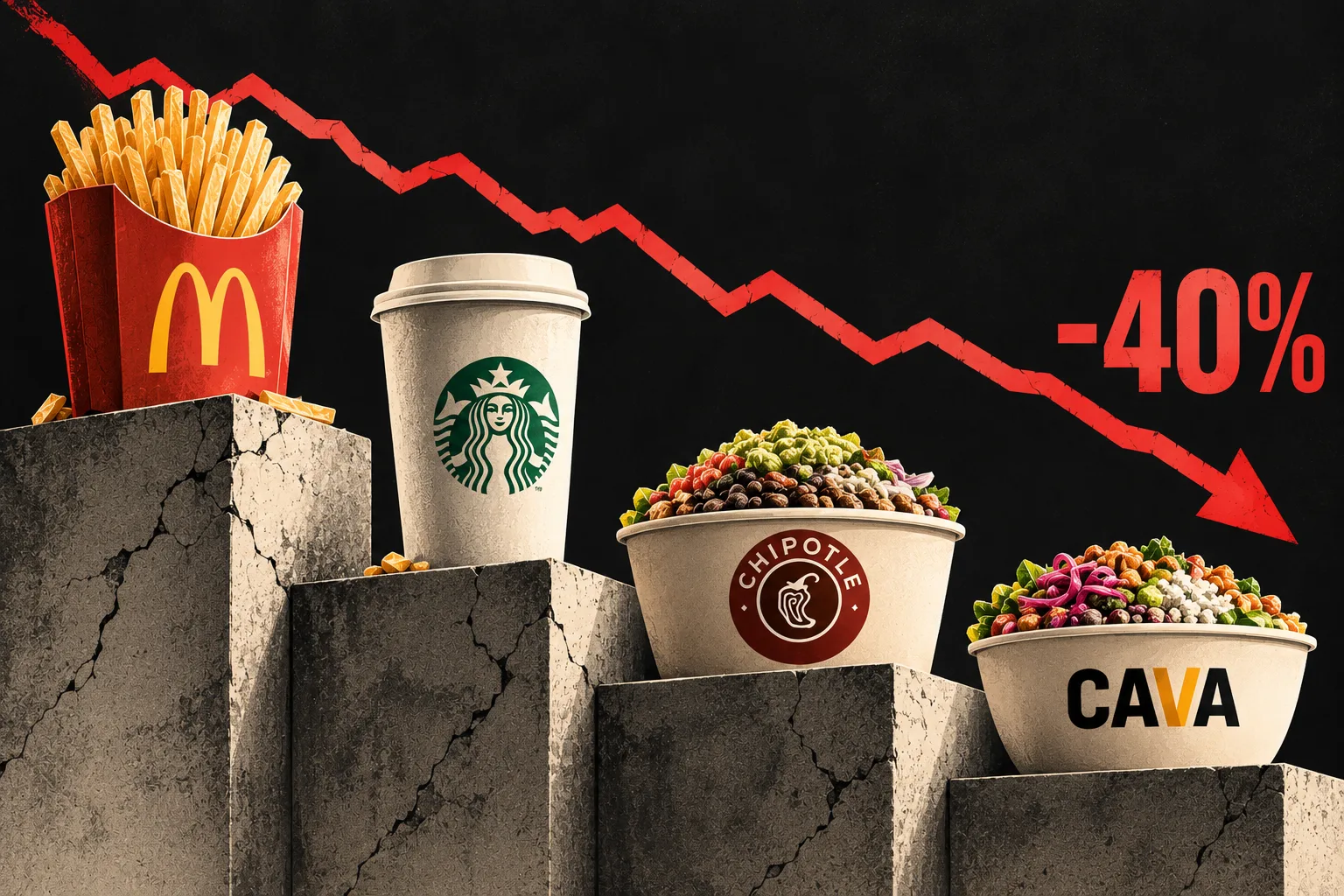
Half of America eats lunch at these chains, yet they’re down as much as 40%. Is this the end for McDonald’s and its peers?

McDonald's, Starbucks, Chipotle, and CAVA rely on the same customer. But the one with the thinnest wallet has left the cheapest brand and is showing up at pricier ones. The market is valuing all four as if the opposite were true.
Key points
McDonald's closed 24.5% below its high, and its CEO says weak traffic is no longer a blip but the norm
Starbucks is the only one of the four near its high, even though its dividend exceeds reported earnings
Chipotle reported earnings below estimates and comparable sales of just +2.1%, yet the stock jumped after results
The hardest-hit stock in the group is also the only one actually gaining customers
On November 4, two of these companies report, and one number that isn’t sales will decide the story
Cheap food, an expensive lesson
McDonald's $MCD is a stock funds hold as an anchor: beta of 0.45, a dividend yield of 2.9%, and a business meant to survive every recession. Yet it closed at 258.12 USD on October 30, 24.5% below its annual high of 341.75 USD, and touched a low of 229.20 USD on October 7. It has lost 13.5% over the year, while the S&P 500 index has gained 10.8%.
The common denominator for all four companies in this article is the lower-income customer. At McDonald's, they have stopped coming; at Chipotle and CAVA, they are now the strongest customer group; and at Starbucks, they have been replaced by bigger spenders. The market is valuing this exactly opposite to what common sense would suggest.
Company | Price on 10/30 | Annual high | Below high | P/E |
|---|---|---|---|---|
McDonald's | 258.12 USD | 341.75 USD | -24.5 % | 20.7 |
Starbucks | 103.67 USD | 110.51 USD | -6.2 % | 60.7 |
Chipotle | 31.89 USD | 41.42 USD | -23.0 % | 28.7 |
CAVA | 58.74 USD | 98.79 USD | -40.5 % | 104.4 |
McDonald's: “that’s the environment” — and on November 4, we’ll see if it’s here to stay
McDonald's global comparable sales slowed to +1.3% in the second quarter, and to just +0.8% in the U.S., while customer counts fell. Growth was therefore driven by bigger checks, not more people at the register. In fall 2025, CEO Chris Kempczinski described visits from lower-income customers as falling at a nearly double-digit rate. This September, at an investor day, he told CNBC that flat traffic and high inflation aren’t a temporary blip but the new normal, and that beef has nearly doubled in price over five years.
One of the things I’ve talked about with our team is that we need to stop talking about this being a challenging environment and simply say that this is the environment. Because when we look ahead, we don’t expect anything to change.
Chris Kempczinski, CEO of McDonald's
That same day, the company announced its NEXT program: roughly 8.5 billion USD in support for franchisees through 2036 and a delay of its 50,000-restaurant target until 2028. The stock responded by falling to a 52-week low. Net debt at 3.7 times EBITDA leaves little room for further discount wars.
On paper, it’s a bargain: P/E of 20.7 versus a five-year average of 27.0, and an analyst consensus price target of 288.70 USD. But P/E is cheap only if earnings aren’t built on a steadily shrinking customer base. Third-quarter results are due before the market opens on November 4 (EPS estimate of 3.38 USD), and the deciding number won’t be sales but U.S. traffic.
Starbucks: the only one near its high, but growth now comes from the menu
Starbucks $SBUX is the only one of the four to have done well this year: up +28.2% over the year and just 6.2% below its high of 110.51 USD. But after its October 29 results, it slipped to 103.67 USD. The fiscal fourth quarter looked great: U.S. comparable sales +7.7%, adjusted earnings per share of 0.80 USD (+54%), and North American operating margin of 12.3% versus 4.5% a year earlier.
The catch is the makeup of that growth. Of the 7.7%, average spend accounts for 5.2% and transaction volume for just 2.4%. A quarter earlier, it was the other way around: transactions in North America grew by 4.5%. Bigger checks amid slowing customer traffic are exactly the formula that first inflated McDonald's earnings from 2022 to 2024 and then broke the company’s back.
The company is also getting smaller: in September it closed around 250 cafés in North America and will open just 90 to 100 new ones there in fiscal 2027, with comparable sales growth expected at around 4% and earnings of 3.15 to 3.25 USD per share. The stock trades at a P/E of 60.7 (forward P/E of 34), and its dividend exceeds reported earnings (payout ratio of 143%). The market is therefore paying for a turnaround that has already largely happened.
Chipotle and CAVA: pricier bowls attracting lower-income customers
Chipotle $CMG trades at 31.89 USD, 23% below its high, and recorded a 52-week low of 27.31 USD on October 23. Its third-quarter results, released on October 28, were underwhelming at first glance: sales +9.6% to 3.3 billion USD, but comparable sales of just +2.1%, with transactions +0.8%, restaurant margin of 23.3% (down 120 basis points), and earnings of 0.27 USD per share, below the 0.29 USD estimate. Yet the stock jumped after the results, and the reason came up on the conference call.
What’s important is that lower-income groups outperformed higher-income groups for the first time this year, with the strongest results in September, when promotional activity was at its lowest.
Scott Boatwright, CEO of Chipotle Mexican Grill
September ended with growth of 3.8%, with almost no discounts. But CFO Adam Rymer added that October slowed along with the entire industry, and the company expects comparable sales of around 2% in the fourth quarter, alongside price increases of roughly 3%. Rymer also acknowledged that it needs nominal growth of around 4% to maintain margins. Chipotle’s P/E of 28.7 versus its five-year average of 51.5 is lower than it’s been in years, but only if lower-income customers stick around through the winter.
CAVA $CAVA is the only one of the group gaining customers. In the second quarter, comparable sales grew by 9%, including a 5.3% increase in traffic, while total sales rose 31.3% to 365.4 million USD.
We’re once again seeing lower-income groups generate the strongest comparable sales results.
Tricia Tolivar, CFO of CAVA Group
But the stock is 40.5% below its high of 98.79 USD. Full-year guidance of 4.5 to 6.5% after a strong first half means the company expects growth to be close to zero in the second half, partly due to fears of cyclosporiasis. On October 30, Mizuho cut its price target from 70 to 56 USD and expects third-quarter comps of 3.5%. At a P/E of 104, any slowdown to competitors’ levels is a problem for the stock, even as the business itself grows.
What will decide the story: one day, two reports, and three numbers
McDonald's reports on the morning of November 4, and CAVA that evening. Here are the signals that will show where the story is headed:
McDonald's (11/4): Positive U.S. customer traffic, not just positive comparable sales, would signal a cyclical recovery and make the P/E discount of 20.7 real. Another quarter of negative traffic alongside bigger checks would mean a structurally smaller company, and Bulios’ fair value of 194 USD would no longer look excessive.
CAVA (11/4): Comparable sales above 4.5% with positive traffic even after the cyclosporiasis scare would keep the growth story alive. Anything below that would leave a P/E of 104 without support.
Starbucks (1/27/2027): Watch the share of comparable-sales growth coming from transactions. If it falls below a third, the turnaround becomes a pricing game, and the market is paying 60 times earnings for the menu, not the customers.
Chipotle (2/2/2027): Comments on November and December. A promised exit rate of 3 to 4% with positive transactions would confirm that lower-income customers have stayed; if growth comes only from a 3% price increase, Chipotle is simply repeating McDonald's mistake with a different menu.
The pricier brands are now making money from the same customers the cheapest brand is losing. The market hasn’t reflected that yet: it is punishing the most heavily the one gaining customers, and the least the one whose growth comes from the check.