These 3 stocks pay up to 5.8% a year. Which one will lose its dividend first?

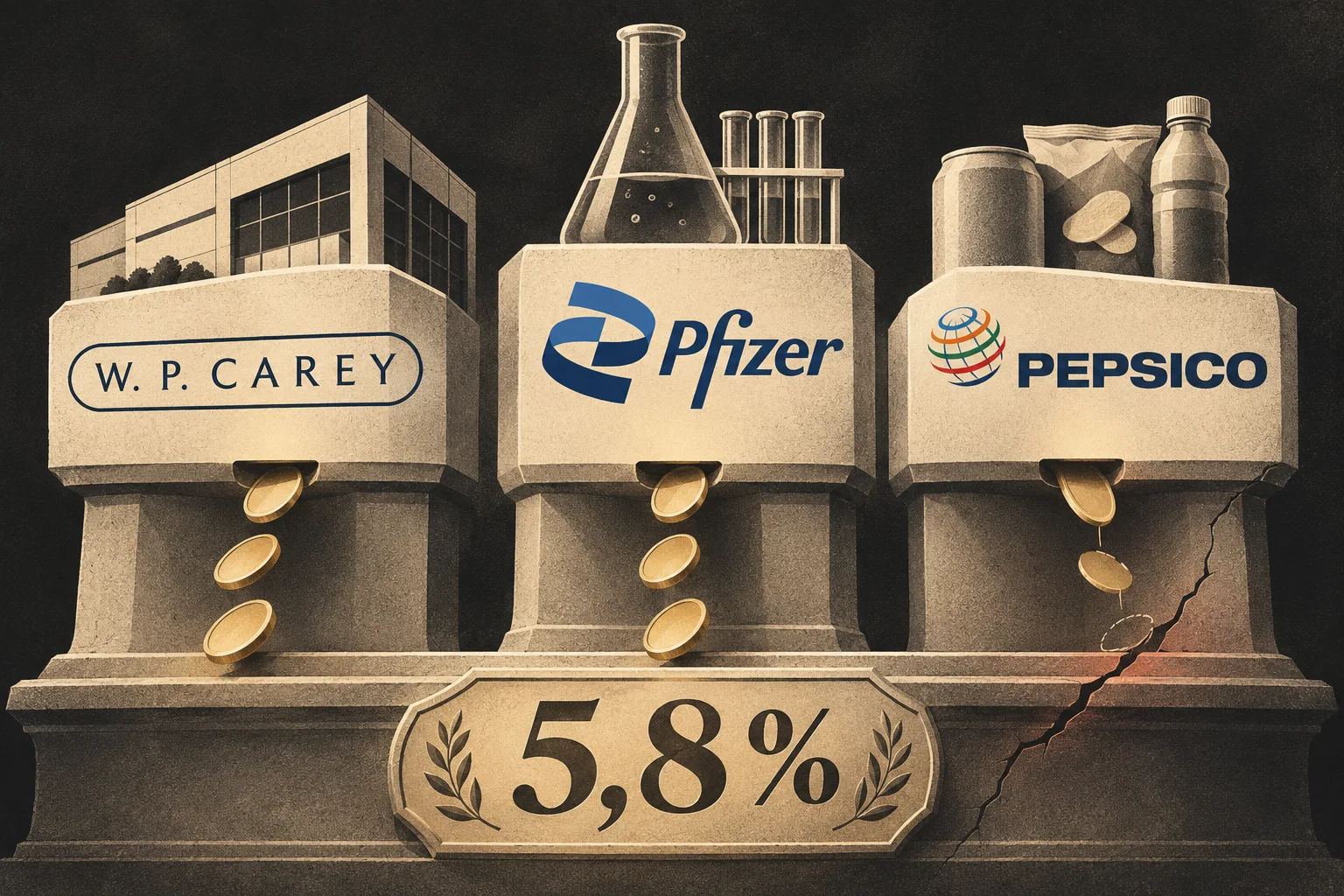
W. P. Carey, Pfizer, and PepsiCo. Based on their payout ratios, two of them are paying out more than they earn, while the third looks exemplary. But that number lies in both directions, and the actual safety ranking is different from what the stock card suggests.
Key points
Three stocks pay 4.1% to 5.8% a year, but their payout ratios rank their safety in exactly the opposite order.
One pays out 132% of its earnings and yet has the most comfortably covered dividend of the three.
Another pays out 226% of its earnings and, last year, failed to raise its dividend for the first time in fifteen years.
The third has the cleanest balance sheet, yet cut its outlook and trades like a no-growth company.
In December, one announcement will hint at whether management still believes it can maintain the payout.
Three yields that look alike. And one number that should warn you—but lies
The stock card makes it look simple. W. P. Carey $WPC pays 5.8% a year, Pfizer $PFE 5.6%, and PepsiCo $PEP 4.1%. Right next to that is the payout ratio: how much of a company's earnings it distributes to shareholders. For W. P. Carey, it's 132%; for Pfizer, 226%; for PepsiCo, 72%. According to that measure, two companies are paying out more than they earn, and only one is acting sensibly.
Stock | Price (Nov. 2, 2026) | Below yearly high | Dividend yield | Payout ratio |
|---|---|---|---|---|
W. P. Carey | 64.75 USD | -16% | 5.8% | 132% |
Pfizer | 30.67 USD | -1% | 5.6% | 226% |
PepsiCo | 140.42 USD | -18% | 4.1% | 72% |
But that number lies in both directions. All three companies have just reported quarterly results (Pfizer released its today), Pfizer is practically at its yearly high, and W. P. Carey and PepsiCo are 16% to 18% below theirs. And when you look at what actually funds the dividend, the safety ranking looks completely different from what the table suggests.
W. P. Carey: 132% of earnings, yet the most comfortably covered dividend of all
Accounting profit is a poor measure for real estate investment trusts (REITs). The company owns 1,755 buildings and depreciates hundreds of millions of dollars' worth each year, even though tenants keep paying rent and the properties aren't actually losing value. Depreciation reduces reported earnings, but it doesn't reduce the cash in the bank. That's why REITs are assessed using AFFO: operating cash flow adjusted for these accounting items.
And the picture looks different there. In the third quarter of 2026, the company generated 1.33 USD in AFFO per share and paid a quarterly dividend of 0.95 USD. That's 71% coverage, the healthiest of the three. In September, it raised its dividend by 4.4% to 3.80 USD a year, raised its full-year AFFO outlook to 5.23–5.29 USD, and same-store rents grew 2.6% year over year thanks to inflation-linked clauses in its contracts.
In September, we increased our quarterly dividend by 4.4% year over year to 0.95 dollars per share, or 3.80 dollars annually, while maintaining a healthy payout ratio of 71%.
Toni Sanzone, Chief Financial Officer of W. P. Carey
Where's the risk? Interest rates. A sharp rise in long-term bond yields makes financing more expensive for REITs and their dividends a less attractive alternative. Hertz has also been added to the watchlist of tenants; it accounts for about 0.6% of rent and could restructure its debt. But the company has actually lowered its estimated rental losses for the rest of the year to 3–5 million USD. Then there's the market's memory: at the end of 2023, W. P. Carey cut its dividend after spinning off its office portfolio, and the stock fell 41.5% from its peak at the time. Bulios's fair value of 80.95 USD and analysts' consensus of 78 USD are now 20% to 25% above the share price.
Pfizer: a dividend at 226% of earnings, a skipped increase, and the obesity bill
Pfizer is the opposite case. For the first nine months of 2026, it reported earnings of 0.99 USD per share but paid shareholders 1.29 USD, or 7.3 billion USD in total. That's where the alarming 226% ratio comes from. However, acquisition-related amortization and one-off items are weighing on reported earnings. On an adjusted basis, the company expects earnings of 2.95–3.05 USD per share this year, and its 1.72 USD dividend will take roughly 57% of that. So, on paper, it's fine.
The problem is cash. Free cash flow over the past 12 months is 11.0 billion USD, while the dividend costs roughly 9.7 billion USD a year. The cushion is thin, and the company also carries 63.2 billion USD in debt, with net debt at 4.9 times EBITDA. On top of that, in November 2025 it bought Metsera for 65.60 USD per share in cash, plus up to 20.65 USD in contingent payments—about 8 billion USD in total, potentially rising by another 2.3 billion USD if its obesity drugs pass regulatory approval. And generics will shave another 1.1 billion USD off revenue this year.
Management knows it. In December 2025, after fifteen years of increases, it left the quarterly dividend unchanged for the first time at 0.43 USD (its 349th consecutive payment). The company's capital framework calls for “maintaining and growing” the dividend over the long term, while share buybacks will come only after debt reduction. The market is ignoring this for now: after rising 24% over the year, the stock is at 30.67 USD, above analysts' consensus target price of 28.50 USD.
Our third-quarter results reflect strong commercial performance around the world and continued operational discipline... Today, we are raising our full-year 2026 revenue and adjusted earnings-per-share outlook, reflecting our strong performance to date and confidence in our business.
Cecile Guegan, Chief Financial Officer of Pfizer
PepsiCo: the lowest yield, the cleanest coverage, and yet a cut outlook
PepsiCo has the lowest yield of the three, but the cleanest numbers. Free cash flow of 12.7 billion USD versus roughly 8 billion USD in dividends, a 72% payout ratio, and debt at 2.3 times EBITDA. In 2025, it raised its dividend for the 53rd consecutive year, to 5.69 USD per share. The balance sheet doesn't threaten the dividend, and no acquisition is going to swallow it up.
But PepsiCo's dividend doesn't rest on its balance sheet; it rests on chips and soft drinks. In the third quarter of 2026, revenue rose 5.6% to 25.27 billion USD, or just 3.1% organically. Adjusted earnings of 2.34 USD per share beat the 2.29 USD estimate, but the company also cut its full-year outlook because of higher input costs and a weaker sales mix. Volumes are stagnant; prices are driving growth. The stock is 18% below its high of 171.48 USD, and at a P/E of 17.5 (compared with a five-year average of 26.3), the market values it as a no-growth company. Bulios's fair value of 132 USD is still 6% below the share price.
What will decide it: three dates and three signals
If a bad year came along, Pfizer would feel the pain first: cash flow with no cushion, high debt, and dependence on new drugs replacing those whose patents are expiring. PepsiCo is second in line; slower dividend growth is more likely than a cut, because its balance sheet can withstand declining volumes. W. P. Carey's payout is covered by long-term contracts with inflation-linked clauses, and would be threatened only by a spike in interest rates or a wave of tenant bankruptcies.
The dates that will decide it:
December 2026: Pfizer declares its dividend for the first quarter of 2027. An increase after a year-long pause would mean management believes in its cash flow; another 0.43 USD would suggest otherwise.
Feb. 2, 2027: PepsiCo's fourth-quarter results; organic volumes are the key figure.
Feb. 9, 2027 (unconfirmed date): W. P. Carey's results.
And the signals that will tell you where things are heading: for W. P. Carey, an AFFO payout ratio above 80% or a sharp rise in U.S. 10-year Treasury yields; for Pfizer, a decline in net debt to EBITDA and the first mention of resumed share buybacks as evidence that debt reduction is progressing; for PepsiCo, a return to positive organic volume growth. The high yield on the stock card won't tell you any of this. It tells you only how much the company has promised, not how it will pay for it.