


Starlink Is Changing the Rules of Satellite Internet. Who Can Compete with Musk?

In just a few years, satellite internet has gone from an expensive niche to a mass-market service, and the strongest player today earns more than all publicly traded competitors combined. Smaller operators are changing hands, new players are burning through capital to build networks, and traditional companies are paying down debt. Which strategies can create value for shareholders?
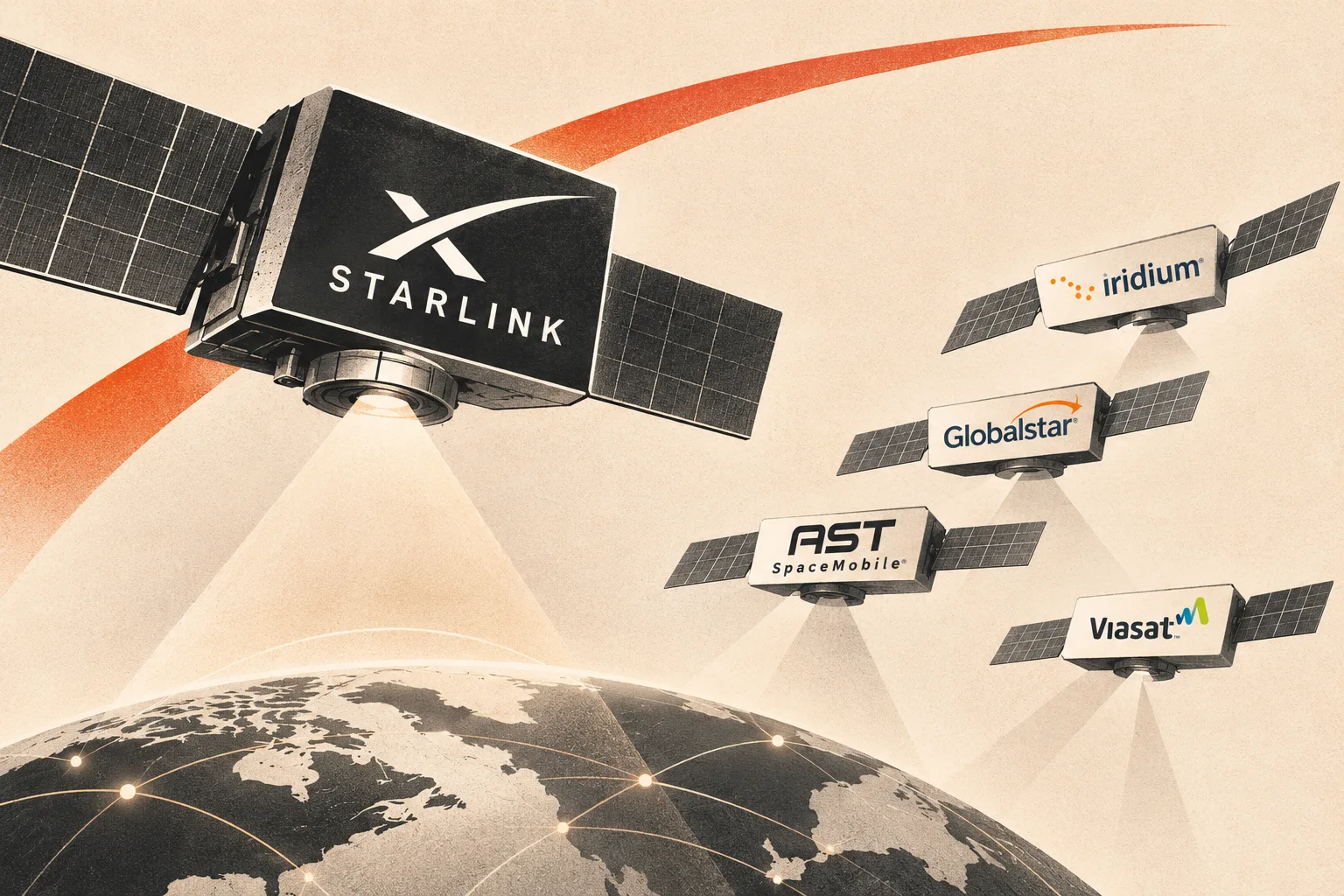
Key points
The market has a clear leader with a cost advantage. A vertically integrated operator with its own rockets is growing by double digits annually and achieving operating margins of around 45%.
The industry is consolidating. Two of the four public operators being tracked are in the process of being acquired by strategic buyers. For their shareholders, closing the transactions matters far more than the companies’ standalone prospects.
Direct-to-cell connectivity for ordinary phones is the biggest opportunity and the biggest risk. The technology already works; the economics don’t yet. Building networks costs billions, and competition is intensifying quickly.
The traditional geostationary model is under pressure. Debt can be reduced, but high EBITDA turns into only a small amount of free cash flow after investment and interest expenses.
There is still room for more players. Specialized services can succeed: mission-critical communications, the Internet of Things, aviation, government contracts, and ownership of scarce spectrum.
Satellite communications have changed more in five years than they did in the previous two decades. In 2020, they were still an expensive way to connect ships, the military, and remote cottages. Today, Starlink serves 174 countries and markets, Amazon is launching its own constellation, and mobile operators are weighing whether satellites will provide them with capacity or start taking their customers. For investors, what matters is who can turn this transformation into free cash flow—not just technological leadership.
Satellite Internet Is Changing the Rules of the Game
GEO, MEO, and LEO: Why Altitude Matters
Satellites differ primarily in orbital altitude. This determines signal delay (latency), the number of satellites needed for coverage, and the economics of the entire network.
Orbit | Altitude | Latency (approx.) | Satellites for global coverage | Typical player |
|---|---|---|---|---|
GEO (geostationary) | approx. 35 786 km | 600 ms or more | 3 to 4 | Viasat, Inmarsat |
MEO (medium Earth orbit) | 8 000 to 20 000 km | 100 to 150 ms | dozens | SES O3b |
LEO (low Earth orbit) | 340 to 1 400 km | 20 to 50 ms | hundreds to thousands | Starlink, Iridium, Globalstar, AST |
A geostationary satellite “hovers” above one location, and a single satellite can cover a third of the planet. But the signal has to travel over 70 000 km round trip, making video calls and gaming practically unusable. A low-orbit satellite is closer, so latency approaches that of fiber-optic connections, but it passes over any one location for only a few minutes. That’s why LEO networks need thousands of satellites and sophisticated handoffs between them. According to its own network update, Starlink reported a peak median latency of 25,7 ms in the US (June 2025), comparable to terrestrial connections.
Cheaper Launches Are Changing the Economics
The LEO model only makes sense if launching satellites into orbit is cheap. Satellites in low orbit have shorter lifespans (around five years), so the entire constellation must be continuously replenished. The reusable first stage of the Falcon 9 rocket has cut costs so much that SpaceX conducted 170 launches in 2025 and, according to its prospectus, launched over 80% of all mass placed into orbit worldwide. A competitor without its own rocket pays market rates for every launch and has to wait in line.
Coverage Is Not the Same as Capacity
Technical coverage means that a satellite passes over a given location. It doesn’t mean the network can serve everyone who wants access. Each satellite’s capacity is shared among all users beneath it, so LEO broadband works best in rural areas and cannot replace fiber in dense cities. The main customer segments are households without a good fixed-line connection, companies with branches in remote locations, shipping and aviation, the military and emergency services, and, increasingly, mobile operators looking to cover dead zones.
Starlink: The Benchmark for the Entire Sector
From Experiment to 13,6 Million Customers
SpaceX launched the first production Starlink satellites in 2019. According to the S-1 prospectus, the service had 2,3 million subscribers at the end of 2023, 4,4 million a year later, and 8,9 million at the end of 2025. As of 30. 9. 2026, it had 13,6 million consumer customers (plus hundreds of thousands of business customers), approximately 11 100 satellites in orbit, and availability in 174 countries or markets (SpaceX 3Q 2026 earnings report).
In Czechia, residential plans cost 745 Kč, 1 010 Kč, and 1 545 Kč per month, depending on speed, according to the price list at starlink.com (October 2026). In many locations, the terminal can be rented with no upfront payment. Starlink is therefore competing directly with fixed-line and LTE connections in rural areas on price.
Starlink Economics in Numbers
Since its IPO, SpaceX has reported Starlink as part of its Connectivity segment. Verified figures from official filings:
2025 (S-1): revenue of 11,4 mld. USD (+50 %), operating profit of 4,4 mld. USD (margin 39 %), adjusted EBITDA of 7,2 mld. USD.
2Q 2026: revenue of 4,29 mld. USD (+66 %), 12,0 million subscribers, ARPU of 66 USD.
3Q 2026: revenue of 5,25 mld. USD (+69 %), operating profit of 2,37 mld. USD (margin 45 %), ARPU of 69 USD.
On an annualized basis, Starlink is therefore generating over 20 mld. USD in annual revenue, more than four times Viasat’s revenue. The flip side: ARPU (average monthly revenue per customer) has fallen by a third since 2023. Growth is being driven by cheaper plans and emerging markets. Starlink is growing through volume, not price, and that is putting downward pressure on competitors’ prices, too.
An important accounting note: SpaceX does not charge itself intercompany revenue for launching its own satellites. It capitalizes launch costs as part of the satellites’ value and depreciates them over time. Starlink’s reported margin therefore depends on how launch costs flow through to depreciation.
Vertical Integration and Starship
SpaceX develops and manufactures satellites, launches them itself, and operates the network and sales. This integration has two advantages. First, cost: competitors pay a margin to rocket suppliers. Second, speed: Starlink can add capacity at a pace no one else can match. In July 2026, Starship launched 20 production V3 satellites on Flight 13, and the first commercial Starship mission, with 26 V3 satellites, took place in 3Q 2026. According to Starlink, each V3 satellite has over 1 Tbps of capacity to users.
Starlink Mobile Is Targeting Operators
The Direct to Cell service (now Starlink Mobile) currently operates through partners such as T-Mobile in the US and KDDI in Japan. In 2025, SpaceX bought spectrum from EchoStar for around 17 mld. USD, later acquired additional bands, and in October 2026 the FCC approved up to 15 000 next-generation satellites for mobile service. According to SpaceX, the more powerful service is expected to launch in late 2027. President Gwynne Shotwell said on the 2Q 2026 earnings call that the company wants to turn Starlink into a full-fledged mobile operator. This poses a direct threat to AST SpaceMobile $ASTS and terrestrial operators.
Where Starlink Has Limits
Capacity in densely populated areas: in some regions, Starlink limits new orders or charges congestion surcharges.
Constellation replacement: satellites’ five-year lifespan means ongoing investment; this is not a one-time build.
Regulation and spectrum: licenses are issued country by country, and a number of countries (India, for example) have delayed the process.
Geopolitics: governments’ dependence on a service run by a single US company and majority shareholder is politically sensitive, benefiting alternatives such as Europe’s IRIS² or Amazon Leo.
Conglomerate structure: in 3Q 2026, the Super Intelligence (xAI) segment accounted for 7,56 mld. USD of total revenue of 14,6 mld. USD and consumed 16,4 mld. USD of 19,6 mld. USD in investment. Anyone buying $SPCX isn’t buying a pure-play satellite business.