


AI Companies Living on Debt

The race for artificial intelligence has long since become more than just a battle of technologies. It has become a battle for capital. Data centers, chips, and production lines cost hundreds of billions of dollars, and companies’ own cash often isn’t enough to pay for them. So companies borrow in the bond market, sell new shares, put together complex off-balance-sheet structures, and sign multiyear commitments. Which of them is borrowing prudently, and where is there a risk lurking beneath the surface that you might not see at first glance?
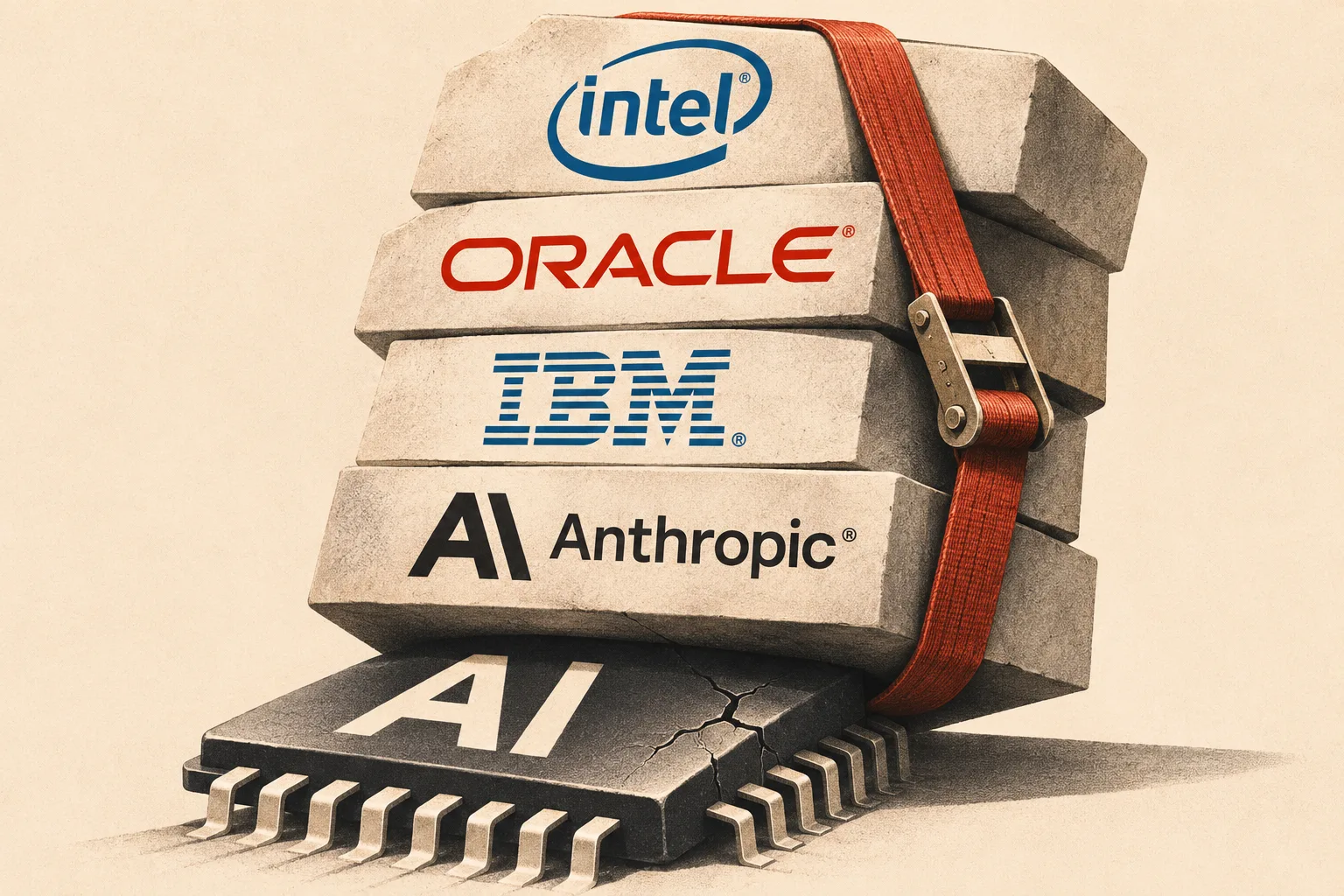
Key points
The race for artificial intelligence is turning into a race for capital. Estimates suggest that AI-related debt could exceed $1 trillion by 2028, and some technology companies are already investing significantly more than they can earn.
One of the best-known technology companies has more than $169 billion in debt, and its credit rating has fallen to the lowest notch of investment grade. Yet it holds hundreds of billions of dollars in orders. Can it turn them into cash quickly enough?
Intel has more cash than debt on its balance sheet, yet its financial position isn’t as safe as it seems. Over the past 15 months, it has raised approximately $45 billion in external capital, but shareholders are paying for it through substantial dilution of their stakes.
One AI company has almost no debt on its balance sheet and more than $130 billion in cash. Off the balance sheet, however, it has hidden long-term commitments for computing capacity worth hundreds of billions. These could pose a much greater risk than conventional bank loans.
Four companies, four completely different ways of financing the AI boom. While one can handle high debt thanks to stable cash flow, others rely on new shares, loans, or future revenue from huge contracts. Which of them is best placed to weather a potential slowdown in AI investment?
Just 3 years ago, a simple rule applied: large technology companies financed their investments from their own cash flow and used debt only marginally. The year 2026 definitively broke that rule. Capital expenditure (capex) on AI infrastructure is growing faster than operating cash, so the gap has to be filled from somewhere. According to analysts at Morgan Stanley $MS, AI-related debt could exceed $1 trillion by 2028, and the October selloff in technology stocks showed that the market is beginning to watch this equation very closely.
The key is to understand that “living on debt” doesn’t mean the same thing for every company. Some borrow in the conventional way on the bond market, and their credit rating is nearing the speculative-grade threshold. Another took on debt to fund an acquisition but generates enough cash to repay it comfortably. A third is financing a huge investment plan mainly with new shares and government money. And a fourth has almost no debt on its balance sheet but has signed commitments worth hundreds of billions of dollars off it. That’s why this analysis looks beyond a single number to the entire financing structure.