


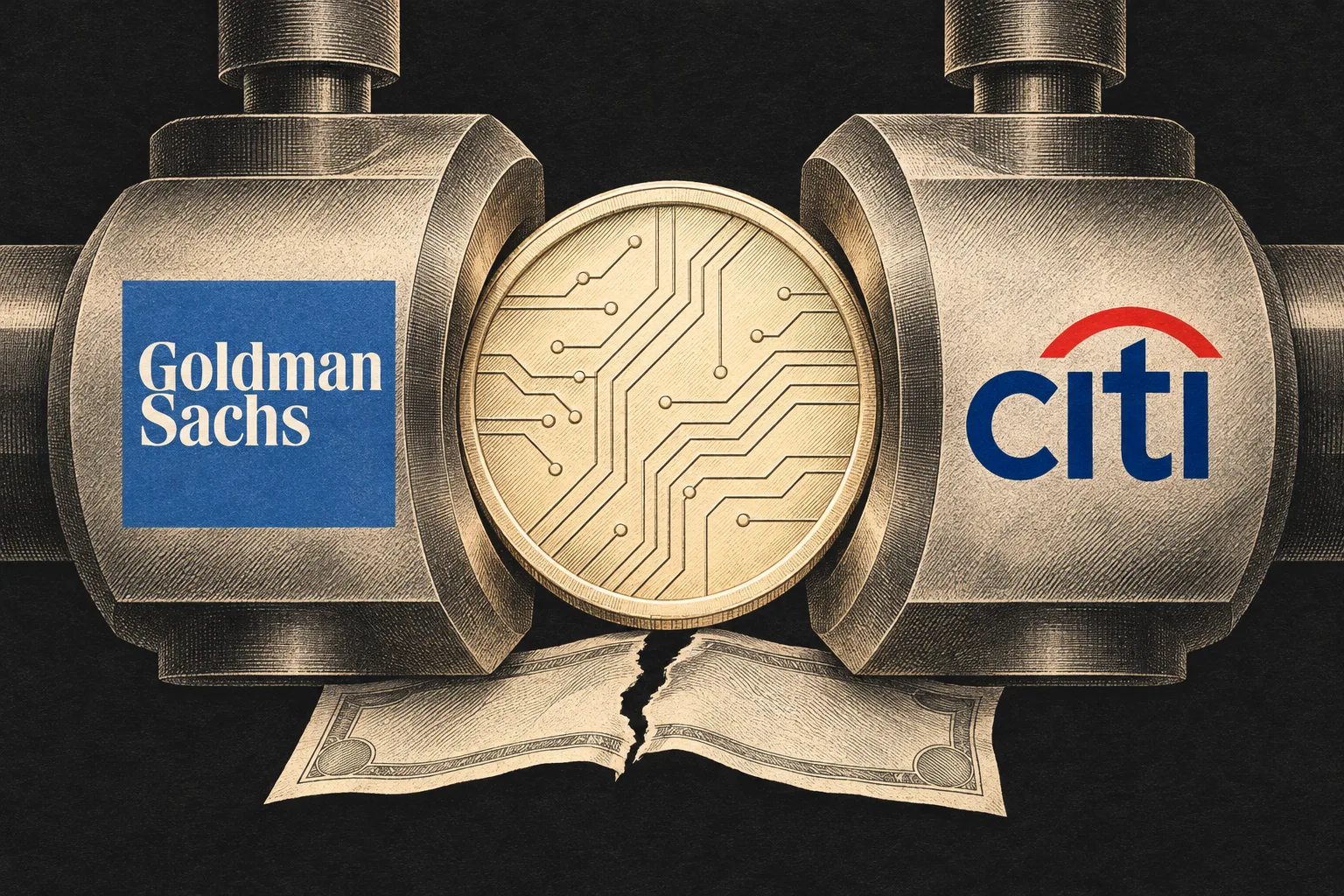
Goldman and Citi are building their own digital dollar. Who loses out?

Goldman Sachs, Citi and 19 other banks have committed $270 million to their own digital dollar. Shares of the company whose digital dollar currently handles most payments in the industry have lost 81% from their peak. Yet for every dollar it earns, it passes 62 cents to someone else.
Key points
Twenty-one banks including Goldman Sachs and Citi have committed $270 million to a company with no name, no CEO and no product
For every dollar Circle earns on reserves, it keeps less than 38 cents
The stock is down 81% from its peak, yet it trades at a triple premium to its industry
The biggest crack in Circle's story has nothing to do with banks and hides in one line of its results
A US law effective January 2027 bans the very thing banks could use to lure clients most easily
Twenty-one banks and a dollar that has no name yet
Goldman Sachs, Citi, Santander, Deutsche Bank and seventeen other financial institutions have earmarked $270 million for a company that so far has no name, no CEO and no product. It only has an internal code name Project Faro and a single goal: to issue its own digital dollar, a token that is always worth exactly one dollar and can be sent over the internet like an email. They plan to launch in the first half of 2027.
The market understood who this is aimed at. Shares of Circle Internet Group $CRCL, the issuer of the USDC digital dollar, fell 6% when the consortium was announced in September and dropped again after the funding news on 10 November. From its peak last June, it has lost over 80%.
The reason for the fear is simple. Circle earns like a bank, just without a banking licence: people and companies entrust dollars to it, receive USDC in return, and Circle invests those dollars in short-term US government debt. It keeps the interest. It pays nothing to USDC holders - the law even forbids it.
And that is exactly what banks can do too, more cheaply and with their own clients, to whom they need not explain anything. A company that was a symbol of the new financial world now faces being copied by the old one.
Yet Circle's latest results show something that did not fit into the bank headlines. The biggest hole in its business has nothing to do with banks. Circle already hands over most of what it earns to someone else. To whom and why is revealed by a single line in its accounts.