


Google Accelerates Its In-House TPU Chips | Future Intelligence #35

Over the past week, the center of gravity in tech shifted from raw computing power to who owns it and how it reaches users. Bottlenecks and competitive pressure are emerging beyond the accelerators themselves - in optics, data, and what you wear on your face. Google expanded its eighth-generation TPUs with two systems available in 2027 and increased the pace of its in-house silicon to four systems a year. Samsung and Google opened preorders for Android XR glasses starting at $395, with 30 frame options. Microsoft is pressing the White House to stop a planned ban on imports of Chinese optical transceivers - a component AI data centers cannot operate without.
Future Intelligence is an exclusive analytical report published once a week and available only to Bulios Black members. Members receive it automatically every Sunday morning by email - in full, including concrete scenarios and market implications. Membership in Bulios Black gives you ongoing access to the report.
Key points
Why Google accelerated development of its own chips to four systems a year and what it is aiming for
What $395 Android XR glasses mean for Samsung and the entire wearable electronics market
How Disney plans to train generative models exclusively on its own archive with Adobe
Why the success of base editing for sickle cell disease is a milestone beyond gene therapy itself
What lies behind the dispute over Chinese transceivers, the Cybercab price, and changes to Meta's infrastructure
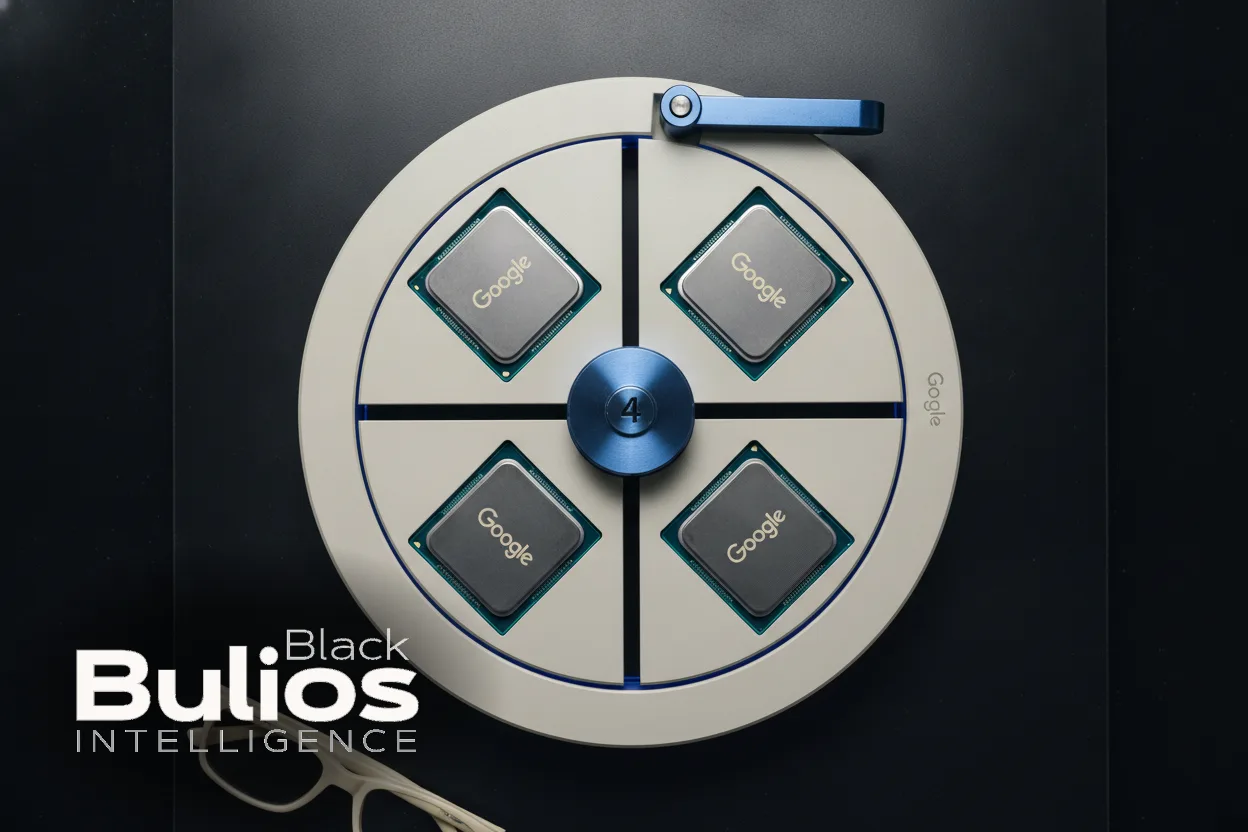
TPU 8tx and 8i Max: Google accelerates its in-house silicon to four systems a year
On November 9, Google expanded its eighth generation of tensor processing units with two systems - TPU 8tx for confidential computing and TPU 8i Max for workloads with very long context. Both will be available in 2027 and build on April's TPU 8t and 8i.
What matters is not one chip, but the pace. “For the first time, we introduced four TPU systems in a single year,” wrote Amin Vahdat, vice president and chief technologist for AI and infrastructure. Until now, the division had released one new processor every two years.
What the new systems actually change
Neither system features new silicon. Google reconfigured the existing eighth generation around what customers repeatedly asked for. The faster cadence is therefore an advantage in system integration, not manufacturing - and that is precisely why it can be replicated faster than a new chip design.
TPU 8i Max combines two 8i chips in a single package: double the computing power, 768 MB of SRAM per chip, and 17.2 TB/s of HBM bandwidth, twice that of the 8i. HBM capacity increases to 384 GB, roughly a third more, in the same rack footprint.
When dozens of agents read an entire codebase or hours of video at once, the bottleneck stops being computation and becomes data movement between memory and cores. This is called the memory wall, and 8i Max tackles it with brute force - more silicon and more bandwidth in the same footprint.
TPU 8tx targets something else: data that must not leave a protected environment, even while being processed. It targets government agencies and regulated industries, uses the low-latency Boardfly network from 8i, AMD EPYC Turin host processors, and offers up to twice the latency performance of 8t.
From an internal tool to a market product
According to Google, nearly 100 customers now use TPUs - from cutting-edge research labs to trading firms, retailers, and universities. Google is also delivering complete systems to customer data centers and expanding distribution through partners including Oracle and Crux AI.
There are two major customer references. Anthropic will have access to around 3.5 gigawatts of TPU-based capacity starting in 2027 through its partnership with Google and Broadcom, and Alphabet says Apple is training its foundation models on the latest generation.
Economics is a stronger argument than specifications. For the previous generation, SemiAnalysis estimates total cost of ownership to be up to 30% lower than GB200 and 41% lower than GB300. Better PyTorch support also lowers switching costs for developers accustomed to the competing platform.
Who is paying for the acceleration
The faster cadence comes with a price tag. Alphabet reported negative free cash flow of $9.1 billion in the third quarter, while Google Cloud revenue reached $30.7 billion, with TPU system sales contributing significantly. Both new systems, however, will not arrive until next year.
Financing is shifting to the debt market. Alphabet launched its first-ever bond offering in Hong Kong and Singapore dollars, aiming to raise around $3 billion equivalent; initial pricing guidance for the Hong Kong tranche was around 4.6% for two-year notes, 5% for five-year notes, and 5.5% for ten-year notes.
Manufacturing is also seeing demand. TSMC reported October revenue of NT$586.89 billion (around USD 17.88 billion), up 59.7% year over year and 14.7% above September. TPUs and competing GPUs are made in the same fabs, so Google's acceleration is more likely to increase volume for $TSM than shift it elsewhere.
The market priced in the shift gradually. $GOOG shares closed up 0.7% at $286.01 on the day of the announcement, with the biggest move coming on Wednesday, up 2.0% to $290.63; Thursday added 1.6% to $295.35 and Friday gave back 1.0% to $292.52. The stock rose 3.0% for the week.
For $NVDA, this is not a customer leaving - Google Cloud plans to deploy the Rubin generation while also selling competing silicon. The change is that from 2027, the biggest buyers of computing power will have a second full-fledged option, benefiting $AVGO and $AMD as well.
Android XR goes on sale: Samsung enters the $395 glasses market
On November 12, Samsung and Google opened preorders for the first glasses on the Android XR platform. The Intelligent Eyewear collection offers three Warby Parker styles and six from Gentle Monster, for a total of 30 frame options. Sales start December 10 in the US and South Korea.