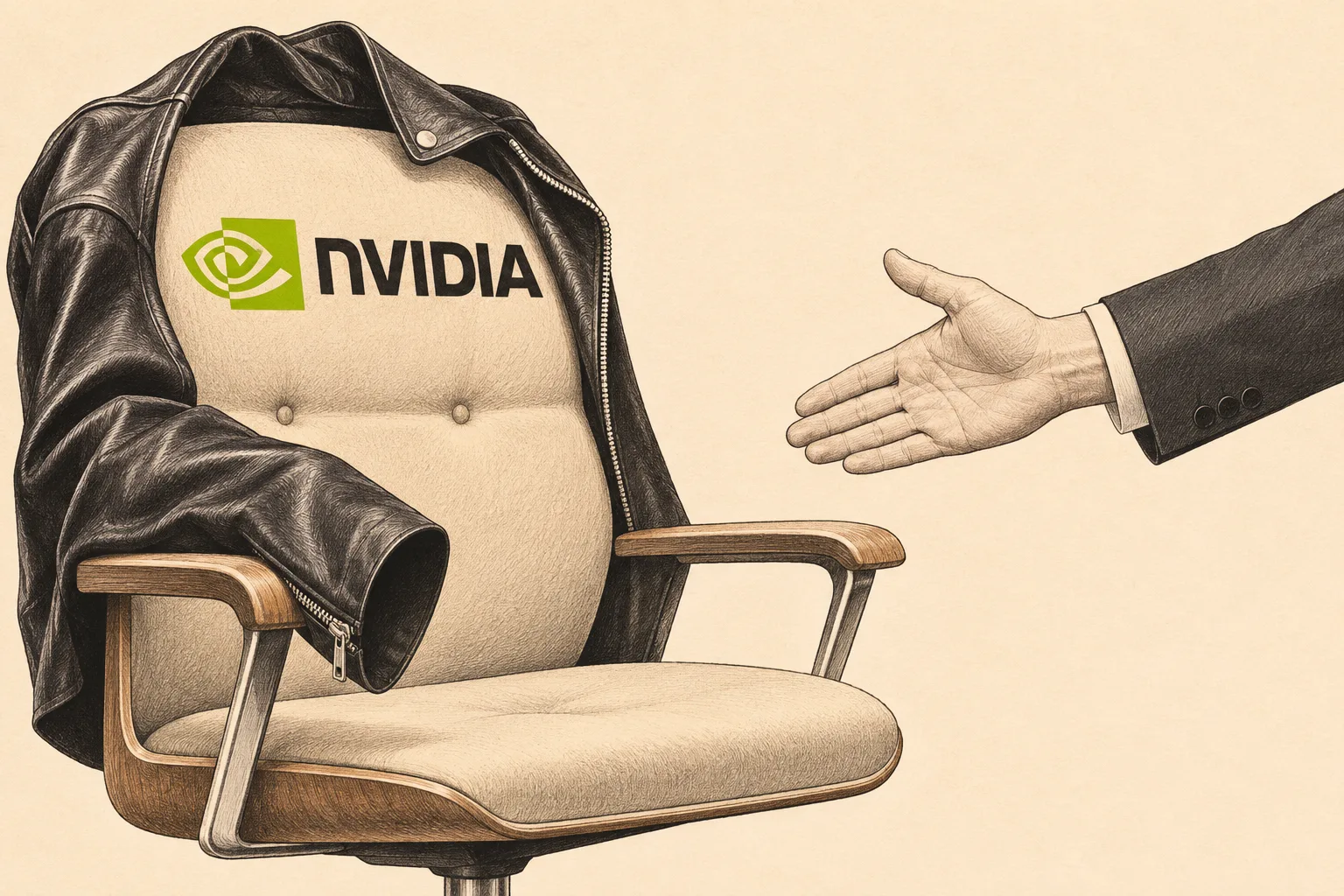
Huang sealed billion-dollar deals with a handshake. Now Nvidia could lose some of them without him

Deals worth hundreds of billions of dollars without contracts, and suppliers that built factories on Huang's word. After his departure, Nvidia was left with $279 billion in commitments and uncertainty over which verbal agreements are still in effect.
Key points
According to Huang, Nvidia still has no contract with the maker of its most powerful chips, even after 30 years.
Suppliers built factories worth billions based solely on Huang's word.
The company was left with $279 billion in commitments after his departure.
All of Nvidia's $NVDA most powerful chips are made by Taiwan's TSMC $TSM. You might expect that the relationship on which the world's most valuable company depends would be safeguarded by thousands of pages of contracts. But in an interview with Lex Fridman this March, Jensen Huang described the exact opposite: over three decades, the two companies have done business worth hundreds of billions of dollars, and, he said, they have no contract with each other.
As long as Huang was running the company, it sounded like a nice story about trust. Since November 12, when the board announced his departure after 33 years, it has become the biggest question mark over Nvidia's future. Huang stepped down a few days after admitting to an extramarital affair with a woman whom US intelligence agencies suspect of spying for China. Longtime CFO Colette Kress has taken over temporarily.
A CEO can be replaced. Deals that were never put on paper and held together only because a particular person stood behind them are harder to replace. Meanwhile, the share price has fallen by about a third from its October record.
Billion-dollar investments on a single word
In the March interview, Huang also described how he managed the supply chain. He personally visited the heads of partner companies, explained what demand would look like two or three years down the road, and asked them to invest billions in new capacity. They did it because they trusted him. And he trusted them to deliver what they promised.
A supply chain built this way has one weakness: the trust belonged to Huang, not the company. Elon Musk, CEO of Tesla $TSLA, said so publicly when he joined voices calling for Huang's return on X on Saturday.
"Many of those deals were based on a handshake with Jensen, not a written contract."
Elon Musk, CEO of Tesla, on X
Musk says the company will lose some of these key deals without Huang. No evidence has been presented so far, and no supplier has publicly said it would scale back its partnership. But the concern was enough to turn a personnel scandal into a debate over whether Nvidia can continue making as many chips as it promised.
1.3 million components in a single rack
The company's latest product shows why suppliers matter so much. Nvidia no longer sells just chips, but entire server racks packed with computing hardware. A single Vera Rubin-generation rack contains around 1.3 million components.
When the company announced this spring that the Vera Rubin platform was ramping up to full production, it spoke of hundreds of partners:
150 suppliers in Taiwan alone
more than 350 factories
production in 30 countries
According to Nvidia, the entire supply chain is about twice as large as for the previous Blackwell generation. And it only works if everyone delivers on time. If one type of memory or connector is missing, a finished rack worth millions of dollars sits in a warehouse.
At a time when all the major players in AI are competing for manufacturing capacity, a supplier's trust can determine who gets priority. Huang spent three decades building that trust.
A $279 billion bill
It would be an exaggeration, however, to say that Nvidia relies only on verbal promises. In its latest quarterly filing with the US Securities and Exchange Commission, the company reported $279 billion in commitments to suppliers. The quarter before, that figure was $119 billion. The commitments are mainly for memory and manufacturing capacity, and the vast majority are due within two and a half years.
Period (Nvidia's fiscal year ends in January) | Commitments |
|---|---|
remainder of fiscal 2027 | $92 billion |
fiscal 2028 | $87 billion |
fiscal 2029 | $88 billion |
fiscal 2030 and beyond | $12 billion |
Total | $279 billion |
So these agreements are on paper. But the filing also acknowledges that some can be canceled, postponed or modified before becoming binding orders, and that any such change could mean additional costs.
The risk goes both ways. Nvidia has committed to taking enormous volumes at a time when its share price is falling and the company is under interim leadership. And suppliers that built new production lines for Nvidia now don't know who they'll be dealing with a year from now. The board itself says operations, commitments to customers and the new product schedule are continuing without interruption.
"The board has full confidence in Colette and the entire leadership team."
Harvey Jones, Nvidia board chair
A return? The board isn't discussing it
Meanwhile, Huang's supporters have launched a campaign. More than 180,000 people have signed a petition calling for his return, and two prominent shareholders, funds Altimeter Capital and Atreides Management, have urged the board to keep all options open. According to the Financial Times on Sunday, Huang himself has discussed the possibility of returning with people close to him.
The board has other concerns. According to a source familiar with its deliberations, it isn't discussing Huang's return at all and is focused on an investigation into whether his conduct endangered national security or corporate secrets. The investigation is being led by law firm Wachtell Lipton. Rene Haas, head of Arm Holdings $ARM, has emerged as a possible successor, but the board says the formal selection process has not yet begun.
Polymarket bettors put the odds of Huang returning by the end of this year at around 11%, and by the end of 2027 at about 38%. A small chance, but not zero.
The first results without the founder
On Tuesday, November 17, after US markets close, Nvidia will report its third-quarter results. The company has set a revenue target of around $108 billion, and Colette Kress will present the figures for the first time in a dual role as CEO and CFO.
The revenue itself is unlikely to surprise, since it was generated while Huang was still at the helm. More important will be what management says about memory shipments, costs and how quickly Vera Rubin production is ramping up.
Whether Huang's handshakes still hold without him will only become clear in the coming quarters, when suppliers decide who gets scarce capacity. Nvidia has a strong argument in the form of orders worth hundreds of billions. But 30 years of personal trust don't transfer to a new CEO along with the office.
Stocks mentioned