Four “boring” stocks from the shopping basket, two opposite fortunes: each hinges on a single number

Toothpaste, chocolate, coffee and frozen pizza. Four “boring” stocks from the same shopping basket, but two are at their yearly highs and two are far below them. Yet each hinges on a single number that has nothing to do with the brand.
Key points
Four companies selling everyday shopping-basket goods sold $54 billion worth of products in a year, but their stocks went in opposite directions.
The highest dividend yield of the four, 6.9%, is no longer what the company is paying.
The chocolate maker increased earnings by 103%, yet its stock is still 27% below its high.
The toothpaste maker trades at a P/E of 39, the level of software companies, and the market is already betting on a turnaround in the US.
For each of them, a single number in the upcoming earnings report will decide the story. The reports are due by February 4.
The same shopping basket, two opposite fortunes
People buy Colgate toothpaste, Reese's bars, Folgers coffee and Birds Eye frozen pizza or vegetables every week, regardless of what the stock market is doing. That is precisely why these stocks are called “boring”: they do not grow like tech companies, but they are supposed to hold their value and pay dividends. This year, that certainty stopped holding true, but in different ways for each.
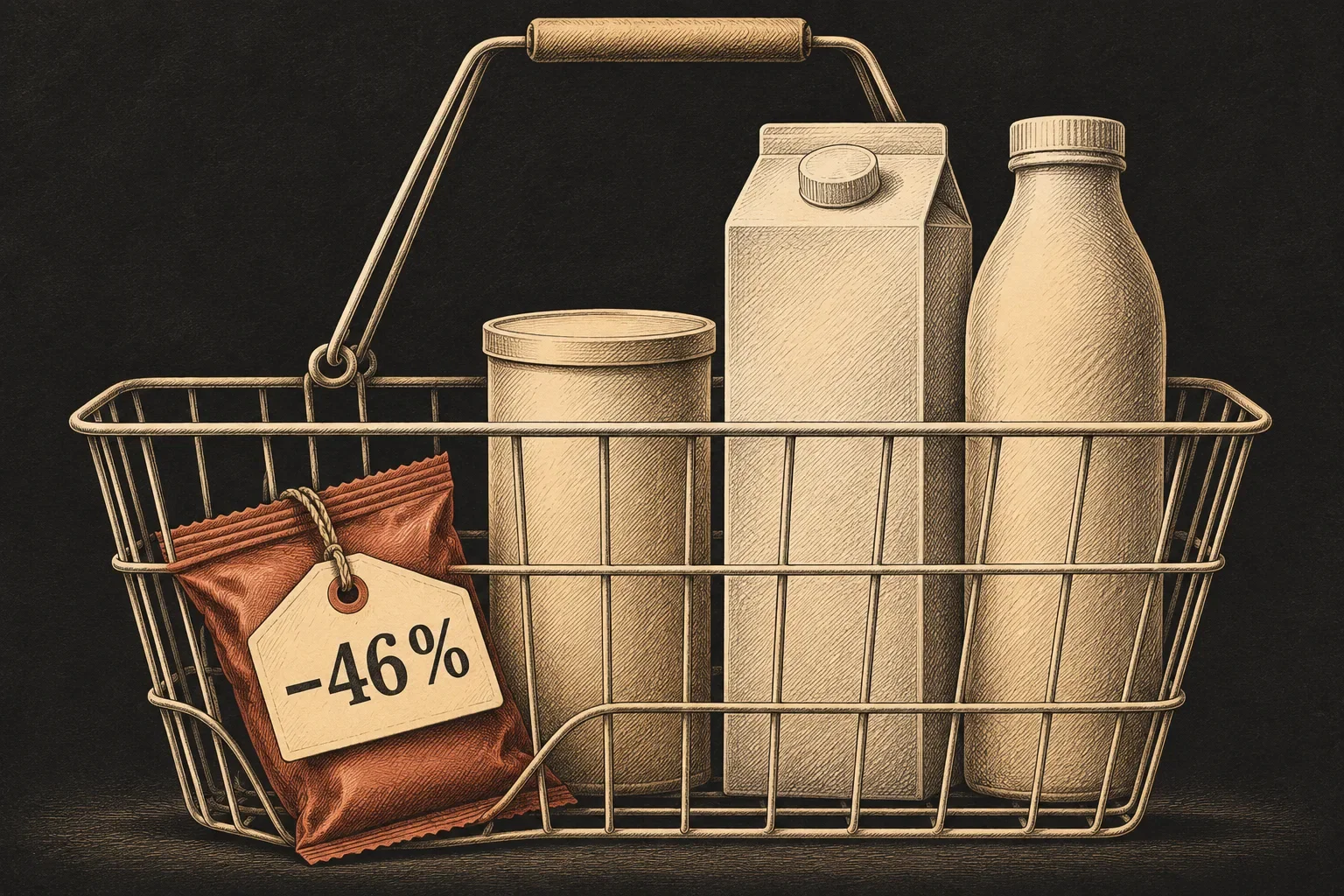
The market split the very same shopping basket into two camps. Colgate-Palmolive $CL and J. M. Smucker $SJM gained more than 27% over the year and are trading just a few tenths of a percent below their yearly highs. Conagra Brands $CAG has lost 46% in three years and is at its lowest in a decade; Hershey $HSY is 27% below its peak. All four sell practically the same things they did last year.
Company | Price | Yearly low - high | Below high | P/E | Dividend |
|---|---|---|---|---|---|
Conagra | 15.16 USD | 12.53 - 20.32 USD | -25 % | loss | 6.9 % |
Hershey | 174.87 USD | 156.16 - 239.48 USD | -27 % | 19.6 | 3.3 % |
Colgate | 100.99 USD | 75.96 - 101.81 USD | -1 % | 39.1 | 2.1 % |
Smucker | 135.54 USD | 88.25 - 136.30 USD | -1 % | 63.1 | 3.3 % |
For each of them, a single number that has nothing to do with brand value is decisive: debt, cocoa, the American shelf and the price of coffee.
A 7% dividend that no longer exists
Conagra's 6.9% yield is based on what the company paid out over the past twelve months. But new CEO John Brase, who has been in the role since June, cut the quarterly dividend from 0.35 to 0.175 USD on July 15. Based on the new annual rate of 0.70 USD, the yield is 4.6%, not 7%. This happened a month after the stock was removed from the S&P 500 index and on the same day the company wrote down $2 billion in brand value. As a result, it has posted an accounting loss of $1.9 billion over the past twelve months.
Operationally, however, Conagra does not look like a company in crisis. In the first quarter of fiscal 2027, it earned an adjusted 0.41 USD per share, significantly more than analysts expected, while organic sales fell just 1.1%. Free cash flow over twelve months reached $877 million, covering the new dividend more than twice over.
The core problem lies elsewhere: $7.8 billion in debt against a company market value of $7.2 billion. Net debt is 3.99 times annual operating profit, and the company wants to bring it down to three times. But it will repay only about $250 million this year; at this pace, it would take years. Analysts take a sober view: their average price target of 13.75 USD is below the current price.
“We expect to repay about $250 million of debt this year. Our target is three times. We are obsessed with getting there as quickly as possible.”
David Marberger, CFO of Conagra Brands
11% fewer bars, 13% higher prices
Hershey is the exact opposite: earnings are growing at a record pace, yet the stock is still 27% below its high. In the third quarter, it earned an adjusted 2.64 USD per share, 103% more than last year, and gross margin jumped by nearly 11 percentage points to 42.7%. The company raised its full-year earnings growth forecast to 36 to 38.5%.
But beneath the surface is a number that keeps the market up at night. The volume of chocolate sold in North America fell 11%, yet sales still grew because prices rose by 13 points. In other words, Americans are buying a tenth fewer bars and paying an eighth more for them. That equation works only until customers reach for a cheaper brand.
The valuation reflects that: P/E of 19.6 versus a five-year average of 26.9. Cocoa remains a risk. CFO Dave Hulays admitted on the conference call that if current conditions persist, earnings growth in 2027 could end up below the planned low-double-digit range.
“We continue to see speculation around El Niño affecting market prices. We do not expect cocoa to remain at current levels in the long term.”
Dave Hulays, CFO of Hershey
Two the market believes in - and two holes beneath the paint
Colgate is the most expensive stock of the four. A P/E of 39 is a level the market usually assigns to software companies, not a toothpaste maker. The numbers are solid: organic sales grew 3.6% in the third quarter, the company holds 41.4% of the global toothpaste market and gross margin is above 60%. But its home market, North America, fell 1.6% and volumes there dropped 3.7%. The company is therefore rebuilding its entire US sales model, with costs continuing into 2027.
There is practically no room for error here. The analysts' average price target of 100.14 USD is below today's price, and Bulios estimates fair value at 76 USD. The market has already priced in a turnaround in America that has yet to happen.
“But it is clear that the business model we are now implementing is helping us offset the very stubborn cost environment we are facing around the world.”
Noel Wallace, CEO of Colgate-Palmolive
Smucker made money on coffee this year. Coffee segment sales rose 13% and its profit increased 124% to $300 million; adjusted earnings per share of 3.24 USD crushed expectations, and the company raised its forecast. The P/E of 63 is misleading: it is a remnant of last year's write-downs, and based on expected earnings the multiple is just 12.6.
But three things do not fit the picture. Of this year's record, 0.84 USD per share came from one-time tariff refunds that will not recur. The company itself expects full-year sales to fall by 1 to 2%. And it has $43 million in cash against $6.9 billion in debt; the dividend amounts to 207% of accounting earnings. It is supported by free cash flow, not profits. The next results are due as soon as November 24.
What will decide the next 90 days
All four companies will show their cards within three months: Smucker on November 24, Conagra on December 18, Colgate on January 29 and Hershey on February 4. For each, it is enough to watch one number:
Conagra: net debt below 3.9 times operating profit and organic sales better than the forecast 2% decline. If so, the 4.6% dividend is covered and the stock is cheap. If debt rises, the price will simply track earnings downward.
Hershey: North American volume better than -11% and cocoa prices that do not derail the 2027 outlook. If both conditions are met, a P/E of 19.6 is the lowest in five years for a company whose earnings are growing.
Colgate: North America returning to growth and the first outlook for 2027. Without that, there is no reason for a stock at its yearly high to keep rising.
Smucker: coffee segment margin after the tariff refunds run their course. If it stays above 30%, the forward P/E of 12.6 makes sense; if it falls, the market was paying for a one-time effect.
The difference between a cheap company and one whose share price is merely falling more slowly than its earnings will not show up in the stock price. It will show up in these four numbers.