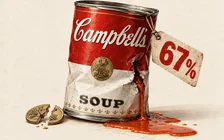
European and American banks are failing and floundering. But it could have a surprisingly positive outcome

The worst situation since 2008. At least that's what all the headlines are saying. But what if this financial catastrophe could have a surprisingly positive effect and a follow-up that no one would have expected at first sight?

The collapse of the banks could have an unexpectedly positive outcome
Credit Suisse $CS has just had its worst day ever - shares are down 22%. The bank's bonds are also plunging and investors are freaking out. With investors questioning the solvency of one of Europe's largest banks, the safety and soundness of the entire global banking system is once again a big question mark for Wall Street. In the United States, meanwhile, investors are still dealing with the fallout from the failures of Silicon Valley Bank $SIVB and Signature Bank.
https://www.youtube.com/watch?v=Q_AuoR3lkpk&t=100s
The once-difficult task now facing Federal Reserve Chairman Powell and his fellow central bankers has just become a seemingly impossible dilemma - continue to fight inflation by raising rates further and tightening credit markets, or fight a new banking crisis that poses systemic risk.
I don't know about you, but I wouldn't want to be Fed chairman right now.
It's worth remembering that just last week Fed Chairman Powell sat before Congress and said the Federal Reserve was "prepared to increase the pace of rate increases." He hedged his statement by referring to the need to consider the "totality of incoming data".

The Fed was ready to raise rates. Source
The yield on 13-week U.S. Treasury bills jumped the most in two months - surpassing 4.8% for the first time since 2007. Meanwhile, the S&P 500 index had its worst day in nearly six months, settling at a six-week low. Whether or not Powell's visit to Capitol Hill last week was the proverbial last straw, he and his fellow central bankers face a monstrous decision next week with tough choices and no ideal solution.
One economist says the Fed is likely to decide between raising rates by 25 basis points and leaving rates at current levels. (Bond futures as of Wednesday afternoon assign equal probability to both options).
"I doubt they will cut rates," Rajan tells Yahoo, which also argues that a more aggressive 50-basis-point rate hike is probably off the table. "That would be a pretty harsh hike at this point that the markets might not unwind," he adds: "The question is 25 or zero."
Historically, the Fed doesn't change the direction of interest rate policy very often, and market participants could get the impression that future rate hikes are off the table. That could undermine the Fed's credibility in fighting inflation and its perceived determination to start raising rates again if inflation doesn't ease. If the Fed raises rates by 25 basis points, it suggests that the Fed is still concerned about inflation and the need to slow the economy. However, this option risks further freezing credit markets and deepening cracks in the financial system.
"The turmoil in the financial sector will do some of the work for the Fed. If the Fed believes the crisis is strong enough to do the dirty work, the Fed will lean toward zero, he explains. "This is all up in the air and very confusing," Rajan says.
If the Fed doesn't move, it risks damaging its hard-won credibility in the midst of the battle against inflation. If the Fed moves to hike, it could exacerbate deteriorating credit market conditions and contaminate "productive" areas of the economy. However, if it makes the right decision, it could indeed make a surprisingly positive outcome out of the situation!
Disclaimer: This is by no means an investment recommendation. It is purely my summary and analysis based on data from the internet and other sources. Investing in the financial markets is risky and everyone should invest based on their own decisions. I am just an amateur sharing my opinions.