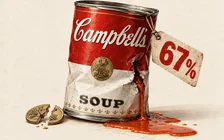
Get ready for a 50% drop and the S&P around 2000, warns noted economic bubble expert Jeremy Grantham

A well-known financial veteran and investor is worried that the long-term wild market situation will result in a super crash that could send a well-known index to half its value and cause investors tremendous pain. What is he basing this on?

Who is Jeremy Grantham?
Jeremy Grantham is a British-American investor and the founder of GMO (Grantham, Mayo, & van Otterloo), an investment company that specializes in stocks and bonds. He is known for his pessimistic predictions about the markets and the world economy. Grantham was born in England and studied mathematics at the University of Sheffield and managerial economics at Harvard University. He then worked in various investment companies before founding his own company, GMO, in 1977.
Grantham is renowned for his long-term views on markets and his predictions about potential market bubbles and crises. In 2000, he predicted that the technology market bubble would soon burst, which it did. In 2007, he warned of a global financial crisis and its consequences on the world economy. Grantham is also known for his interest in conservation and the environment. In 2011, he founded the Grantham Research Institute on Climate Change and the Environment at the London School of Economics, which focuses on research on climate change and its effects on the economy. In 2018, Grantham was included in Time magazine's list of the 100 most influential people in the world.
But that's not relevant now. What matters is that the man who can predict bubbles is warning again.
Jeremy Grantham claims that the bursting of what he calls the Everything Bubble could cause the S&P 500 index to fall by up to 50% and plunge the US economy into a painful recession.

A 50% drop? That would be painful indeed
According to Grantham, prices of stocks, bonds, real estate, art and other investments have climbed to unsustainable levels during the pandemic. The current bubble is exorbitant compared to previous ones, surpassing both the dot-com and 2008 in size, Grantham said.
https://www.youtube.com/embed/1AWraBm51tc?rel=1"Keep in mind that I'm not talking about a mild decline like in 2000," Grantham continued, predicting that the bearmarket could persist well into next year. He noted that the dot-com crash caused only a mild recession, but even so, the Nasdaq index fell 82% in that period and the S&P 500 index halved its value. The bubble expert predicted that if the US was lucky, the S&P 500 index could fall by about 24% to a level of about 3,000 points. If events go badly, the benchmark index could fall below its pandemic low to around 2,000 points, he warned.
According to Grantham, a recession is inevitable when a superbubble bursts, and the subsequent decline is even worse when the speculative frenzy involves multiple asset classes. He also sees the current banking crisis as a problem and noted that US credit markets may come under pressure due to high debt levels and rising interest rates. This, he said, could exacerbate the effects of the bursting of the asset market bubble.
On the other hand, like Michael Burry, Grantham is still warning and waiting for his prediction to come true. He spoke about the superbubble six months ago.
https://www.youtube.com/watch?v=-Ap-6xZjzFY
Disclaimer: This is in no way an investment recommendation. It is purely my summary and analysis based on data from the internet and other sources. Investing in the financial markets is risky and everyone should invest based on their own decisions. I am just an amateur sharing my opinions.