Analysis of Northrop Grumman: A perfectly balanced arms giant?

An arms giant that by its nature offers the perfect defensive combination for investors. It's just that he's getting paid for his reliability, and it's just a matter of whether the investor will accept that price.

Northrop Grumman $NOC is an American defense and security company based in Falls Church, Virginia. It is one of the largest defense companies in the world, providing products and services for the defense of the United States and its allies.
In 2018, Northrop Grumman had revenue of $30.1 billion, operating profit of $5.1 billion, and pre-tax profit of $4.4 billion. It has approximately 85,000 employees and supplies key systems and products to the U.S. armed forces, including the B-2 Spirit and B-21 Raider bombers, F-35 Lightning II fighter jets, Tomahawk missiles, spacecraft and satellites.
The company is organized into four business segments:
Aeronautics Systems: In this segment, Northrop Grumman manufactures and supplies aircraft and aeronautical systems for combat, strategic and multirole deployments. In 2018, this segment generated $14.7 billion, representing 49% of the company's total sales.
Defense Systems: includes missiles, space and cyber systems, electronic warfare and information dominance systems, and naval systems. In 2018, this segment generated USD 8.8 billion, or 29% of sales.
Mission Systems: focuses on C4ISR (command, control, communications, computers, information, surveillance, and intelligence) systems. In 2018, it generated USD 6.1 billion, or 20% of turnover.
Technology Services: provides technical support, expertise, systems integration, software development and other technology services. In 2018, the segment generated USD 1.3 billion, or about 4% of the company's turnover.
The company expects its sales to continue to grow as it continues to invest in new programs and technologies and win new contracts. In particular, it will focus on the growing areas of cybersecurity, hypersonic weapons and space systems. It also expects to benefit from its 2018 acquisition of Orbital ATK for $7.8 billion in cash.
Competition
Northrop Grumman operates in the defense and security sectors. This is a sector of the arms industry that includes manufacturers of military aircraft, ships, ground equipment, weapons, missiles, satellites and related technologies. This sector is heavily influenced by government demand and is largely non-cyclical.
Northrop Grumman's largest competitors in this sector are:
-Lockheed Martin $LMT - the world's largest defense company, produces F-35 and F-22 fighters, missiles, ships for the US Navy.
-General Dynamics $GD - manufactures submarines, naval ships, land vehicles, weapons and related equipment for the US military and allies.
-Raytheon $RTX - specializes in missiles (Tomahawk), sensors, radio electronics, cybersecurity and other defense technologies.
-Boeing $BA - although primarily known as a commercial aircraft manufacturer, also produces military aircraft (FA-18 Super Hornet, AH-6 Little Bird), satellites, missiles, and other military systems.
-BAE Systems - a British company that is one of the world's largest suppliers of military equipment - produces combat vehicles, ships, Eurofighter Typhoon aircraft, and other equipment for European and U.S. militaries.
The defence sector is highly competitive but protected by high barriers to entry. North America, Europe and some Asian countries (China, India) are creating steady demand. Innovation, the ability to win and execute large military contracts, security clearances, lobbying and strategic relationships with governments are key success factors. The sector is performing well, as evidenced by solid company stock performance and good margins. Future growth potential is expected to arise from geopolitical risks and rising defence budgets. Companies in this sector are sensitive to changes in military budgets, political changes and the broader geopolitical situation. For example, escalating conflicts will lead to increased demand, while reduced tensions or austerity measures may reduce demand. The shares of these companies are thus more volatile in response to these factors.
Current situation
The risk in the short term is a correction in the aerospace and defence industry due to high valuations.
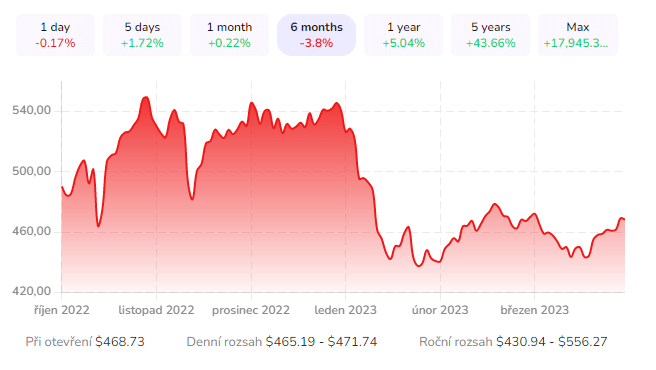
The current yield of 1.47% is low and a decline in the share price could lead to a new wave of new buying as investors look to lock in a higher yield on a stock whose dividend is likely to continue to grow, as it has for 17 years in a row.
Expectations of further growth in defence budgets are also likely to boost NOC's earnings and, consequently, its share price. NOC CEO Kathy Warden has previously noted that its government customers are favoring longer-term demand signals, which is a positive.
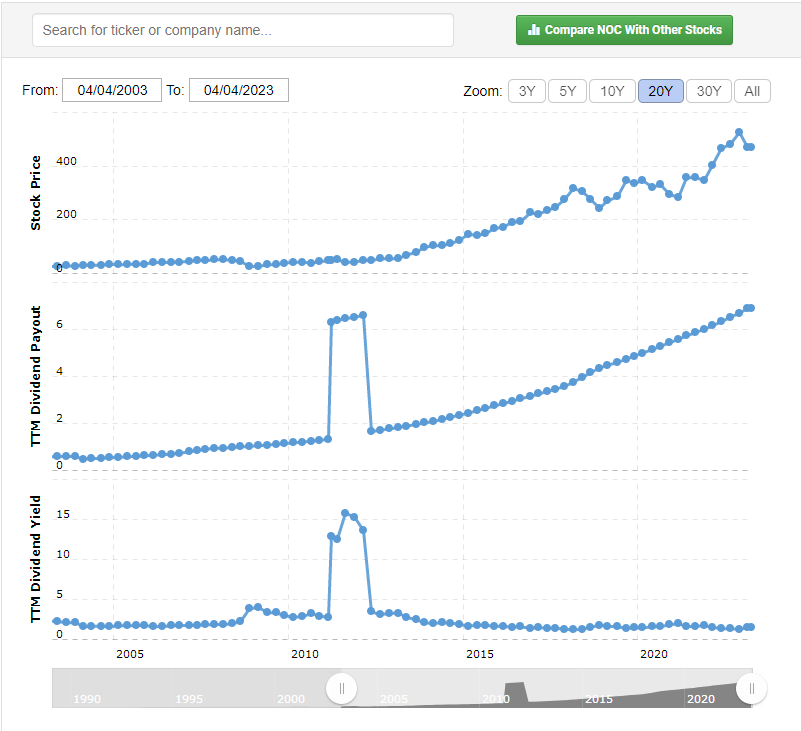
The dividend has been growing over the long term. Source
Finally, NOC also uses smart buybacks to boost earnings per share and intends to continue to do so. The number of shares outstanding today is 156.5 million, down 33% from 233.9 million in 2013. NOC has committed to $1.5 billion in share repurchases in 2022, with a slightly higher outlook for 2023. These buybacks are a good use of capital given that net debt over the past twelve months is $12.5 billion, which is manageable for a company of NOC's size.
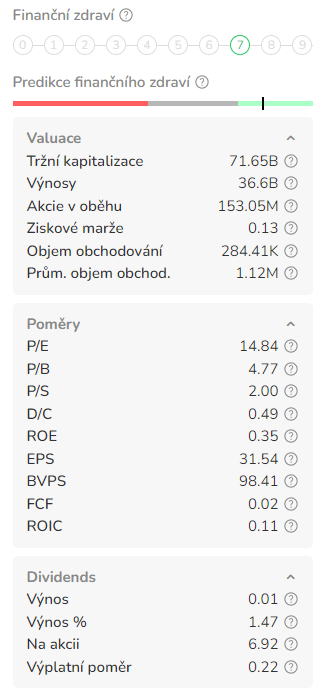
NOC is certainly not bad. For me personally, it does not offer a high enough yield and I find the valuation unnecessarily high. But by its nature, it undoubtedly offers a really attractive combination of factors for many investors. But I think one could wait for a lower price.
Disclaimer: This is by no means an investment recommendation. This is purely my summary and analysis based on data from the internet and other sources. Investing in the financial markets is risky and everyone should invest based on their own decisions. I am just an amateur sharing my opinions.