
Walmart’s announcement that CEO Doug McMillon will retire in early 2026 marks the end of one of the most influential leadership eras in modern retail. McMillon wasn’t just an operator — he was the architect of the company’s digital rebirth, taking a traditional brick-and-mortar powerhouse and turning it into a hybrid retail ecosystem able to stand toe-to-toe with Amazon. What began as a defensive push into e-commerce became a transformation worth hundreds of billions in market value.
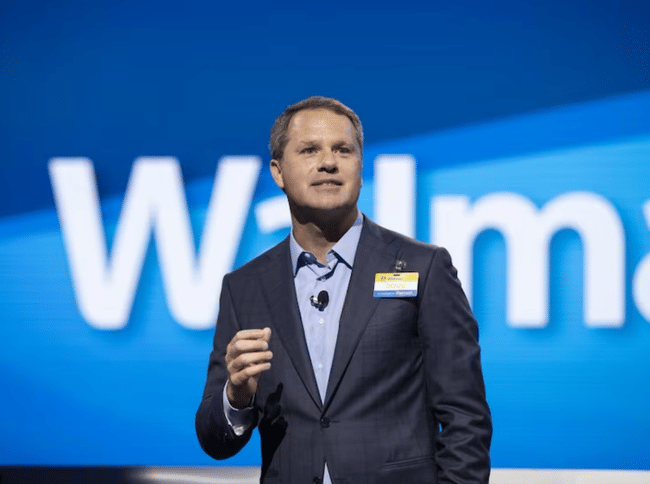
Yet the market reacted cautiously. Shares slipped despite the company presenting a clean succession plan with John Furner stepping in, an executive credited with revitalizing Walmart’s U.S. division. Now comes the real question: can Walmart sustain McMillon’s momentum, or does his departure expose a gap no strategy can quickly fill?
The McMillon Era: From traditional retailer to tech empire
When Doug McMillon became CEO, Walmart was valued at roughly $250 billion and faced a wave of fears that Amazon would gradually overtake it. Under his leadership, the opposite happened. Walmart learned to compete with Amazon in e-commerce, created a robust logistics network, massively digitized operations, and invested in technology that brought the company closer to the modern age.
The result is today's market capitalization exceeding $800 billion and a Walmart that is no longer just "the place you go to buy cheap stuff." It's a complex ecosystem with its own fintech services, advertising platform, growing online division, and ambition to become a dominant player in the retail use of AI.
That's why McMillon is leaving as a very strong, respected and successful CEO - and that's what makes his departure even more perceptive.
A successor from his own ranks
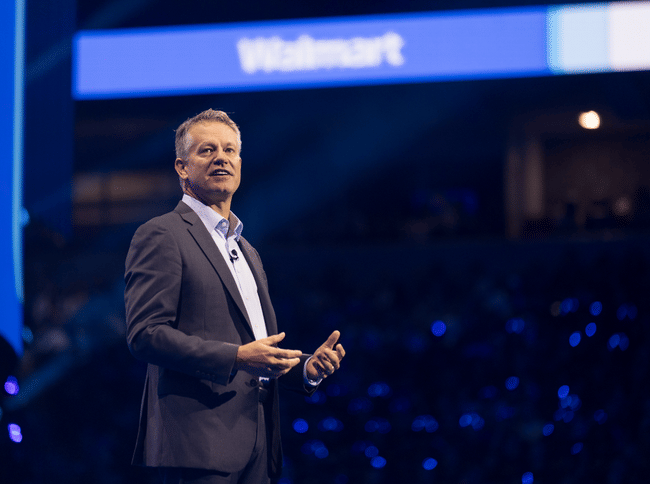
John Furner is no outsider to Walmart. He joined the company back in 1993 as an hourly employee and worked his way up through Sam's Club to head the U.S. division. He is one of those people who understand operations, culture and customer behavior well.
During his era, Walmart U.S. has significantly strengthened its ability to respond to rapid changes in demand, accelerated digital operations, streamlined omnichannel, and strengthened technology projects using data analytics and automation. It is Furner's knowledge of all layers of the business that gives management confidence that Furner can take Walmart through "the next chapter of transformation," as Chairman Greg Penner describes it.
What's more, Furner takes over the company as retail enters a new era - an era in which artificial intelligence, robotic logistics and hyper-personalised services will play a key role.
The tipping point: Why change is coming now
The announcement comes at a time when the entire US retail industry is in a state of turmoil. Consumers are more cautious, more price-sensitive and the margin for error is shrinking. Target is changing CEOs, Amazon is looking for more growth areas, and many industries are suffering from the pressures of stagnant demand.
For Walmart, this is a pivotal moment, as the company is now in a period that resembles the turning point between two generations of retail. The first one was all about price and mass sales. The second will be about AI, automation, logistical precision and the ability to hold margins in an environment where every dollar counts.
So Furner has a chance to confirm that he's coming in at the right time - or, conversely, to counter that expectations will be extremely high post-McMillan.
What to expect next?
The departure of a strong CEO is always a test for investors. McMillon may remain on the board temporarily, but the leadership transition will be a test of strategy consistency. Walmart is entering a phase where it will have to:
- Accelerate the implementation of AI in logistics and customer service.
- Seek new sources of growth outside of traditional retail.
- Maintain its lead over Target $TGT, Costco $COST and Amazon $AMZN.
- Protect margins in a price-sensitive consumer environment.
Furner has strong fundamentals but also a difficult period ahead. Walmart has had a decade of growth and transformation - the question now is whether it is entering another phase of stability or an era that will require even more predatory innovation.
And that's what the coming years will be about: whether Walmart can build on its renaissance of the last decade, or whether it will begin to move back closer to traditional retail, from where McMillon successfully pulled it out a decade ago.