
Shares of the Irish airline are trading about one-fifth below analysts’ average price target. The low price is driven by record profits, a net cash position, and a recent dispute with a British regulator.
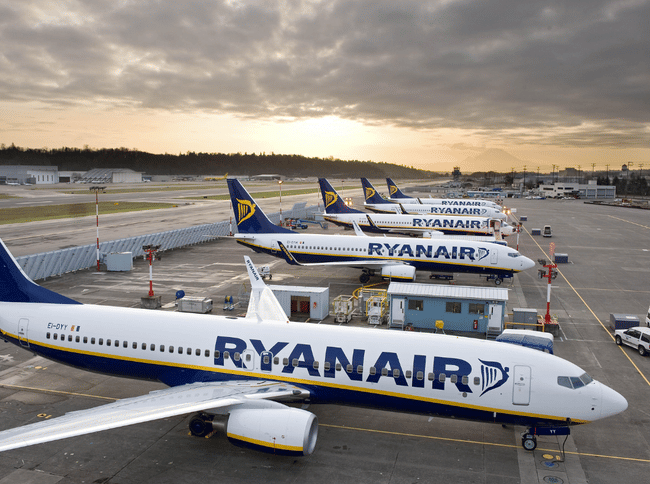
Ryanair shares ($RYAAY ) are hovering around $62 in mid-June, while the average target price estimate from analysts covering the stock remains close to $74, with the highest estimates reaching as high as $82. There is a 20% gap between the current price and where the market sees the company in a year. For an airline—especially a European one—this is not exactly a typical picture; airlines are usually synonymous with fragile margins and perpetually strained balance sheets.
Ryanair has been an exception in this regard for quite some time, but its latest results have further underscored that exceptional status.
Numbers That Are Uncommon for an Airline
Fiscal year 2026 (which ended for Ryanair at the end of March) brought a profit after tax of 2.17 billion euros, up 35% year-over-year. Excluding one-time items, the increase in profit was even more significant—40%. Revenue rose by 11% to 15.54 billion euros, while total operating costs, conversely, fell by 6%. The company also carried a record 208.4 million passengers, despite ongoing delays in aircraft deliveries from Boeing $BA.
Key highlights from the fiscal year 2026 results:
Net cash of 2.1 billion euros as of March 31, 2026—meaning the company has more cash than debt
Equity increased by 3.1 billion euros to 10.1 billion euros
P/E ratio around 5x, below the company’s five-year median
PEG ratio of 0.83, suggesting that the market is not fully pricing in the company’s growth
Dividend yield around 1.6% plus an ongoing share buyback program
By comparison, most major airlines have long struggled with high debt due to costly aircraft leases and sensitivity to fuel prices. Ryanair, on the other hand, can afford to finance the purchase of new aircraft from its own resources while simultaneously paying dividends to shareholders.
"Boeing is indeed addressing its delivery issues. We will have 29 new aircraft by the summer of 2026, and the first 15 MAX 10s will arrive by the summer of 2027."
Michael O’Leary, CEO of Ryanair
Why Analysts Are Raising Target Prices
Sentiment among analysts has improved significantly in recent months. In March, Evercore ISI raised its rating to “Outperform” and increased its price target from $75 to $80. Zacks Research upgraded the stock to “Strong Buy.” According to data from Yahoo Finance, five of the analysts covering the stock have a buy recommendation, and none recommend selling.
“Even if Bitcoin doesn’t go to zero”— that’s how one might paraphrase skeptics’ bet on the airline sector in general, but Ryanair has long proven the opposite: the low-cost model works even in a cyclical business, as long as the company keeps costs firmly under control.
It’s also interesting to compare valuation multiples within the industry. According to a recent Yahoo Finance analysis , Ryanair is trading at a P/E ratio of around 5x, which is cheaper than its European competitors, whose average is 15.4x —but more expensive than the global average for the airline sector, which hovers around 8.9x. In other words, Ryanair isn’t the cheapest stock in the sector, but it’s among those with the strongest balance sheets.
The dispute over family seats complicates the picture
In mid-June, a regulator stepped into what had otherwise been an encouraging story. The UK’s Competition and Markets Authority (CMA) launched a formal investigation into how Ryanair charges for its so-called “mandatory family seat”—a fee of around eight pounds per flight that an adult accompanying a child aged 2 to 11 must pay to sit next to the child.
The regulator is examining whether this requirement constitutes an unfair commercial practice and whether the fee is presented to customers in a transparent manner. Ryanair has rejected the investigation, calling the allegations unfounded.
"Our investigation will focus on how Ryanair handles family seat reservations and how the price is presented to customers, to determine whether it complies with consumer law."
Hayley Fletcher, Director of Consumer Protection, CMA
In and of itself, this is a relatively minor case— the British regulator can, in extreme cases, impose a fine of up to 10% of the company’s global revenue—but the investigation is only just beginning, and similar disputes involving Ryanair are nothing new. For investors, this is more of a reminder that regulatory risk in the European aviation industry will never completely disappear, even if the financial figures look flawless.
Ten-Year Plan: From 200 to 300 Million Passengers
Meanwhile, the company’s management is communicating a significantly longer-term ambition. Ryanair plans to grow from approximately 200 million to 300 million passengers carried annually over the next ten years, largely thanks to an order for 300 Boeing 737 MAX 10 aircraft, with deliveries scheduled to continue through 2034.
The company also expects that the average profit per passenger—currently around 10 euros—could gradually increase to 14 euros, thanks to a combination of rising European airfares and maintaining a cost advantage over the competition. According to the company’s management, capacity constraints at both Airbus and Boeing actually benefit those players with the earliest-secured aircraft orders—and Ryanair is among them.
The question remains how quickly this long-term vision will be reflected in the stock price, which is currently trading at a discount to analysts’ estimates. In the short term, the direction of the stock price will likely be determined more by the outcome of the dispute with the British regulator and how quickly Boeing catches up on delayed deliveries—but in the long term, Ryanair has a combination of factors on the table that is hard to find in the aviation sector: growing profits, a net cash position, and a clearly articulated growth plan for the next decade.