


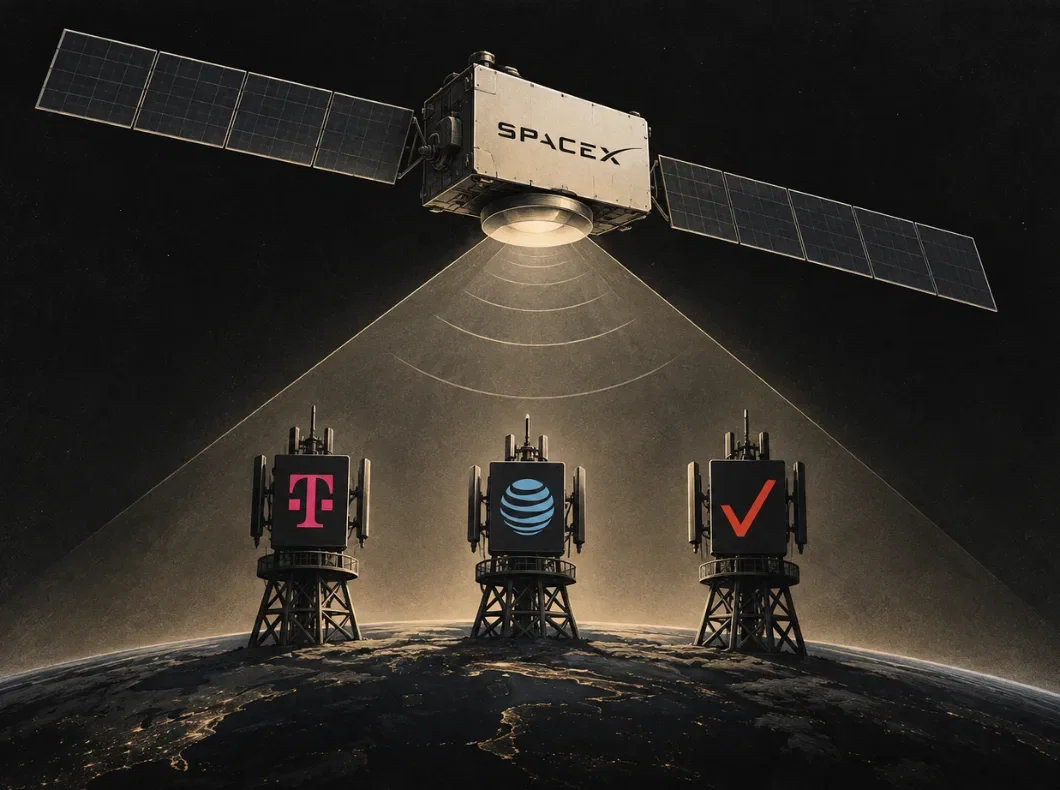
SpaceX is moving into mobile networks. How big a threat is it to traditional operators?

SpaceX announced on October 8 the purchase of low-band spectrum for roughly 8 billion USD, and shares of T-Mobile, Verizon, and AT&T experienced one of their worst days in recent years. The market has started to price Starlink as a future fourth operator. The key question is whether the satellite mobile service can actually damage operators' cash flow within five years, or whether this is an overreaction.
Key points
SpaceX owns 65 MHz of spectrum from EchoStar (approved by the FCC in May 2026) and has an agreement for 14 MHz of low-band spectrum from Grain Management, which the FCC has yet to review. But spectrum is not a network.
Starlink Mobile currently works through partners and mainly offers messaging and limited data. Full-fledged competition is planned for the end of 2027 on satellites that are not yet flying.
Satellites have limited capacity in cities. Without a dense terrestrial network, they mainly threaten rural areas and customers who want a single bill for home internet and mobile.
In the base case, operators' free cash flow falls by roughly 10%, in the negative case by roughly 25%. The main driver is price pressure, not customer churn.
All three stocks are trading below nine times this year's free cash flow after the drop, so part of the negative scenario is already priced in, most of all for T-Mobile.
Just a year ago, satellite connectivity for phones seemed like a nice add-on that helps operators fill coverage gaps. During 2026, however, SpaceX transformed from a partner into a declared competitor. It went public, bought spectrum for tens of billions of dollars, and management openly talks about taking market share from the so-called big three. For investors in $TMUS, $T, and $VZ, this is a fundamental question, because the U.S. mobile market is an oligopoly and its value rests on the pricing discipline of three players. A fourth competitor with a multi-billion-dollar budget could disrupt this balance even without gaining a large number of customers.
SpaceX and Starlink Mobile
What SpaceX actually owns
Buying spectrum, regulatory approval, and launching service are distinct phases that media often lump together. In September 2025, SpaceX $SPCX agreed with EchoStar $ECHO to buy AWS-4, H-block, and unpaired AWS-3 bands for about 17 billion USD in cash and stock. The FCC approved the transaction on May 12, 2026, and explicitly allowed the use of the spectrum for satellite, terrestrial, and hybrid networks. However, formal closing of the transfer is not expected until November 2027. On October 6, 2026, the FCC conditionally approved a constellation of up to 15,000 satellites for direct-to-phone connectivity, with a requirement to have half of them in orbit by October 2032.
The most recent step is the agreement with Grain Management on October 8, 2026, to buy up to 14 MHz of paired spectrum in the 800 MHz band. The company did not disclose the price; the Wall Street Journal reports it at around 8 billion USD in cash. The transaction has not yet received FCC approval. Low-band is important because the signal penetrates buildings, which has been the biggest weak point of satellite service. Analyst Tim Farrar, however, points out that it is a very small amount of spectrum, which is not enough without an extensive network of terrestrial transmitters in cities.
What the service can do today and what is just a plan
Today (verified): approximately 650 first-generation satellites that use partner operators' spectrum. According to SpaceX's May 2026 prospectus, they served about 7.4 million unique devices per month in about 30 countries. The service offers messaging, emergency calls, and data for selected applications.
In the U.S. (commercially): T-Mobile sells the T-Satellite service for $10 per month; it is included in more expensive plans. Since April 2026, it is also offered by the virtual operator US Mobile.
Plan (unverified): second-generation satellites are supposed to fly from 2027 and offer up to 150 Mb/s per user. SpaceX wants to launch the expanded service by the end of 2027.
Plan (without budget): at the earnings call on August 4, 2026, Gwynne Shotwell and Elon Musk mentioned terrestrial small cell base stations placed on existing Starlink home antennas. The company did not provide an estimate of capital expenditures.
Why satellites cannot replace a dense network of transmitters
A terrestrial operator repeatedly uses the same spectrum in thousands of small cells, so it can serve millions of people simultaneously in a single city. A satellite beam covers an area of hundreds of square kilometers and all users within it share a single capacity. Moreover, a phone does not have a directional antenna and loses signal inside buildings. The current first generation therefore provides, according to available analyses, only a few megabits per second per user. The economic consequence is straightforward: satellite is a cheap way to cover empty countryside, but an expensive way to serve densely populated cities. That is why SpaceX needs a terrestrial component, and why there was speculation about talks with cable operator Charter $CHTR, as Bloomberg reported in June. Charter did not confirm a deal.