These 3 Stocks Could Either Go to Zero or Triple

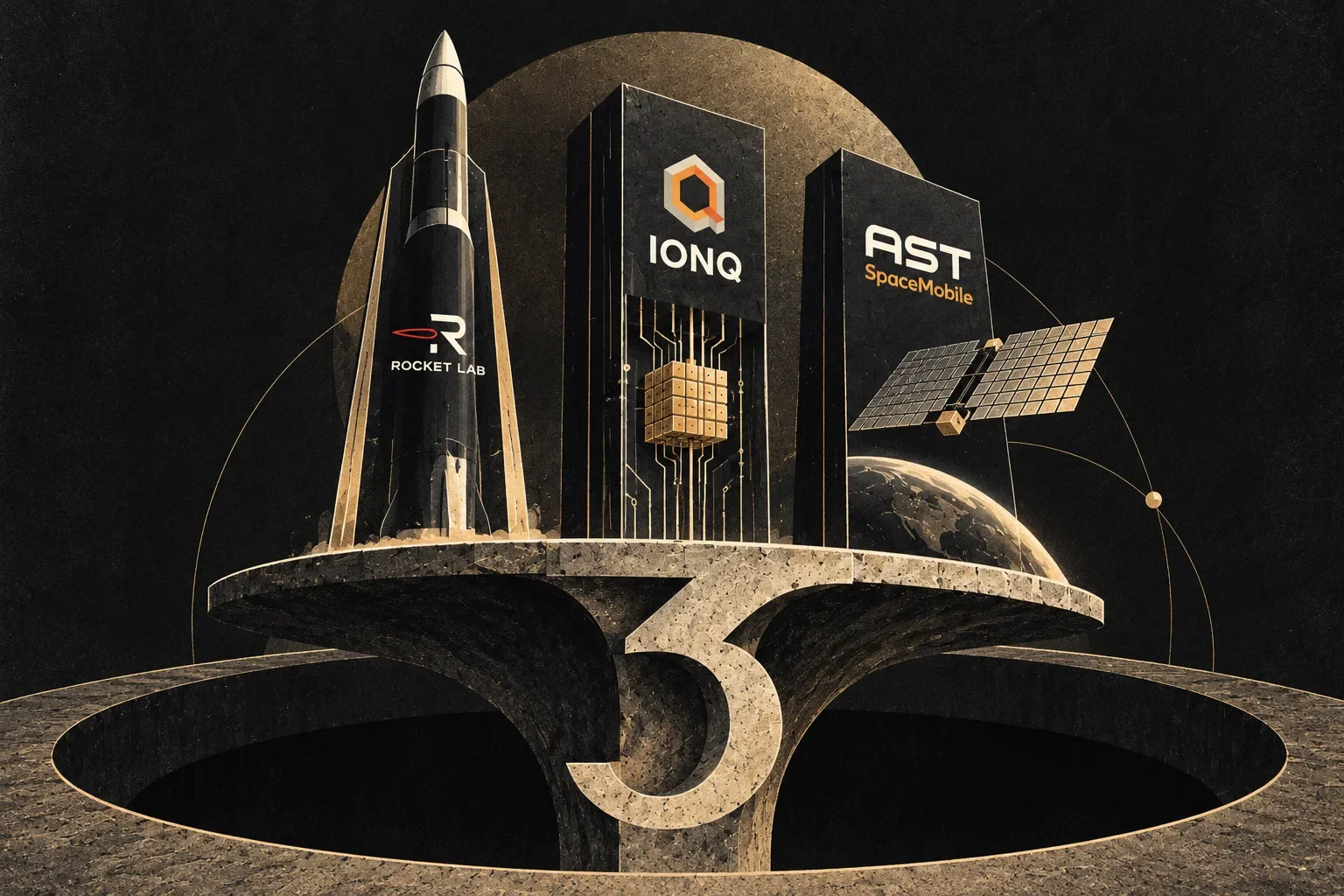
A rocket, a quantum computer, and mobile coverage from orbit. Three companies where investors could lose their entire investment—or multiply it several times over. Why are they worth watching now?
There is a type of investment known as an asymmetric bet. You invest a small amount you can afford to lose and wait for an outcome that either never arrives or pays off many times over. This isn’t investing in the sense of dividends and steady profits. It’s more like a lottery ticket—but one where you know the rules and what needs to happen for you to win.
This fall has several such tickets on offer. After SpaceX $SPCX went public in June, valuing Elon Musk’s company at around $2 trillion, investors’ money flowed into it, and smaller space and technology companies began to slide. Three of them are now trading 60% to 70% below their highs, even though their businesses are growing faster than ever.
Company | Share price (Oct. 20) | 52-week high | Drop from high | Market capitalization | Cash (June 30) |
|---|---|---|---|---|---|
Rocket Lab | 50,90 USD | 151,00 USD | -66 % | 30,5 billion USD | 2,1 billion USD |
IonQ | 31,26 USD | 73,87 USD | -58 % | 12,0 billion USD | approx. 3 billion USD |
AST SpaceMobile | 41,13 USD | 133,86 USD | -69 % | 12,3 billion USD | 2,3 billion USD |
Rocket Lab: business growing at a record pace, market waiting on one rocket
Rocket Lab $RKLB is the furthest along of the three. Its small Electron rocket flies regularly, the company builds satellites and their components, and its second-quarter results showed record revenue of $234 million, up 62% year over year. Its backlog of contracted orders grew to $2.36 billion, and the U.S. Space Force awarded it a $397 million contract to monitor airborne threats from orbit.
“The second quarter was another fantastic quarter for Rocket Lab, characterized by record results and tremendous momentum that continued long after it ended.”
Sir Peter Beck, Rocket Lab founder and CEO, in a press release on second-quarter 2026 results
But the entire bet on Rocket Lab rests on one thing: its medium-lift Neutron rocket, which is meant to compete with SpaceX’s Falcon 9. And it has hit a setback. On October 14, the company announced that the first launch had been pushed back to 2027 because of defects in the first-stage composite tank. It’s already the fourth delay since 2021, and the stock lost about a fifth of its value in a week.
What makes Rocket Lab an asymmetric bet? The company has $2.1 billion in cash, and operating cash flow burn totaled just $134 million in the first half of the year. So it has time. If Neutron gets off the ground and sells for the announced $50 million to $55 million per launch, the company will gain access to a market where SpaceX currently has no serious competition. Analysts at Stifel maintain a $150 price target, while TD Cowen’s is $90. But if Neutron takes another year and another billion dollars, the company will be selling shares again, as it did to raise $1.53 billion in the first half of the year.
IonQ: someone just paid 15% more than the stock was trading for
IonQ $IONQ builds trapped-ion quantum computers and is at the earliest stage of the three companies. Second-quarter revenue reached $80.1 million, up 287% year over year, but its operating loss for the first half exceeded $600 million. The stock has fallen 58% from its November high.
In the summer, the company completed its $1.8 billion acquisition of semiconductor foundry SkyWater to secure its own U.S. production of quantum chips. It raised its full-year revenue outlook after the merger to $450 million to $460 million. And on October 14, it announced a $2 billion share offering, which was purchased in full by a single investor managed by Heights Capital Management.
That deal is worth paying attention to. The investor paid $40 per share, 15% more than the stock was trading for. In addition, it received seven-year warrants for another 100 million shares, with an exercise price of $69.46—double the price at the time. In other words, someone with $2 billion is betting that IonQ’s stock will double.
“This investment will accelerate the commercialization of our full-stack quantum platform and is a tremendous vote of confidence in the pioneering innovation that defines IonQ.”
Niccolo de Masi, IonQ chairman and CEO, in a press release on the October 14, 2026 share offering
The downside is dilution. IonQ’s share count has increased by about 72% since the end of 2024, and the new offering, along with stock-funded acquisitions, will add another several dozen percent. If quantum computers catch on commercially, that won’t matter. If they don’t, the losses will be spread among an ever-growing number of shareholders.
AST SpaceMobile: racing Musk to deliver a signal from space
AST SpaceMobile $ASTS wants to beam mobile service directly from satellites to ordinary phones, with no special antennas required. In its half-year report, it cites 13 satellites in orbit, agreements with more than 60 operators serving a combined 3 billion-plus customers, and contracted revenue of $1.3 billion. By early 2027, it aims to have about 45 satellites in space, the number needed for continuous coverage of major markets.
“Following the recent launch of BlueBirds 11, 12, and 13, our space-based mobile broadband network has grown to 13 satellites in orbit, each the largest ever in low Earth orbit.”
Abel Avellan, AST SpaceMobile chairman and CEO, in a press release on second-quarter 2026 results
The company has been dealt two blows this year. In April, Blue Origin’s New Glenn rocket placed the BlueBird 7 satellite in the wrong orbit, and it was lost. Then, in early October, SpaceX received approval from U.S. regulator FCC for a 15,000-satellite network to connect directly to phones and spent $8 billion to acquire spectrum for its own Starlink Mobile service. AST’s stock fell to a 52-week low of $39.02 on October 20.
The asymmetry is greatest here, in both directions. The company has $2.3 billion in cash and borrowed another $1.15 billion through convertible bonds in July, bringing total debt to more than $3 billion. It spent about $1 billion on operations and satellites in the first half of the year. At this rate, its cash will last a year, two at most. Even so, Deutsche Bank analysts raised their rating to Buy in October, with a $93 price target, arguing that operators such as AT&T or Verizon will need their own satellite partner to compete with Musk. Piper Sandler, on the other hand, downgraded the stock, fearing SpaceX will take up the launch capacity AST depends on.
What needs to happen for the bet to pay off
The scenario is similar for all three companies. Revenue is growing, they have enough cash for one to two years, and their share prices are low not because their businesses have failed, but because the market has run out of patience. That’s exactly when an asymmetric bet makes sense: the upside is a return to the highs, or 2.5 to 3 times the current price; the downside is zero.
It comes down to which milestones to watch for:
Rocket Lab: Neutron’s first successful flight and completion of the acquisition of satellite operator Iridium
IonQ: first major commercial contracts and proof that quantum computers can solve problems classical computers cannot
AST SpaceMobile: reaching 45 satellites and launching beta service with operators
If any of these milestones aren’t reached by the end of 2027, another share sale and further dilution are likely. If they are, the stock won’t move by percentage points, but by multiples. That’s the appeal—and the danger—of this kind of bet, which is why it should only involve money you can afford to lose.