These 3 Stocks Have Fallen as Much as 57%. In Ten Days, We’ll Know Whether the Market Overdid It

Rivian, Robinhood, and Albemarle all fell in October, even on days when good news came out. Between October 27 and November 4, all three will report their numbers. For one, the bar is on the floor; for another, it’s over its head.
Key points
Rivian reported record deliveries, Robinhood got a Dubai license, and Albemarle received an upgraded rating—and all three fell.
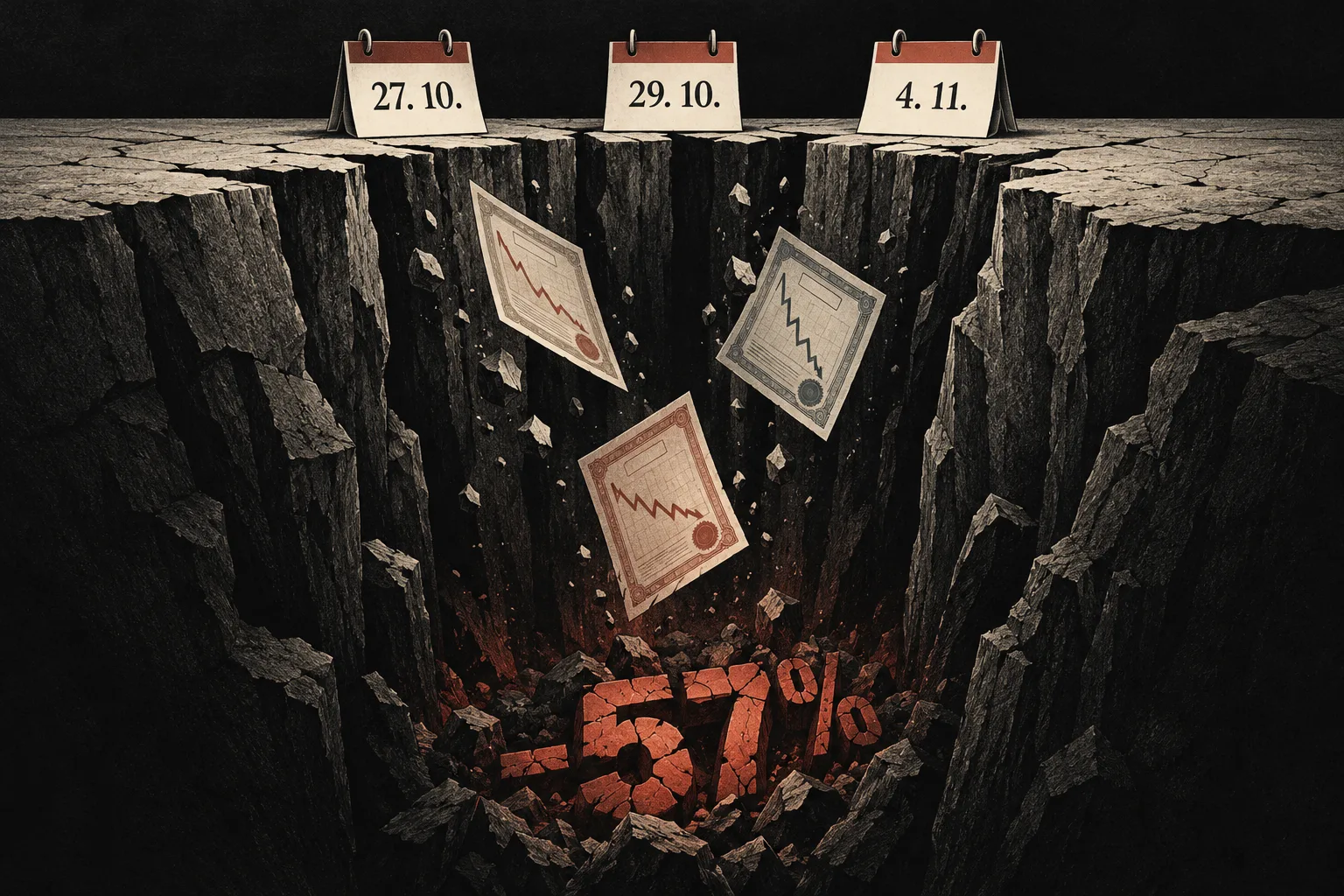
Albemarle is down 57.6% from its April high of 221 USD, and its quarter was decided by the exchange in Guangzhou.
After falling by a fifth in a month, Robinhood is still trading at 37 times earnings, which are expected to decline year over year.
Rivian has known its delivery figures since October 2, so the stock’s reaction will come down to one figure from the R2 ramp-up.
Between October 27 and November 4, all three will lay their cards on the table, and the bar is set differently for each.
Three stocks that fell in October even after good news
October had one thing in common for these three companies: good news came out, and the stock still fell. Rivian $RIVN reported record quarterly deliveries, and its share price went down. Robinhood $HOOD obtained a license for Dubai and lost over 5% that day. Albemarle $ALB received an upgraded rating from Mizuho and still slid to a one-year low.
The market simply stopped paying for stories. It wants receipts. And it will get them from all three within ten days.
Company | Price on Oct. 23 | 52-week high | Down from high | P/E | Earnings |
|---|---|---|---|---|---|
Robinhood | 95.07 USD | 150.47 USD | -36.8 % | 36.9 | Oct. 27 |
Rivian | 11.83 USD | 22.69 USD | -47.9 % | loss | Oct. 29 |
Albemarle | 93.67 USD | 221.00 USD | -57.6 % | 49.8 | Nov. 4 |
Albemarle leads the way down: from its April high of 221 USD (Apr. 16, 2026), it fell to 93.67 USD, a decline of 57.6%. Rivian is just above its 52-week low of 11.60 USD, and Robinhood has shed over 20% in a single month. Three different declines, three different reasons, and one figure for each company that will decide the report.
Robinhood (Oct. 27): the highest bar of all three
At first glance, Robinhood’s decline makes no sense. The second quarter was a record: revenue rose 32% to 1.31 billion USD, earnings per share reached 0.62 USD, and revenue from prediction contracts jumped more than tenfold to 156 million USD. But that same report also showed the other half of the picture: crypto revenue fell 38% to 100 million USD, and 0.14 USD of the 0.62 USD in earnings was a one-time accounting gain from deconsolidating a fund.
The market noticed the other half. The stock fell 8.5% on October 14 after Wolfe Research downgraded it, and another 5.3% on October 22, the day the company announced its Dubai license. September data for Sept. 1–24 show why: 4.4 billion prediction contracts traded, but crypto volume was only 17 billion USD.
Consensus expects third-quarter earnings of 0.56 USD per share, versus 0.61 USD a year earlier. That would be a year-over-year earnings decline for a company trading at 37 times earnings, while the capital markets sector trades at 11.8 times. Bulios fair value of 67.52 USD is 29% below the current price. That kind of premium can only be justified by growth that has to show up in the report.
“The last number we shared was roughly 1.5 million people who had used prediction markets. Now that number is approaching 2 million.”
Shiv Verma, Robinhood CFO
Rivian (Oct. 29): deliveries are known; now it’s about the loss on every R2
Of the three companies, Rivian has the least room for surprises, which is more of an advantage in its situation. It delivered a record 19,248 vehicles in the third quarter, versus an estimate of 18,001, and reaffirmed its full-year target of 65,000 to 70,000. The market expected the target to be raised, but it wasn’t, and the stock fell. It has lost roughly 30% since its July results.
So the results are not about volume, but about what the company is paying for that volume. The cheaper R2 model, priced at 58,000 USD, has been shipping since June, and the third quarter is its first full quarter of ramp-up. In the second quarter, the ramp-up cost roughly 100 million USD above normal expenses, and the automotive division posted a gross loss of 36 million USD. Management said in advance that the third quarter would include the full costs of the second shift.
Consensus expects a loss of 0.65 USD per share (estimates go as high as 0.86 USD) on revenue of around 2.0 billion USD. Cash of 5.3 billion USD is being bolstered by the July offering of 1.3 billion USD, but that also added 86 million new shares. To meet its full-year target, Rivian must deliver roughly 23,000 to 28,000 vehicles in the fourth quarter.
“Ramping up production of a vehicle, especially when it’s the very first launch of a new model, is complicated. It involves orchestrating the ramp-up of hundreds of suppliers. All suppliers have to ramp up at the same pace.”
RJ Scaringe, Rivian founder and CEO
Albemarle (Nov. 4): the Chinese exchange, not the company, decided the quarter
For Albemarle, the third quarter was decided thousands of miles from headquarters. The price of lithium carbonate on the Guangzhou exchange fell 11.8% on October 12 to 104,740 yuan per ton, roughly 15,600 USD. That’s half of the May high of 209,880 yuan. The trigger was an EU-China agreement to limit hybrid exports and concerns about excess supply in 2027.
Why does this matter so much for the stock? Because Albemarle itself has disclosed what lithium prices do to its business. In the price scenarios it gave with its second-quarter results, at around 20 USD per kilogram it expects EBITDA of 2.4 to 2.6 billion USD; at 10 USD per kilogram, just 0.9 to 1.0 billion USD. The market is now between the two scenarios, closer to the worse one.
The second quarter was strong: revenue of 1.7 billion USD (+31%), adjusted EBITDA of 858 million USD. But the CFO himself flagged a sequential decline in the third quarter due to expensive spodumene inventory and lower prices. Consensus expects earnings of 2.52 USD per share on revenue of 1.5 billion USD.
The gap between the share price and analysts’ view is widest for Albemarle of all three: consensus price target of 174 USD versus the current 93.67 USD, Mizuho targets 130 USD after its upgrade, and BMO targets 175 USD. Short interest is around 10% of the freely traded shares. The dividend has grown for 18 consecutive years, but a payout ratio of 86% suggests another year of low lithium prices would put it under pressure. So the test isn’t the quarter, but what management says about its 2027 price scenario.
“The required supply increases are reaching the market more slowly than demand is growing, due to limited spodumene availability, temporary supply disruptions from Africa, and a slower-than-expected ramp-up of Chinese lepidolite mines. As a result, inventories are low and the physical lithium market remains tight.”
Kent Masters, Albemarle Chairman and CEO
Calendar and signals: who has the lowest bar and who has the highest
Three reports, three different tests. Here’s what to watch:
Oct. 27. Robinhood (after the market closes, call at 17:00 ET): prediction-contract revenue for all of September versus the crypto decline. And earnings per share above or below last year’s 0.61 USD. A decline would be the first in a long time, leaving the 29% premium over fair value unsupported.
Oct. 29. Rivian (after the market closes): automotive gross margin and cash burn. How much did the R2 ramp-up cost compared with 100 million USD in the second quarter? And any mention of more than 23,000 vehicles in the fourth quarter.
Nov. 4. Albemarle (after the market closes, call on Nov. 5): whether management sticks with the 20 USD per kilogram scenario or shifts to 10 USD. The second signal is volume guidance of 225,000 to 235,000 kilotons, which has already been affected once by a fire at Talison.
Rivian has the lowest bar. The market has known its deliveries since October 2, the loss is priced in, and only the margin can surprise. Albemarle’s bar is outside its control: whatever the company does, the conference call will be about lithium prices, which it doesn’t set. Robinhood has the highest bar. The stock has lost a fifth in a month, yet still trades at 37 times earnings, which consensus expects to decline year over year. The drop hasn’t pushed its price below value; it has only reduced the premium. Anyone who knows by the evening of November 5 which of the three companies cleared the bar will also know which October sell-off was overdone.