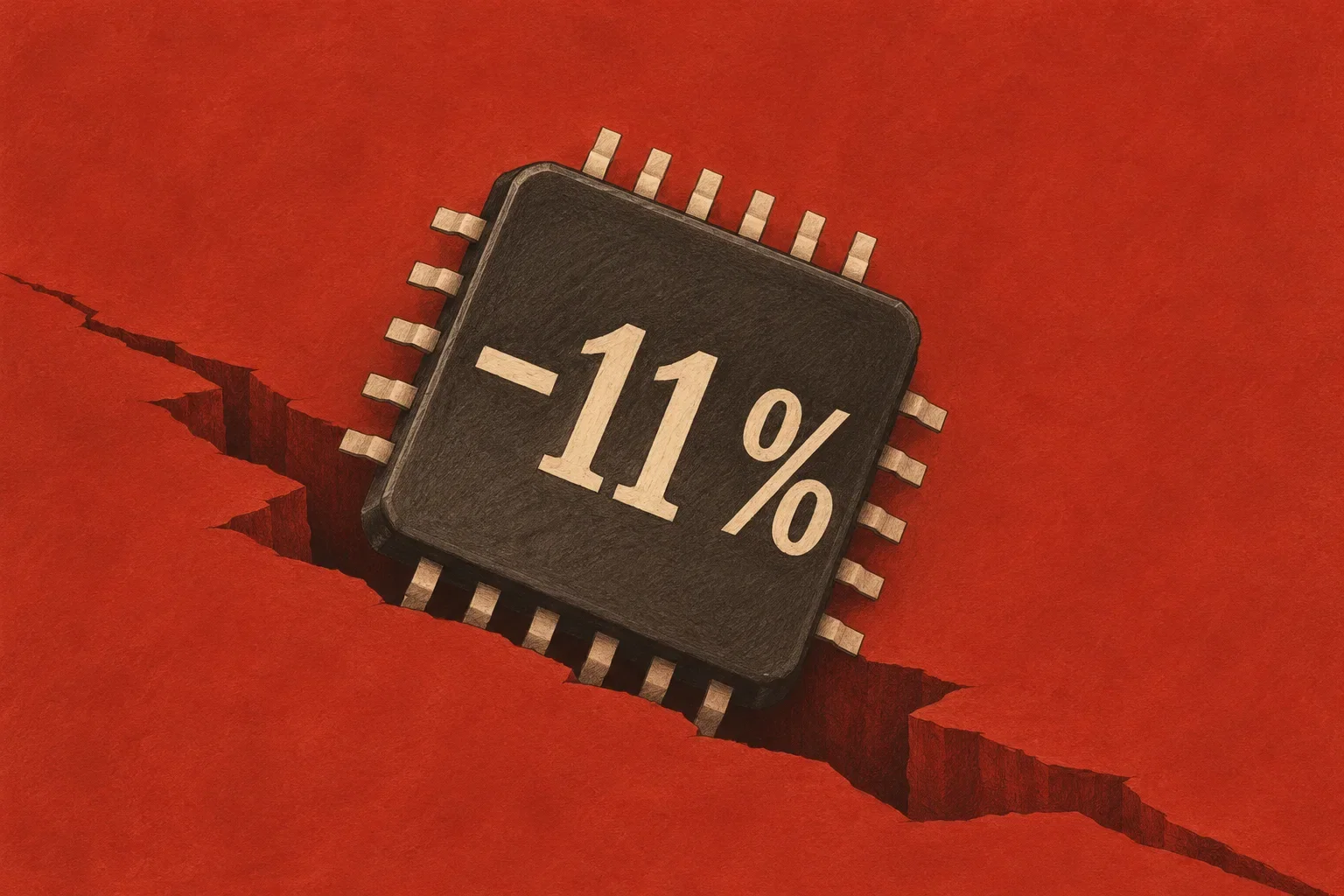
Wall Street suffered its worst day since April 2025. Chip stocks lost 11%

The day after the election, which the market celebrated with a record rally, came a hard fall. The Nasdaq slid into correction territory, Nvidia lost around 8%, and retail investors, who had spent years buying every dip, sold the most since March 2020.
Key points
The Nasdaq lost 5.5% and fell into correction territory, while the chip index plunged 11% in a single day.
Voters rejected data centers in 40 of 41 referendums, and Democrats are calling for a nationwide moratorium.
Retail investors sold $358 million worth of stocks, the most since the COVID crash in March 2020.
On Wednesday, Wall Street was celebrating. Democrats won control of both chambers of Congress, oil prices were falling, and the Dow Jones gained 1,569 points, its biggest rise since April 2025. By Thursday, that celebration was gone. The Dow gave back more than 1,800 points and closed at 51,523, the S&P 500 lost more than 4%, and the tech-heavy Nasdaq plunged 5.5%. All three major indexes thus suffered their worst day since April 2025, when Trump’s tariff charts sent markets tumbling.
The narrower Nasdaq 100 fared even worse, dropping 6.4%—its worst day since March 2020, when the COVID panic began. The Nasdaq Composite is now more than 10% below its October 6 record, a decline known on Wall Street as a correction. All 11 sectors of the S&P 500 ended in the red, and the VIX fear index jumped more than 60% to around 27, its sharpest rise in more than two years.
For the Dow Jones, it was also the worst second trading day after a congressional election since 1896.
Chips lost 11% in a day and a third of their value in a month
The epicenter of the sell-off was clear from the opening bell. The Philadelphia Semiconductor Index, SOX, plunged nearly 11% during the day. Nvidia shares $NVDA shed around 8%, their biggest drop since April 2025, and broke below their 200-day moving average, which many investors watch as the dividing line between an uptrend and a downtrend. AMD $AMD lost 15%, Micron $MU around 13%, and memory maker SanDisk $SNDK as much as 20%. Qualcomm $QCOM plunged after giving a weak outlook for phone-chip sales.
But Thursday’s plunge was no isolated event—just the culmination of a month-long slide:
Stock | Decline over the past month |
|---|---|
Lam Research $LRCX | -36% |
Applied Materials $AMAT | -30% |
AMD $AMD | -22% |
Nvidia $NVDA | -15% |
The sell-off wasn’t limited to hardware. Palantir $PLTR lost more than 10% and is now around a quarter below its October high. Software stocks such as CrowdStrike $CRWD and Cloudflare $NET fell similarly. Tesla $TSLA and newly traded SpaceX $SPCX shares each dropped more than 9%, as a Democratic Congress complicates their planned merger, according to analysts.
Voters said no to data centers
But why did sentiment turn around in a single night? The answer lies at the bottom of the ballot. On Tuesday, voters in 10 states weighed in on 41 local referendums on data-center construction. They opposed the projects in all but one. A CNBC poll also found that 56% of voters said AI and data centers were a major or important factor in their decisions.
The issue also helped elect new Democratic governors in Texas, Georgia, and Ohio—states where the most data centers are being built. Texas Governor-elect Gina Hinojosa is calling for a halt to approvals for new data centers until lawmakers adopt safeguards. And some Democrats in Congress are already calling for a nationwide moratorium and promising hearings where AI company executives will testify under oath.
For investors, this means one uncomfortable thing. The entire story behind Nvidia, AMD, and Micron shares rests on the assumption that data centers will keep being built at an ever-faster pace. If construction slows, demand for chips will slow too. Trump can veto legislation, but permitting decisions are made at the state and local levels, beyond the reach of his veto.
“They’re shooting the generals”
The election was just the trigger. The real explosive material had been building for weeks. Nomura bank strategist Charlie McElligott wrote in a Thursday commentary that hedge funds are shedding the year’s biggest winners to lock in gains before year-end. In his view, it’s not a deterioration in company fundamentals, but who is selling and why.
“They’re shooting the generals. Single-stock moves are absolutely insane.”
Charlie McElligott, cross-asset strategist, Nomura
In the military metaphor, the generals are the stocks that led this year’s rally. They’re the ones falling the most, while boring stocks have barely moved. Goldman Sachs prime brokerage data showed that hedge funds wiped out all their net purchases of AI-related stocks accumulated since the start of 2025 in just five trading days. According to Morgan Stanley, they cut their overall exposure by 7.8%, the most since tracking began in 2016.
And this is where the spiral starts. When prices fall, leveraged ETFs have to sell automatically at the end of the day to maintain three times leverage. Volatility-managed funds have to reduce risk when the VIX jumps. None of them are making decisions based on whether Nvidia has good prospects. They’re selling because their algorithms tell them to.
Retail investors buy the dip for the first time since COVID
But the most striking change came from where nobody expected it. For the past six years, retail investors have been the most reliable buffer for the U.S. stock market. They treated every dip as a bargain and bought. On Thursday, for the first time, they did the opposite.
According to Vanda Research data, by 3 p.m. New York time they had sold individual stocks for a net $358 million. That’s the biggest one-day net sale since March 17, 2020, when they sold $502 million worth of stocks.
“This is what we would call a total capitulation by retail investors.”
Viraj Patel, global macro strategist, Vanda Research
One interesting detail: some of those same investors were also buying leveraged funds such as TQQQ and SOXL, which bet on a threefold rise in the Nasdaq and semiconductors, respectively. In other words, they’re selling individual companies but still betting on a turnaround for the sector as a whole. Meanwhile, according to Patel, institutional investors are on a “buyers’ strike”—sitting on the sidelines while no one steps in to buy the dip.
Corporate profits are up 40%. So what’s the problem?
The paradox of Thursday’s session is that nothing happened to the economy or companies. Corporate profits in the S&P 500 are growing nearly 40% year over year, according to Apollo chief economist Torsten Sløk, and the U.S. economy grew 3.4% in the third quarter. October layoff data were the lowest since 2023. None of that changed in 24 hours.
What changed was what the market is willing to pay for. For the past two years, investors paid a premium for chip stocks on the assumption that data-center construction would proceed without obstacles. On Tuesday, voters took that certainty away, and the market repriced it in a single day. AMD CEO Lisa Su commented with unusual candor.
“I think the market can sometimes be a little short-sighted. That’s just how it is.”
Lisa Su, CEO, AMD
Su also insists that demand for AI chips is strong and that investment across the industry is continuing. But in a market where hedge funds are closing out the year, algorithms are selling according to a formula, and retail investors are retreating for the first time since the pandemic, positioning—not fundamentals—is what matters. McElligott warned that some of this year’s momentum trades are approaching “round-trip” levels, meaning a return to where they started at the beginning of the year. If that happens, it will mean that all of this year’s gains in AI stocks were merely borrowed.