Broadcom Beat Estimates. Wall Street Still Punished the Stock by 13%.

Record revenue, analyst expectations cleared and yet Broadcom's shares dropped roughly 12% in after-hours trading. The culprit: a Q3 AI chip revenue forecast of $16 billion, falling short of the $17.2 billion the market had priced in. A 7% miss on a single forward guidance line was enough to erase months of stock gains. It's a stark reminder of just how unforgiving markets have become for any AI-adjacent company that fails to over-deliver.
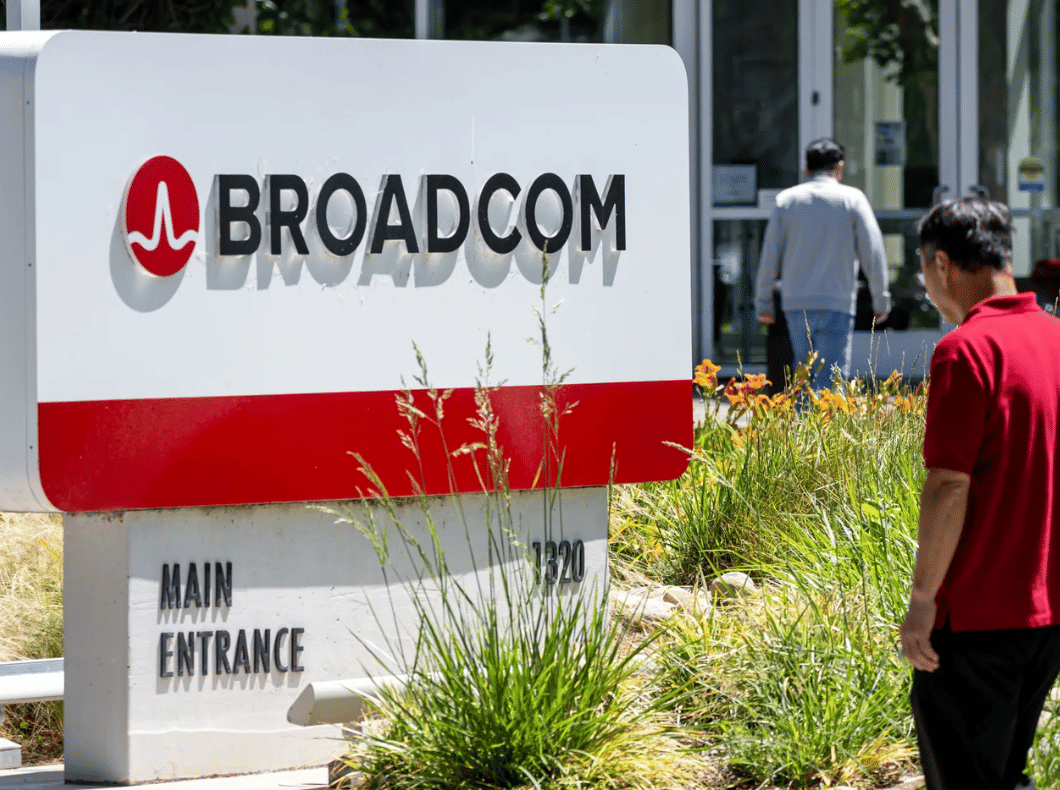
Record quarter not enough to beat expectations
Total revenue for the second quarter came in at $22.19 billion, up 48% year-over-year, slightly beating the consensus estimate of $22.13 billion. Adjusted earnings per share were $2.44 versus expectations of $2.39. Results were solid across segments, but the market focused on the outlook, not historical numbers. In a world where valuations of AI stocks are outpacing fundamentals by quarters, it is not enough to beat estimates; it is also necessary to beat analysts' anecdotal buy-side targets, which tend to be significantly higher than the published consensus.
AI sales up 143%, yet disappointing
AI semiconductor revenue in the second quarter came in at $10.8 billion, up 143% year-over-year. Still, it remained below buy-side analysts' internal estimates, which were calling for $11.3 billion. Structurally, it's a paradox: triple-digit growth, yet disappointment. The explanation is simple - the market has overestimated the pace at which hyperscalers (operators of large data centers like Meta $META or Google $GOOG) are migrating to custom chip architectures designed in collaboration with Broadcom $AVGO. While the Q3 forecast of 16 billion still represents a significant acceleration from the previous quarter, market psychology is determined by comparison to expectations, not absolute numbers.
Software lagged, semiconductors dragged
The results of the two main segments showed a different picture. While semiconductor solutions revenue grew 79% year-on-year to $15.01 billion, beating estimates of $14.65 billion, the infrastructure software segment grew only 9% to $7.18 billion. The software, mostly coming from the VMware acquisition in 2023, has not yet met the growth rate to match the premium paid. For investors, this is a signal that Broadcom remains primarily an AI hardware story, not a diversified platform. The overall outlook for the third quarter, revenue of approximately $29.4 billion, up 84% year-over-year, while beating consensus of $28 billion, remained below the more aggressive buy-side target of $30 billion.
CEO Tan did not promise more than was necessary
One of the key signals of the evening was what CEO Hock Tan didn't say. He reiterated the goal of exceeding $100 billion in annual AI revenue by 2027, but did not raise short-term projections or overall guidance for 2026. It was a disappointment for some investors; they might have expected an increase in outlook at that rate of demand. Tan appears to be taking a cautious approach to avoid a situation where it fails to meet its self-imposed target in the next quarter. This tactic is rational from a corporate communication management perspective, but it contributed to the stock's short-term decline.
Customer concentration and competitive pressure are real risks
Broadcom is built on a relatively narrow customer portfolio, with Google, Meta, Anthropic, OpenAI and probably ByteDancebeing the main customers for custom AI chips. Google has been in this segment the longest, developing tensor processing units (TPUs, specialized chips for AI computing) in collaboration with Broadcom since 2015. While this reliance on a handful of customers brings revenue visibility, it also means that a single strategic decision by one of these players can hit results noticeably. Marvell Technology $MRVL has been gaining strength in this segment, taking some of the contracts that both players are competing for.
Sector reaction and market sentiment
Broadcom's decline immediately impacted other semiconductor titles. Shares of Intel $INTC and AMD $AMD fell 1.5-2.2% in aftermarket trading. Shares of Nvidia $NVDA, which lost 3.6% during the regular session, remained roughly unchanged after the close, with investors seemingly distinguishing Broadcom's business model (custom chips) from Nvidia's (standardized GPUs). Direxion's Ryan Lee summarized that the market in the current phase of the AI rally is demanding perfect results from companies and punishing any hesitation harshly. Tech giants have approximately $700 billion of AI infrastructure spending planned for 2026, so demand remains robust in the macro view. But the question remains how much of that spending will be on Broadcom's custom chips versus Nvidia's own hyperscaler or GPU solutions.
This article was written and reviewed in line with the Bulios editorial standards.
Follow Bulios on Google News
Be among the first to discover new analyses, news and market moves.
Recommended articles